
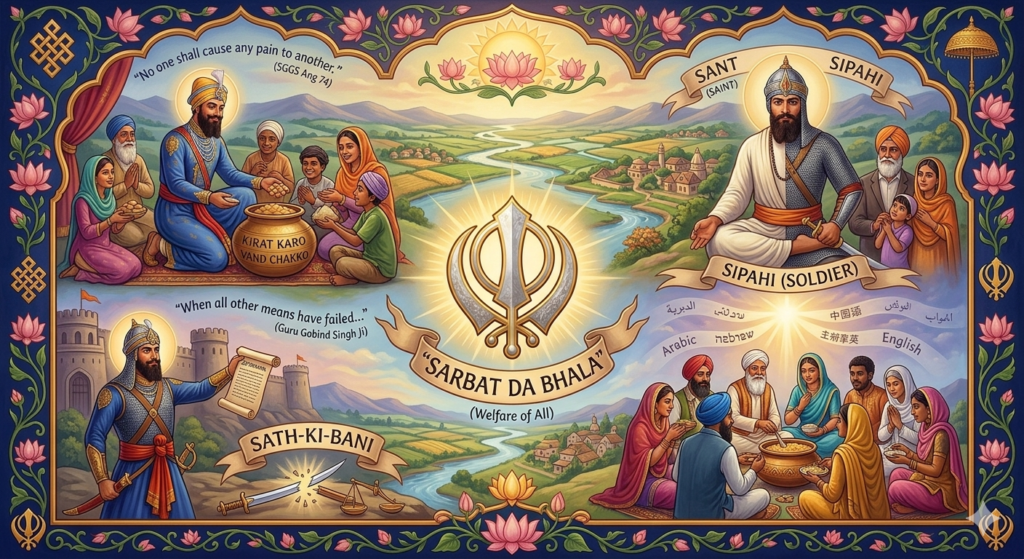
In Sikhism, the concept of “National Character” is deeply intertwined with the ideal of the Gurmukh (one who faces the Guru) and the establishment of Halemi Raj (a humble, benevolent regime). The Sikh perspective emphasizes that a nation’s strength lies in the fearless and selfless character of its citizens.
The primary source for these values is the Guru Granth Sahib Ji, along with the historical precedents set by the Ten Gurus and the Sikh Rehat Maryada (Code of Conduct).
- The Ideal of “Halemi Raj” (The Benevolent State)
The Guru Granth Sahib envisions a society where no one is oppressed. Guru Arjan Dev Ji describes this “National Character” as one of humility and peace:
“The Merciful Lord has now given a command: No one shall cause any pain to another. All shall live in peace, and the regime shall be a humble one.” (SGGS, Ang 74)
In this framework, a nation’s character is judged by how it treats its weakest members. A righteous state is not defined by its power, but by its service (Seva) and justice (Nyay).
- The “Saint-Soldier” (Sant-Sipahi) Concept
Sikhism introduces a unique dual identity for a citizen’s character, formalized by Guru Gobind Singh Ji. A member of the nation should be:
- Sant (Saint): Internally calm, spiritually grounded, and devoted to truth.
- Sipahi (Soldier): Externally brave, physically fit, and ready to stand against tyranny.
This creates a national character that is essentially pro-active. It is not enough to be personally “good”; one must have the courage to intervene when justice is violated.
- Sarbat da Bhala (Welfare of All)
The Sikh daily prayer (Ardas) ends with the formal plea for “Sarbat da Bhala”. This defines the Sikh outlook on nationalism: it is never “my nation first” at the cost of others.
- Universalism: The character of a Sikh-influenced nation is one that seeks the prosperity of the entire human race, regardless of borders, religion, or caste.
- Equality: The Guru Granth Sahib explicitly rejects the caste system: “Recognize the whole human race as one” (Guru Gobind Singh Ji). A nation with a strong character must ensure absolute equality.
- Key Pillars of National Character in Sikhism
Principle | Holy Reference / Origin | Meaning for National Character |
Kirat Karo | Teachings of Guru Nanak Dev Ji | Honesty and hard work; a nation of productive, ethical workers. |
Vand Chakko | Teachings of Guru Nanak Dev Ji | Sharing resources; a character of social security and charity. |
Nirbhau & Nirvair | Mool Mantar (SGGS, Ang 1) | “Without Fear” and “Without Hatred.” A nation that is brave but not aggressive. |
Deg Tegh Fateh | Sikh Slogan / Philosophy | The “Cooking Pot” (Charity) and the “Sword” (Protection) shall prevail together. |