
20-09-2026
Freedom, Equality and National Consciousness
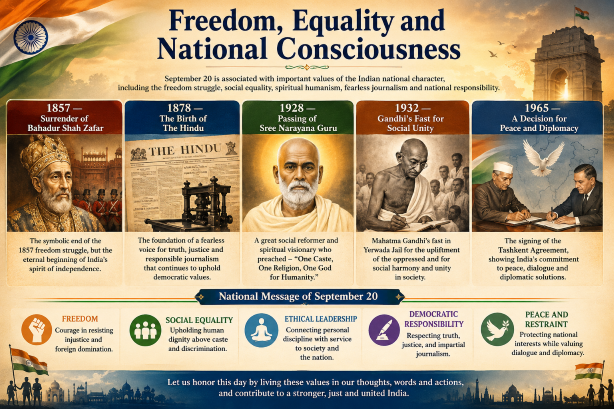
September 20 is associated with important values of the Indian national character, including the freedom struggle, social equality, spiritual humanism, fearless journalism and national responsibility.
1857 — Surrender of Bahadur Shah Zafar
After the First War of Independence in 1857, the last Mughal emperor, Bahadur Shah Zafar, was arrested at Humayun’s Tomb on September 20. This event became a symbol of Indian resistance to foreign rule and reflected the collective desire for freedom.
1878 — The Birth of The Hindu
On September 20, 1878, The Hindu began publication as a weekly newspaper from Madras. Its founders promoted fairness, justice, and public accountability, making the newspaper an important voice of national consciousness and democratic responsibility.
1928 — Passing of Sree Narayana Guru
Sree Narayana Guru, a respected social reformer and spiritual leader, passed away on September 20, 1928. His teachings of human unity, social equality and opposition to caste discrimination strengthened the inclusive and humanitarian character of India.
1932 — Gandhi’s Fast for Social Unity
Mahatma Gandhi began a fast unto death in Yeravda Jail on September 20, 1932, to oppose separate electorates for the Depressed Classes. The subsequent dialogue between Gandhi and Dr. B. R. Ambedkar led to the Poona Pact on September 24. This episode highlights the importance of social justice, political representation, and national unity.
1965 — A Decision for Peace and Diplomacy
During the India–Pakistan War, the United Nations Security Council called for a ceasefire and negotiations on September 20. India accepted the ceasefire the following day. This demonstrated that national security can be balanced with wise diplomacy, restraint, and a commitment to peace.
National Message of September 20
- Freedom: Courage in resisting injustice and foreign domination.
- Social equality: Upholding human dignity above caste and discrimination.
- Ethical leadership: Connecting personal discipline with service to society and the nation.
- Democratic responsibility: Respecting truth, justice, and impartial journalism.
- Peace and restraint: Protecting national interests while valuing dialogue and diplomacy.
19-09-2026
Diplomacy, Courage, Justice and Talent
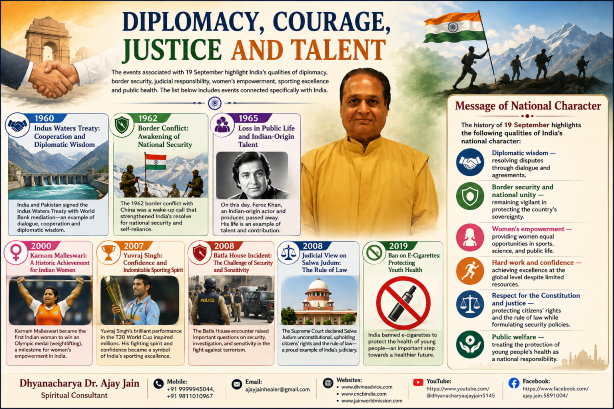
The events associated with 19 September highlight India’s qualities of diplomacy, border security, judicial responsibility, women’s empowerment, sporting excellence and public health. The list below includes events connected specifically with India.
1960–Indus Waters Treaty: Cooperation and Diplomatic Wisdom
On 19 September 1960, India and Pakistan signed the Indus Waters Treaty in Karachi. The agreement demonstrated the importance of dialogue and diplomacy for managing water resources and promoting regional stability, even during difficult political circumstances. It should be noted that India’s signatory was Prime Minister Jawaharlal Nehru.
1962-Border Conflict: Awakening of National Security
On 19 September 1962, tension and military confrontation along the India–China border intensified. This period made India deeply aware of the importance of border security, military preparedness, and national unity.
1965-Loss in Public Life and Indian-Origin Talent
Balwantrai Mehta, former Chief Minister of Gujarat, passed away on 19 September 1965. On the same date, astronaut Sunita Williams, whose family has Indian roots, was born. Together, these events reflect India’s tradition of public service and the global achievements of people of Indian origin.
2000-Karnam Malleswari: A Historic Achievement for Indian Women
At the Sydney Olympics, Karnam Malleswari won a bronze medal in weightlifting and became the first Indian woman to win an Olympic medal. Her achievement became an inspiring example of courage, discipline, hard work, and women’s empowerment.
2007-Yuvraj Singh: Confidence and Indomitable Sporting Spirit
On 19 September 2007, during the T20 World Cup, Yuvraj Singh hit six sixes in one over against England and scored a half-century in only 12 balls. This memorable achievement symbolizes the energy, confidence and ability of Indian youth to turn challenges into opportunities.
2008-Batla House Incident: The Challenge of Security and Sensitivity
On 19 September 2008, an encounter took place between the police and suspected terrorists in Delhi’s Batla House area. Police Inspector Mohan Chand Sharma was killed in the incident. The event became a subject of debate concerning national security, counter-terrorism operations, and the need for transparent investigation in a democratic society.
2008-Judicial View on Salwa Judum: The Rule of Law
On the same day, the Supreme Court directed restrictions on the activities of armed civilian groups associated with the Salwa Judum anti-Naxal campaign in Chhattisgarh. The decision highlighted the principle that national security must be pursued while protecting citizens’ rights and upholding constitutional values.
2019-Ban on E-Cigarettes: Protecting Youth Health
In September 2019, the Government of India took steps toward banning e-cigarettes and electronic nicotine-delivery systems. The objective was to protect young people from the possible health effects of nicotine-based products. This measure was viewed as a policy that placed public health among the nation’s priorities.
Message of National Character
The history of 19 September highlights the following qualities of India’s national character:
- Diplomatic wisdom — resolving disputes through dialogue and agreements.
- Border security and national unity — remaining vigilant in protecting the country’s sovereignty.
- Women’s empowerment — providing women equal opportunities in sports, science, and public life.
- Hard work and confidence — achieving excellence at the global level despite limited resources.
- Respect for the Constitution and justice — protecting citizens’ rights and the rule of law while formulating security policies.
- Public welfare — treating the protection of young people’s health as a national responsibility.
18-09-2026
Cultural Pride and Inclusive Federalism
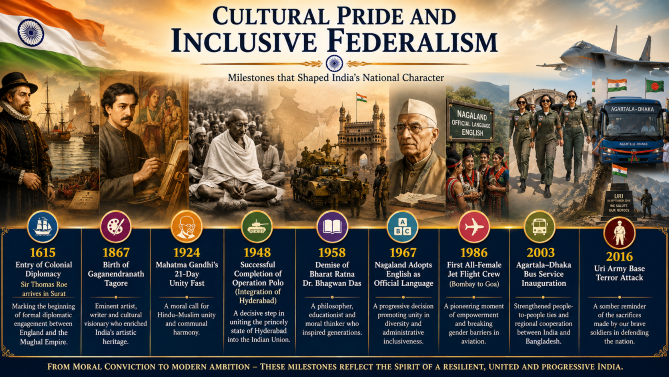
September 18 holds significant historical weight in India’s journey, marking key turning points that reflect the evolution of National Character—from moral conviction and territorial integrity to valor, cultural pride and inclusive federalism.
1615: Entry of Colonial Diplomacy (Sir Thomas Roe Arrives in Surat)
Theme: Vigilance and Cultural Sovereignty
Context: Sir Thomas Roe arrived as King James I’s ambassador to Mughal Emperor Jahangir. This milestone marks the start of British commercial and political maneuvering in India, serving as an enduring historical reminder of the necessity for national vigilance, self-determination, and economic self-reliance.
1867: Birth of Gaganendranath Tagore
Theme: Artistic Conscience and Cultural Renaissance
Context: Born in Calcutta, Tagore became a pioneering modern artist and satirist during the Bengal Renaissance. His work challenged societal dogmas and colonial influence through art, embodying intellectual courage and cultural self-expression.
1924: Mahatma Gandhi’s 21-Day Unity Fast
Theme: Moral Leadership and Communal Harmony
Context: In response to rising communal riots, Mahatma Gandhi initiated a 21-day fast in Delhi as a penance to unite Hindus and Muslims. This act defined the core Indian ideal of Ahimsa (non-violence) and moral accountability as foundations of national unity.
1948: Successful Completion of Operation Polo (Integration of Hyderabad)
Theme: Sovereignty and Territorial Integrity
Context: The 5-day military operation concluded on September 18 as the Nizam of Hyderabad surrendered to Indian forces. Under the resolute leadership of Sardar Vallabhbhai Patel, this event cemented the geopolitical unity of independent India.
1958: Demise of Bharat Ratna Dr. Bhagwan Das
Theme: Intellectual Integrity and Ethical Governance
Context: Passing of the eminent philosopher, freedom fighter, and scholar who championed value-based education and social welfare. His legacy reinforces the nation’s ethos of scholarly duty and public service.
1967: Nagaland Adopts English as Official Language
Theme: Unity in Diversity and Federal Adaptability
Context: Nagaland formally adopted English to bridge linguistic divides across its diverse tribes and facilitate national communication. This moment highlighted India’s pluralistic spirit and flexible constitutional framework.
1986: First All-Female Jet Flight Crew (Bombay to Goa)
Theme: Gender Empowerment and Progressive Modernity
Context: Indian women aviators operated an all-female commercial jet flight for the first time. It marked a major stride toward gender parity and shattered barriers in high-skill professional sectors.
2003: Agartala–Dhaka Bus Service Inauguration
Theme: Good Neighborliness and Peaceful Diplomacy
Context: India launched direct bus transit connecting Tripura to Bangladesh, embodying the values of regional harmony, peaceful diplomacy, and shared heritage.
2016: Uri Army Base Terror Attack
Theme: Indomitable Courage, Sacrifice, and National Resolve
Context: Four heavily armed terrorists attacked an Indian Army base in Uri, Jammu & Kashmir, leading to the martyrdom of 19 brave soldiers. The national grief and unanimous response underlined India’s unyielding military resolve, duty, and defense of sovereignty.
17-09-2026
Territorial Consolidation, Social Movements and Modern Developmental
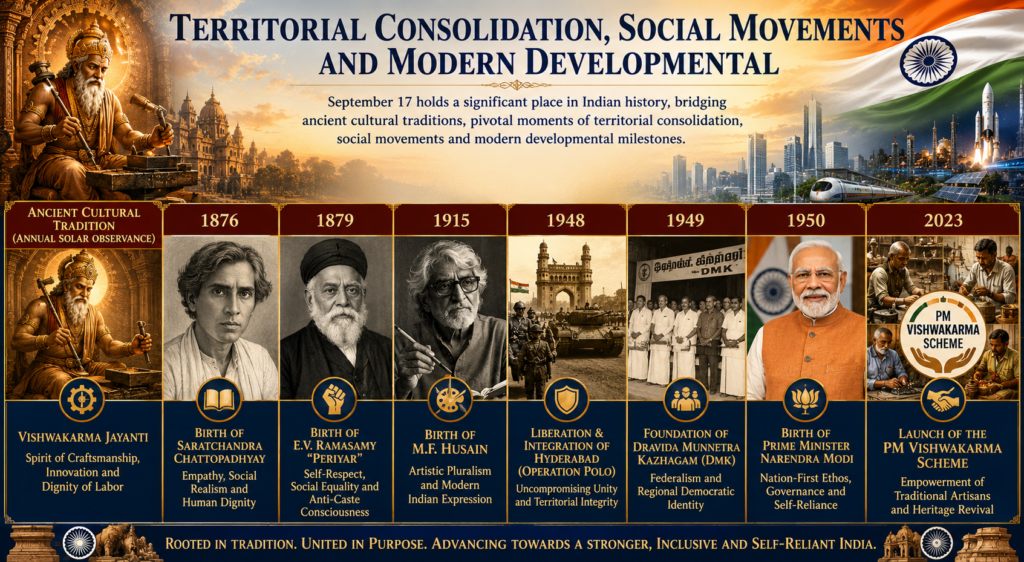
September 17 holds a significant place in Indian history, bridging ancient cultural traditions, pivotal moments of territorial consolidation, social movements and modern developmental milestones.
Ancient Cultural Tradition (Annual Solar Observance)
Vishwakarma Jayanti — Spirit of Craftsmanship, Innovation and Dignity of Labor
Event: Celebrated annually on September 17 (marking Kanya Sankranti in the solar calendar), this day honors Lord Vishwakarma, revered in Indian tradition as the divine architect and builder of the universe.
National Character Context: It embodies the civilizational ethos of respecting tools, honoring manual skill and recognizing craftsmanship and labor as essential pillars of nation-building.
1876 – Birth of Saratchandra Chattopadhyay — Empathy, Social Realism and Human Dignity
Event: Birth of Saratchandra Chattopadhyay, one of Bengal and India’s most widely read novelists (author of Devdas, Parineeta and Pather Dabi).
National Character Context: His literary works brought intense social critique, highlighting the struggles of women, marginalized communities and feudal oppression, fostering an ethos of empathy and progressive social reform across the nation.
1879-Birth of E.V. Ramasamy “Periyar” — Self-Respect, Social Equality and Anti-Caste Consciousness
Event: Birth of E.V. Ramasamy (Periyar), social reformer and leader of the Self-Respect Movement in Southern India.
National Character Context: Periyar’s legacy contributed to India’s democratic dialogue around rationalism, caste abolition, gender equality and social justice, reinforcing the constitutional spirit of egalitarianism.
1915-Birth of M.F. Husain — Artistic Pluralism and Modern Indian Expression
Event: Birth of Maqbool Fida Husain, one of India’s most celebrated modern progressive artists.
National Character Context: His vast canvas of work captured Indian mythology, history and rural life, reflecting the vibrant cultural diversity and modern artistic renaissance of post-independence India.
1948-Liberation & Integration of Hyderabad (Operation Polo) — Uncompromising Unity and Territorial Integrity
Event: After a five-day military action ordered by Sardar Vallabhbhai Patel (Operation Polo), the Nizam of Hyderabad formally surrendered, merging the princely state into the Indian Union.
National Character Context: A cornerstone moment in defining India’s territorial sovereignty. It highlighted the national character of decisive leadership and secular democracy over feudal division. (Officially designated as Hyderabad Liberation Day).
1949-Foundation of Dravida Munnetra Kazhagam (DMK) — Federalism and Regional Democratic Identity
Event: Founded by C.N. Annadurai in Chennai, splitting from the Dravidar Kazhagam.
National Character Context: Marked the political crystallization of Dravidian ideology and linguistic empowerment, deepening Indian federalism and reinforcing the idea that strong regional identities enrich the central union.
1950-Birth of Prime Minister Narendra Modi — Nation-First Ethos, Governance and Self-Reliance
Event: Birth of Narendra Damodardas Modi in Vadnagar, Gujarat—India’s 15th Prime Minister and the first born in post-independence India.
National Character Context: Represents a shift toward mass civic mobilization, grassroots leadership, national security focus and aspirational self-reliance (Atmanirbhar Bharat).
2023-Launch of the PM Vishwakarma Scheme — Empowerment of Traditional Artisans and Heritage Revival
Event: The Government of India launched the ₹13,000-crore scheme to provide skill training, toolkits and collateral-free credit to traditional artisans and craftspeople across 18 trades.
National Character Context: Re-engages ancient cultural identity with modern economics, aiming to integrate traditional micro-craftsmen (Vishwakarmas) into global value chains while boosting local self-sufficiency (Vocal for Local).
16-09-2026
Epochs of Valor, Cultural Devotion and National Pride
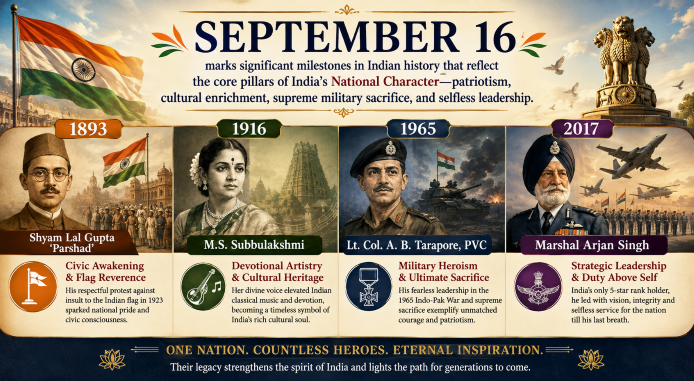
September 16 marks significant milestones in Indian history that reflect the core pillars of India’s National Character—patriotism, cultural enrichment, supreme military sacrifice, and selfless leadership.
Key Historical Events of September 16
1893: Birth of Shyam Lal Gupta ‘Parshad’ (Patriotism & Symbolic Identity)
Event: Born in Kanpur, Freedom Fighter Shyam Lal Gupta wrote the historic anthem “Vijayi Vishwa Tiranga Pyara, Jhanda Uncha Rahe Hamara.”
Context with National Character: Adopted by the Indian National Congress in 1924, this song served as a rallying cry during the independence movement, instilling deep civic pride, unity, and reverence for the national flag.
1916: Birth of Bharat Ratna M.S. Subbulakshmi (Cultural & Spiritual Heritage)
Event: Birth of legendary Carnatic vocalist M.S. Subbulakshmi in Madurai, Tamil Nadu.
Context with National Character: The first musician to be awarded the Bharat Ratna, Subbulakshmi embodied Indian spiritual values and devotional artistic excellence. Mahatma Gandhi famously remarked that hearing her sing Bhajans was more moving than listening to anyone else speak.
1965: Supreme Sacrifice of Lt. Col. A. B. Tarapore, PVC (Indomitable Valor)
Event: During the 1965 Indo-Pak War, Lt. Col. Ardeshir Burzorji Tarapore led the 17 Poona Horse in the Battle of Chawinda. Despite being severely wounded, he refused evacuation and led his regiment to destroy sixty enemy tanks before making the supreme sacrifice.
Context with National Character: Posthumously awarded the Param Vir Chakra, his bravery represents the unyielding resolve, duty, and selflessness of the Armed Forces.
2017: Passing of Marshal of the IAF Arjan Singh (Dignified Military Leadership)
Event: Demise of Marshal of the Indian Air Force Arjan Singh, DFC, at the age of 98.
Context with National Character: As India’s first and only five-star Air Force officer, he successfully led the IAF during the 1965 war with extraordinary calm, tactical foresight, and dedication to safeguarding sovereign skies.
15-09-2026
Empathy, Science and Service
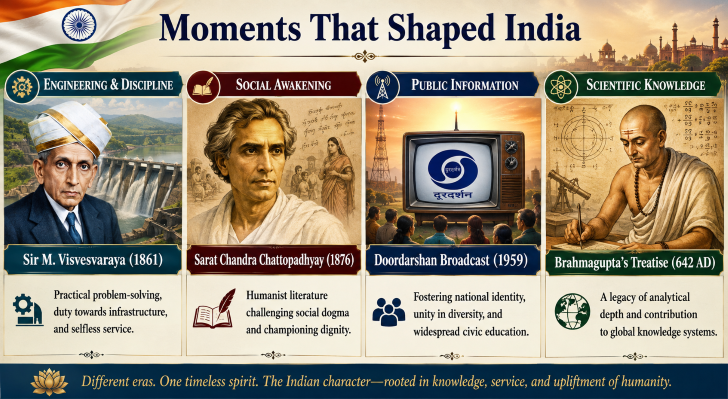
The date 15th September holds a profound place in India’s historical and social calendar. Each major milestone connected to this date reflects key dimensions of the National Character—innovation, literary realism, technological outreach, public service and civic responsibility.
Year wise Events of Importance (15th September)
642 AD: Completion of Khandakhadyaka by Brahmagupta
Event: The ancient Indian mathematician and astronomer Brahmagupta completed his major treatise Khandakhadyaka, detailing planetary longitudes, eclipses, and early concepts of gravity.
National Character Dimension: Scientific Inquiry & Intellectual Heritage — Demonstrates India’s early commitment to rational thinking, mathematical precision and astronomy.
1861: Birth of Sir Mokshagundam Visvesvaraya (National Engineer’s Day)
Event: Birth of Bharat Ratna Sir M. Visvesvaraya, legendary civil engineer, statesman and Dewan of Mysore. Celebrated annually across India as National Engineer’s Day since 1968.
National Character Dimension: Nation-Building, Self-Reliance & Technical Excellence — Represents disciplined public service, visionary infrastructure planning, and technological progress.
1876: Birth of Sarat Chandra Chattopadhyay
Event: Birth of renowned Bengali novelist Sarat Chandra Chattopadhyay (author of Devdas, Parineeta, and Charitraheen) in Hooghly, Bengal.
National Character Dimension: Social Realism & Empathy — Exposed societal double standards, orthodox rigidities, and promoted compassion and dignity for women in literature.
1959: Launch of Doordarshan (India’s First Public Broadcaster)
Event: Experimental television broadcasting began in New Delhi under All India Radio, which later grew into Doordarshan.
National Character Dimension: Democratization of Information & Cultural Unity — Served as a foundational pillar for public education, rural development messaging, and civic integration across diverse regions.
14-09-2026
Sovereign Identity, Democratic Unity and Civic Valor
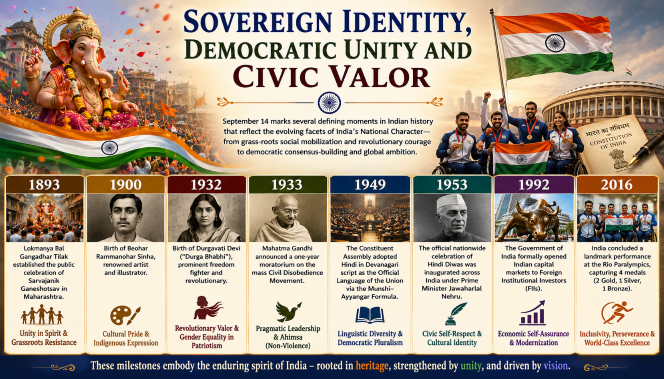
September 14 marks several defining moments in Indian history that reflect the evolving facets of India’s National Character—from grass-roots social mobilization and revolutionary courage to democratic consensus-building and global ambition.
1893 — Cultural Mobilization & Anti-Colonial Unity
Event: Lokmanya Bal Gangadhar Tilak established the public celebration of Sarvajanik Ganeshotsav in Maharashtra.
National Character Dimension: Unity in Spirit & Grassroots Resistance
Significance: By transforming a private household ritual into a large-scale public festival, Tilak bypassed British anti-assembly laws. The event forged a shared civic space, bridging caste and class divides to kindle the spirit of Swaraj (self-rule) through cultural pride.
1900 — Aesthetic Heritage & Constitutional Artistry
Event: Birth of Beohar Rammanohar Sinha, renowned artist and illustrator.
National Character Dimension: Cultural Pride & Indigenous Expression
Significance: Sinha played a pivotal role in illustrating the original calligraphic manuscript of the Constitution of India—including the iconic Preamble page. His life work exemplified how artistic excellence serves as a canvas for a nation’s sovereign ethos.
1932 — Unyielding Bravery & Revolutionary Sacrifice
Event: Birth of Durgavati Devi (“Durga Bhabhi”), prominent freedom fighter and revolutionary.
National Character Dimension: Revolutionary Valor & Gender Equality in Patriotism
Significance: A key figure in the Hindustan Socialist Republican Association (HSRA), Durga Bhabhi risked her life to assist Bhagat Singh in his escape after the Saunders execution and actively led armed anti-colonial resistance, epitomizing the fearless contribution of women to Indian liberation.
1933 — Moral Discipline & Strategic Patience
Event: Mahatma Gandhi announced a one-year moratorium on the mass Civil Disobedience Movement.
National Character Dimension: Pragmatic Leadership & Ahimsa (Non-Violence)
Significance: Demonstrating moral accountability and strategic foresight, Gandhi paused mass resistance to focus on constructive village programs, eradication of untouchability and internal ethical discipline within the freedom movement.
1949 — Democratic Consensus & Official Identity
Event: The Constituent Assembly adopted Hindi in Devanagari script as the Official Language of the Union via the Munshi–Ayyangar Formula.
National Character Dimension: Linguistic Diversity & Democratic Pluralism
Significance: Rather than imposing a single “national language,” the Constituent Assembly crafted a balanced compromise that honored regional diversity while establishing a shared administrative tongue for the newly independent republic. September 14 was chosen to mark this historic adoption, laying the foundation for Hindi Diwas.
1953 — Institutionalizing National Heritage
Event: The official nationwide celebration of Hindi Diwas was inaugurated across India under Prime Minister Jawaharlal Nehru.
National Character Dimension: Civic Self-Respect & Cultural Identity
Significance: Marking the 50th birth anniversary of Beohar Rammanohar Sinha and four years since the Constituent Assembly decision, September 14 became an annual national observance to foster literary pride, administrative self-reliance, and mother-tongue education.
1992 — Economic Resilience & Global Confidence
Event: The Government of India formally opened Indian capital markets to Foreign Institutional Investors (FIIs).
National Character Dimension: Economic Self-Assurance & Modernization
Significance: Following the landmark 1991 reforms, this decision signaled India’s transition toward global economic integration, demonstrating the country’s adaptability and willingness to compete on the world stage.
2016 — Indomitable Grit & Sporting Triumph
Event: India concluded a landmark performance at the Rio Paralympics, capturing 4 medals (2 Gold, 1 Silver, 1 Bronze).
National Character Dimension: Inclusivity, Perseverance & World-Class Excellence
Significance: Led by trail-blazing athletes like Deepa Malik (first Indian woman Paralympic medalist) and Devendra Jhajharia, this campaign redefined national pride in para-sports, embodying the spirit of overcoming adversity through determination.
13-09-2026
Formed in Fortitude
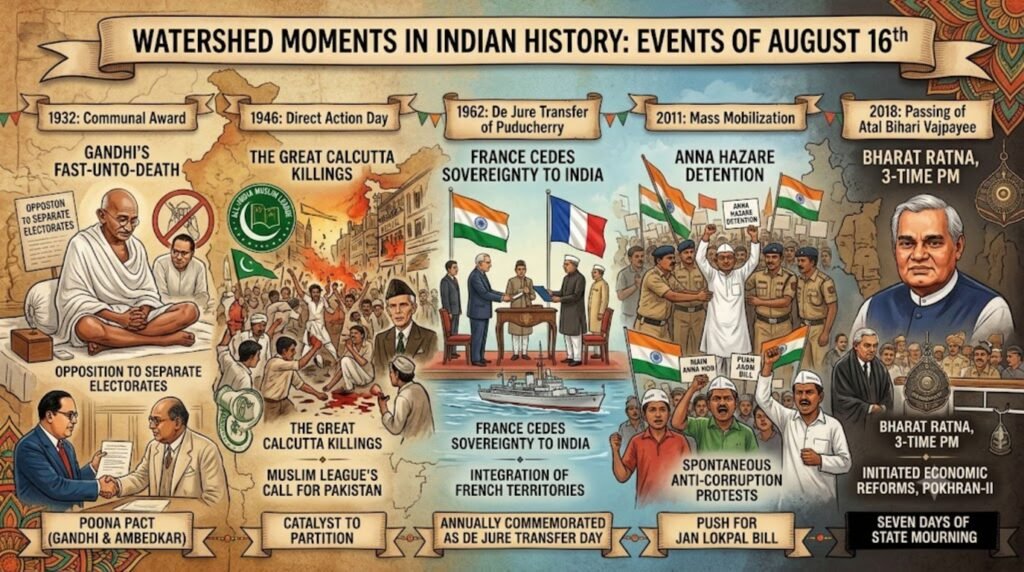
September 13th stands as a landmark for political fortitude, territorial integration, and civilizational honor, illustrating core principles of India’s National Character—unyielding moral courage, decisive leadership, and quiet psychological resilience.
1929: The Supreme Sacrifice for Human Dignity
- Event: Freedom fighter Jatindra Nath Das (Jatin Das) passed away in Lahore Central Jail after a 63-day hunger strike protesting the discriminatory and inhumane treatment of Indian political prisoners.
At just 24 years old, Jatin Das chose physical dissolution over compromising on the dignity and rights of political detainees. Dubbed the “young Dadhichi” by Subhas Chandra Bose, his martyrdom ignited a wave of national consciousness, proving that the Indian freedom struggle was fundamentally rooted in self-respect and moral integrity.
1948: The Iron Resolve for National Integration
- Event: Deputy Prime Minister Sardar Vallabhbhai Patel launched Operation Polo (Police Action) to integrate the princely state of Hyderabad into the Union of India.
Faced with an autocratic regime attempting to establish a hostile, unviable enclave in the heart of the subcontinent, Indian leadership acted with strategic clarity. Operation Polo reflected the nation’s refusal to accept Balkanization, establishing that democratic unity and territorial integrity are non-negotiable pillars of the modern republic.
1997: The Elevation of Universal Compassion
- Event: India accorded a full State Funeral with military honors to Mother Teresa in Calcutta (Kolkata).
By bestowing the republic’s highest state honors upon a foreign-born missionary, India highlighted its ancient philosophy of Vasudhaiva Kutumbakam (the world is one family). It reflected a national character that recognizes and reveres selfless service, charity and humanitarian dedication above sectarian or geographical boundaries.
2008: Stoic Resilience Against Terror
- Event: Synchronized serial bomb blasts struck public markets in New Delhi, prompting an immediate civic and security response.
Despite deliberate attempts to provoke panic and communal fracture, citizens responded with composure, solidarity and quick recovery. This silent endurance underscores a collective psyche that rejects terror-driven division and maintains social cohesion even under provocation.
From the martyrdom of young revolutionaries in 1929 to the decisive unification of the republic in 1948, September 13th captures a National Character forged through moral conviction, sovereign clarity and enduring civilizational strength.
03-09-2026
From Resistance to Resilience
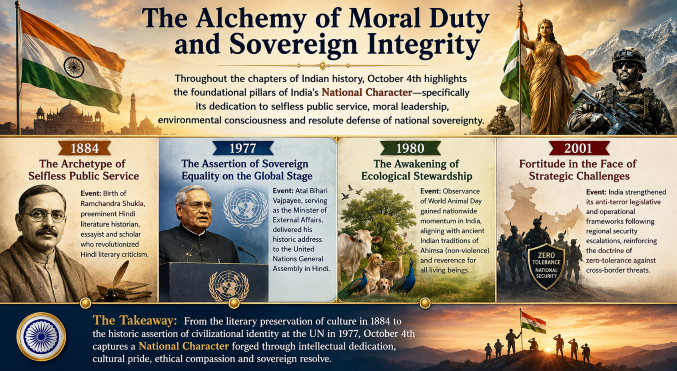
September 3rd holds several significant events in Indian history that have shaped the nation’s character, reflecting themes of resistance, unity, cultural excellence and strategic resilience.
1767: Battle of Changama — Early Resistance to Colonial Power
On September 3, 1767, British forces under Colonel Smith were defeated in the Battle of Changama by the combined armies of Hyder Ali of Mysore and the Nizam. This was part of the First Anglo-Mysore War and marked one of the early instances where Indian rulers successfully challenged British military expansion, reinforcing a spirit of resistance and sovereignty in the national psyche.
1916: Annie Besant Launches Home Rule Movement
On this day in 1916, Annie Besant initiated the Home Rule Movement, a pivotal chapter in India’s freedom struggle. The movement demanded self-governance and galvanized mass participation across regions, embodying the democratic and self-determination values that would later define independent India’s national character.
1947: Constituent Assembly Debates — Building a Democratic Republic
On September 3, 1947, the Constituent Assembly held crucial debates on framing India’s Constitution. These discussions laid the foundation for a secular, democratic and inclusive republic, reflecting the nation’s commitment to justice, liberty and equality—core pillars of India’s identity.
1987: Vishwanathan Anand Becomes India’s First Chess Grandmaster
At just 17, Vishwanathan Anand became India’s first chess Grandmaster on September 3, 1987. His achievement symbolizes intellectual excellence, discipline and global competitiveness—traits that have become increasingly associated with modern India’s national character.
1999: Post-Kargil Military Modernization
Following the Kargil War, India launched a new phase of military modernization on September 3, 1999. This strategic shift underscored the nation’s resolve to strengthen its defense capabilities and safeguard sovereignty, reinforcing a character of vigilance and self-reliance.
These events collectively illustrate how September 3rd has been a date of reflection and action in India’s journey—each contributing to a national character defined by courage, unity, intellectual pursuit, and strategic foresight.
02-09-2026
Sovereignty, Unity and Innovation
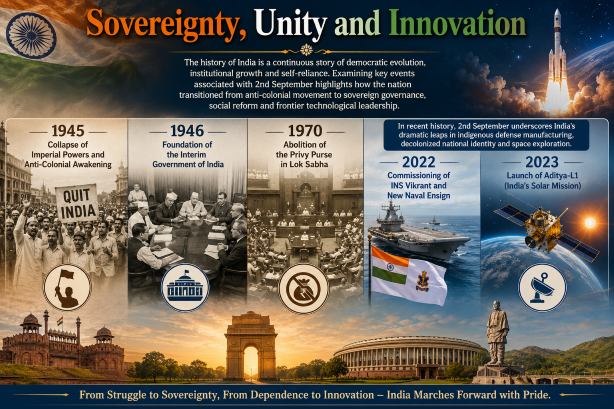
The history of India is a continuous story of democratic evolution, institutional growth and self-reliance. Examining key events associated with 2nd September highlights how the nation transitioned from anti-colonial movement to sovereign governance, social reform and frontier technological leadership.
- The Era of Struggle: Resisting Hegemony and Claiming Self-Rule
The early milestones of this date mark a crucial turning point—moving from anti-colonial awakening to the direct assumption of political responsibility and democratic governance.
1945 – Collapse of Imperial Powers and Anti-Colonial Awakening: The formal end of World War II on 2 September 1945 significantly weakened European colonial empires. In India, this global power shift accelerated the dismantling of imperial rule and galvanized the final push for independence.
National Character: Strategic anti-colonial awareness and the relentless pursuit of freedom.
1946 – Foundation of the Interim Government of India: Pandit Jawaharlal Nehru took charge as the Vice President of the Executive Council on 2 September 1946, establishing India’s Interim Government. This landmark event represented the first self-governing executive authority created to steer the nation toward complete independence.
National Character: Democratic transition, political courage and constitutional self-determination.
- The Era of Building: Social Justice and Constitutional Equality
In the post-independence era, 2nd September stands as a testament to the deliberate process of constructing a truly egalitarian republic free from feudal legacies.
1970 – Abolition of the Privy Purse in Lok Sabha: On 2 September 1970, the Lok Sabha passed the historic bill to abolish Privy Purses—royal stipends previously guaranteed to former rulers of princely states. This reform reinforced the constitutional promise that all citizens stand equal in the eyes of the law.
National Character: Unwavering commitment to social justice, economic equity and democratic ideals.
- The Era of Advancement: Strategic Self-Reliance and Frontier Science
In recent history, 2nd September underscores India’s dramatic leaps in indigenous defense manufacturing, decolonized national identity and space exploration.
2022 – Commissioning of INS Vikrant and New Naval Ensign: India inducted its first indigenously designed and built aircraft carrier, INS Vikrant, at Cochin Shipyard on 2 September 2022. The historic event also unveiled the new Indian Navy Ensign, drawing inspiration from the royal seal of Chhatrapati Shivaji Maharaj to shed colonial maritime symbols.
National Character: Industrial self-reliance (Atmanirbharata), indigenous engineering excellence and cultural pride.
2023 – Launch of Aditya-L1 (India’s Solar Mission): ISRO successfully launched its first dedicated solar space observatory, Aditya-L1, placing it at the Sun-Earth L1 Lagrange point to study solar dynamics and space weather.
National Character: Frontier scientific innovation, deep-space capability and global technological leadership.
01-09-2026
Struggle, Build and Advance
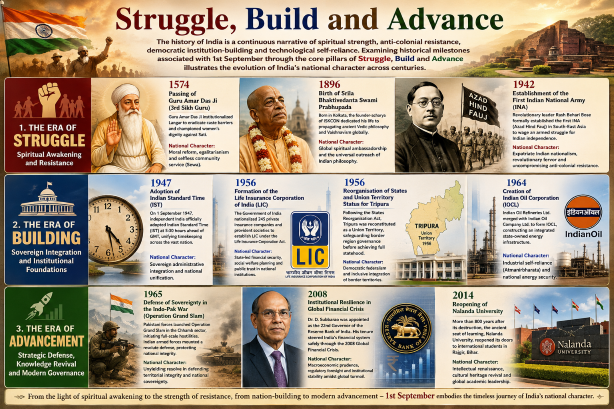
The history of India is a continuous narrative of spiritual strength, anti-colonial resistance, democratic institution-building and technological self-reliance. Examining historical milestones associated with 1st September through the core pillars of Struggle, Build and Advance illustrates the evolution of India’s national character across centuries.
- The Era of Struggle: Spiritual Awakening and Resistance
The early milestones of 1st September highlight the ethical, spiritual and anti-colonial foundations of the Indian consciousness—from social reform and spiritual ambassadorship to revolutionary resistance against foreign hegemony.
1574 – Passing of Guru Amar Das Ji (3rd Sikh Guru): Guru Amar Das Ji, who institutionalized Langar (free community kitchen) to eradicate caste barriers and championed women’s dignity against Sati, passed away on this day.
National Character: Moral reform, egalitarianism and selfless community service (Sewa).
1896 – Birth of Srila Bhaktivedanta Swami Prabhupada: Born in Kolkata, the founder-acharya of ISKCON dedicated his life to propagating ancient Vedic philosophy and Vaishnavism globally.
National Character: Global spiritual ambassadorship and the universal outreach of Indian philosophy.
1942 – Establishment of the First Indian National Army (INA): Revolutionary leader Rash Behari Bose formally established the first INA (Azad Hind Fauj) in South-East Asia to wage an armed struggle for Indian independence.
National Character: Expatriate Indian nationalism, revolutionary fervor and uncompromising anti-colonial resistance.
- The Era of Building: Sovereign Integration and Institutional Foundations
Following independence, 1st September became a landmark date for unifying administrative systems, state-led welfare, and public sector industrialization.
1947 – Adoption of Indian Standard Time (IST): On 1 September 1947, independent India officially adopted Indian Standard Time (IST) at 5:30 hours ahead of GMT, unifying timekeeping across the vast nation.
National Character: Sovereign administrative integration and national unification.
1956 – Formation of the Life Insurance Corporation of India (LIC): The Government of India nationalized 245 private insurance companies and provident societies to establish LIC under the Life Insurance Corporation Act.
National Character: State-led financial security, social welfare planning and public trust in national institutions.
1956 – Reorganisation of States and Union Territory Status for Tripura: Following the States Reorganisation Act, Tripura was reconstituted as a Union Territory, safeguarding border region governance before achieving full statehood.
National Character: Democratic federalism and inclusive integration of border territories.
1964 – Creation of Indian Oil Corporation (IOCL): Indian Oil Refineries Ltd. merged with Indian Oil Company Ltd. to form IOCL, constructing an integrated state-owned energy infrastructure.
National Character: Industrial self-reliance (Atmanirbharata) and national energy security.
- The Era of Advancement: Strategic Defense, Knowledge Revival and Modern Governance
In modern history, 1st September reflects India’s resolute territorial defense, economic stewardship through global crises, and the revival of ancient academic heritage.
1965 – Defense of Sovereignty in the Indo-Pak War (Operation Grand Slam): Pakistani forces launched Operation Grand Slam in the Chhamb sector, initiating full-scale hostilities. Indian armed forces mounted a resolute defense, protecting national integrity.
National Character: Unyielding resolve in defending territorial integrity and national sovereignty.
2008 – Institutional Resilience in Global Financial Crisis: Dr. D. Subbarao was appointed as the 22nd Governor of the Reserve Bank of India. His tenure steered India’s financial system safely through the 2008 Global Financial Crisis.
National Character: Macroeconomic prudence, regulatory foresight and institutional stability amidst global turmoil.
2014 – Reopening of Nalanda University: More than 800 years after its destruction, the ancient seat of learning, Nalanda University, reopened its doors to international students in Rajgir, Bihar.
National Character: Intellectual renaissance, cultural heritage revival and global academic leadership.
31-08-2026
India’s Journey Through Time
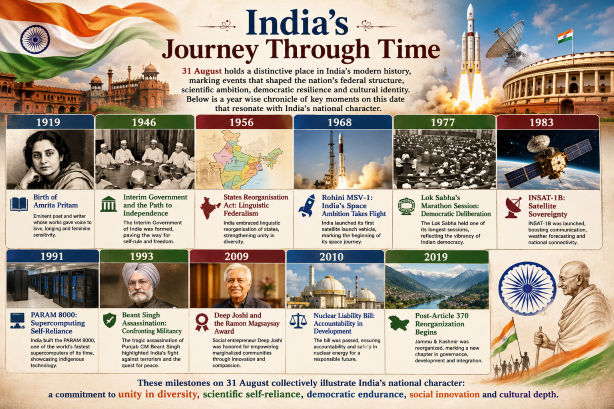
31 August holds a distinctive place in India’s modern history, marking events that shaped the nation’s federal structure, scientific ambition, democratic resilience and cultural identity. Below is a year wise chronicle of key moments on this date that resonate with India’s national character.
1919 – Birth of Amrita Pritam
Though not an “event” in the political sense, 31 August 1919 saw the birth of Amrita Pritam, one of India’s most celebrated poets and writers. Her literary legacy—spanning Punjabi and Hindi, partition narratives and feminist voices—enriches India’s cultural character and pluralistic identity.
1946 – Interim Government and the Path to Independence
On 31 August 1946, crucial steps were taken toward forming the Interim Government of India, with Jawaharlal Nehru playing a central role. This move signaled a decisive shift from colonial rule to self-governance, embodying the spirit of political maturity and negotiated transition that defines India’s democratic ethos.presidentofindia.
1956 – States Reorganisation Act: Linguistic Federalism
On 31 August 1956, President Dr. Rajendra Prasad gave his assent to the States Reorganisation Bill, which became the States Reorganisation Act. This landmark legislation redrew India’s internal boundaries largely on linguistic lines, reinforcing unity through diversity and institutionalizing a federal structure that respects regional identities—a cornerstone of India’s national character.
1968 – Rohini MSV-1: India’s Space Ambition Takes Flight
On 31 August 1968, India successfully launched the two-stage sounding rocket Rohini MSV-1. This achievement marked an early milestone in India’s indigenous space program, reflecting the nation’s commitment to scientific self-reliance and long-term technological vision.
1977 – Lok Sabha’s Marathon Session: Democratic Deliberation
On 31 August 1977, the Lok Sabha recorded history with its longest-ever sitting—approximately 22 hours—during a special golden jubilee session debating issues of national importance. This demonstrated India’s parliamentary democracy at work: exhaustive, inclusive, and committed to deliberation even under pressure.
1983 – INSAT-1B: Satellite Sovereignty
On 31 August 1983, India’s satellite INSAT-1B was launched aboard the US Space Shuttle Challenger. INSAT-1B strengthened India’s capabilities in telecommunications, broadcasting, and meteorology, advancing the national goal of using space technology for public welfare and development.
1991 – PARAM 8000: Supercomputing Self-Reliance
On 31 August 1991, India unveiled PARAM 8000, its first indigenously developed supercomputer, built by C-DAC. Born out of technology denial regimes, PARAM symbolized India’s resolve to achieve strategic autonomy in high-end computing—a trait central to its modern national character.
1993 – Beant Singh Assassination: Confronting Militancy
On 31 August 1993, Punjab Chief Minister Beant Singh was assassinated in an RDX car blast in Chandigarh. This tragic event underscored the challenges India faced during the peak of militancy in Punjab, and the resilience with which democratic institutions and civil society responded to restore normalcy.
1993 – Pranab Mukherjee Returns to Union Cabinet
Also on 31 August 1993, Pranab Mukherjee rejoined the Union Cabinet as Commerce Minister. His return highlighted the continuity of experienced leadership in India’s economic policymaking during a period of liberalization and reform.
2009 – Deep Joshi and the Ramon Magsaysay Award
On 31 August 2009, Indian social worker Deep Joshi was among six Asians honored with the Ramon Magsaysay Award in Manila. Recognized for his work in rural development and farmer empowerment, Joshi’s award reflects India’s strong tradition of grassroots activism and social innovation.
2010 – Nuclear Liability Bill: Accountability in Development
On 31 August 2010, the Indian Parliament passed the Civil Liability for Nuclear Damage Bill (Nuclear Public Liability Bill). This legislation established a framework for compensation in the event of nuclear accidents, balancing India’s pursuit of nuclear energy with democratic accountability and public safety.
2019 – Post-Article 370 Reorganization Begins
On 31 August 2019, following the abrogation of most provisions of Article 370, the first wave of administrative reorganization in Jammu & Kashmir commenced. This marked a significant, controversial chapter in India’s constitutional evolution, reflecting the complex interplay between national integration, security, and federalism.
These milestones on 31 August collectively illustrate India’s national character: a commitment to unity in diversity, scientific self-reliance, democratic endurance, social innovation and cultural depth.
30-08-2026
Syncretism, Swaraj and Scientific Spirit
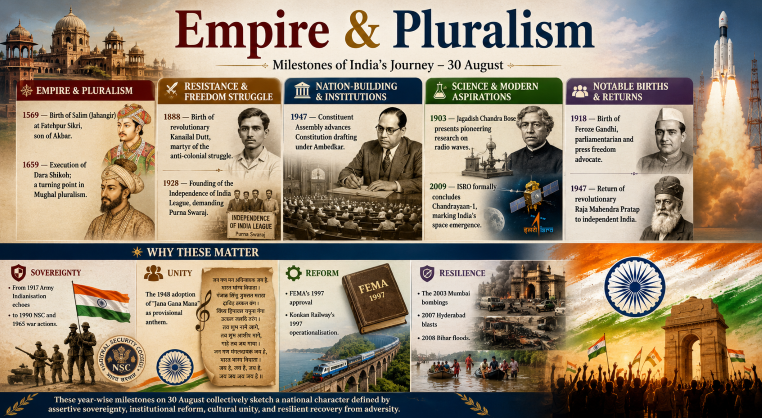
30 August has witnessed several pivotal moments in India’s history—spanning empire, resistance, institution-building and cultural achievement—that collectively illuminate the subcontinent’s evolving national character: pluralism under strain, the quest for self-rule and the drive toward modernity.
Empire, Pluralism and Succession Crises
1569 (30/31 August) — Birth of Salim (later Emperor Jahangir) at Fatehpur Sikri, son of Akbar. His reign would later reflect both the Mughal tradition of cultural synthesis and the tensions of succession and authority.
1659 — Execution of Dara Shikoh on Aurangzeb’s orders in Delhi. Dara, Shah Jahan’s eldest son and a syncretic thinker, symbolized a more inclusive imperial ethos; his death marked a decisive turn toward a more orthodox political-religious style in the Mughal state.
Resistance, Nation-Building and Constitutional Foundations
1888 — Birth of Kanailal Dutt, revolutionary who was later executed for his role in the anti-colonial struggle. His life exemplifies the radical strand of India’s freedom movement that embraced sacrifice for national liberation.
1903 — Jagadish Chandra Bose presented his pioneering research on radio waves (microwave optics), underscoring India’s early contributions to modern science and reinforcing a national self-image rooted in scientific achievement.
1928 — Founding in India of the Independence of India League by figures including Jawaharlal Nehru (with support from leaders like Subhas Chandra Bose in broader efforts). The League pushed for complete independence (Purna Swaraj), sharpening the national demand beyond dominion status and shaping the ideological core of the freedom struggle.
1947 — In the immediate aftermath of Independence, the Constituent Assembly advanced the work of drafting the Constitution under B.R. Ambedkar’s leadership. This institutional turn—building a democratic, rights-based republic—became central to India’s post-colonial national character.
Science, Culture and Modern Aspirations
2009 — ISRO formally concluded the Chandrayaan-1 mission. Though the mission ended after remarkable discoveries (including evidence of lunar water), it signaled India’s emergence as a serious space-faring nation and boosted national confidence in high-tech indigenous capability.
1947 — Return to India of Raja Mahendra Pratap, the revolutionary who had helped set up the Provisional Government of India in Kabul (1915). His homecoming symbolized the reintegration of exiled nationalists into the newly sovereign polity.
29-08-2026
Sport, State and Society
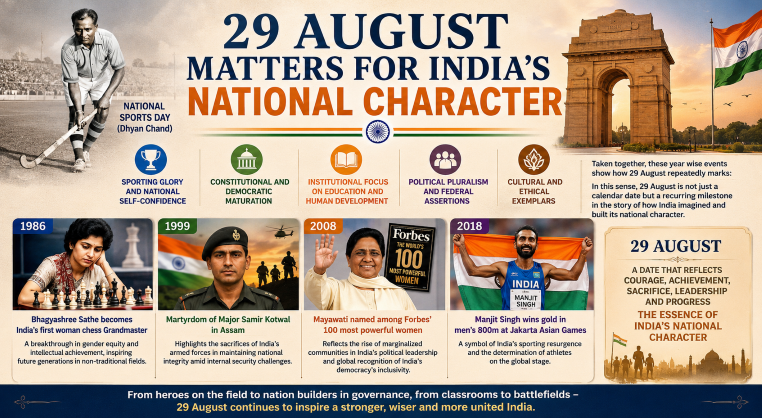
August 29 holds a special place in India’s historical memory because it repeatedly marks moments that shaped the nation’s identity—its sports spirit, constitutional foundations, education policy and political evolution. Below is a year wise chronicle of the most significant 29 August events that contributed to India’s national character.
Sporting Nationhood and Heroism
1905 – Birth of Major Dhyan Chand (Allahabad, Uttar Pradesh).
Widely regarded as the “magician of hockey,” Dhyan Chand’s extraordinary skill helped India dominate Olympic hockey (gold in 1928, 1932, 1936) and became a symbol of national pride during the freedom struggle.
1998 / 2000s – Institutional recognition of sporting excellence on this date, including national awards to sportspersons like Sachin Tendulkar (Bharat Ratna) and other Arjuna/Dronacharya awardees, reinforcing the state’s role in celebrating athletic achievement.
National Sports Day – In later years, 29 August was officially observed as National Sports Day in honour of Dhyan Chand, making the date an annual reminder of discipline, excellence, and national unity through sport.
Constitutional and Democratic Foundations
1947 – Drafting Committee of the Constituent Assembly constituted under Dr. B.R. Ambedkar on 29 August 1947 to prepare the Constitution of India.
This is a foundational moment for India’s democratic character, establishing the framework for a sovereign, socialist, secular, and democratic republic.
1957 – Passage of the Civil Rights Act, 1957, reflecting the young republic’s commitment to equality and the protection of civil liberties in a diverse society.
Education and Institution-Building
1947 – Re-establishment/Organisation of the Education Department under what would later become the Ministry of Human Resource Development, signaling the priority given to education in nation-building immediately after Independence.
These steps show how 29 August became linked with the institutional pillars—Constitution, education, and sports—that define India’s modern national character.
Political Evolution and Federal Dynamics
1974 – Formation of the Lok Dal party under Chaudhary Charan Singh on 29 August 1974.
This marked an important phase in the rise of non-Congress, agrarian-based politics and contributed to the multi-party federal character of Indian democracy.
2008 – Shibu Soren proving his majority in the Jharkhand Assembly on 29 August 2008, illustrating the complexities of coalition politics and regional assertions in India’s federal structure.
Cultural and Social Memory
1887 – Birth of Dr. Jivraj Mehta, Gandhiji’s physician and the first Chief Minister of Gujarat, representing the blend of public service, ethics, and regional leadership in post-Independence India.
1931 – Death of Jadonang, the Naga spiritual leader who laid the groundwork for the Naga movement, a reminder of the diverse ethno-cultural strands that compose the Indian nation and the ongoing negotiation of identity within the Union.
1952 – Death of Sister Euphrasia, an Indian Christian saint, underscoring the pluralistic religious and spiritual traditions that form part of India’s social fabric.
1976 / 1980s references – Death anniversaries of figures like Kazi Nazrul Islam (poet and revolutionary) are sometimes associated around this period in popular compilations, highlighting the cultural and literary contributions that enrich national identity.
Why 29 August Matters for India’s National Character
Taken together, these year wise events show how 29 August repeatedly marks:
Sporting glory and national self-confidence (Dhyan Chand, National Sports Day).
Constitutional and democratic maturation (Drafting Committee, Civil Rights Act).
Institutional focus on education and human development (Education Department reorganisation).
Political pluralism and federal assertions (Lok Dal, regional government formations).
Cultural and ethical exemplars (leaders, saints, poets, and social reformers).
In this sense, 29 August is not just a calendar date but a recurring milestone in the story of how India imagined and built its national character.
28-08-2026
Threads of Nationhood
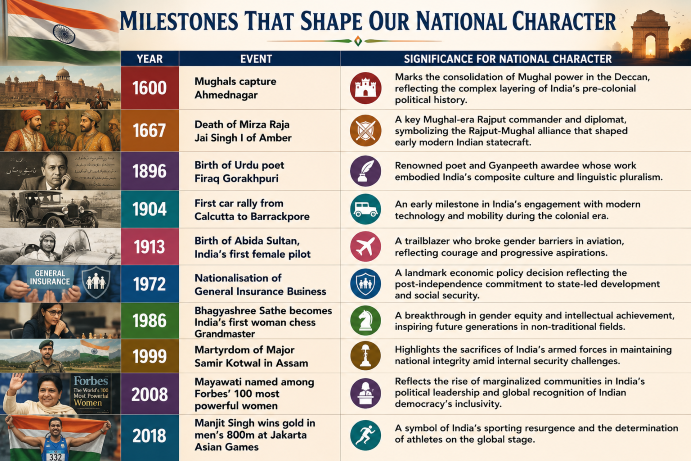
August 28 holds a distinctive place in India’s historical memory, marking moments that reflect the nation’s evolving political, cultural, scientific and sporting identity. From Mughal-era conquests to post-independence reforms and global sporting triumphs, these events collectively illuminate strands of India’s national character—resilience, pluralism, aspiration, and institutional strength.
Key Year wise Events on 28 August in Indian Context
Year | Event | Significance for National Character |
1600 | Mughals capture Ahmednagar | Marks the consolidation of Mughal power in the Deccan, reflecting the complex layering of India’s pre-colonial political history. |
1667 | Death of Mirza Raja Jai Singh I of Amber | A key Mughal-era Rajput commander and diplomat, symbolizing the Rajput-Mughal alliance that shaped early modern Indian statecraft. |
1896 | Birth of Urdu poet Firaq Gorakhpuri | Renowned poet and Gyanpeeth awardee whose work embodied India’s composite culture and linguistic pluralism. |
1904 | First car rally from Calcutta to Barrackpore | An early milestone in India’s engagement with modern technology and mobility during the colonial era. |
1913 | Birth of Abida Sultan, India’s first female pilot | A trailblazer who broke gender barriers in aviation, reflecting courage and progressive aspirations. |
1972 | Nationalisation of General Insurance Business | A landmark economic policy decision reflecting the post-independence commitment to state-led development and social security. |
1986 | Bhagyashree Sathe becomes India’s first woman chess Grandmaster | A breakthrough in gender equity and intellectual achievement, inspiring future generations in non-traditional fields. |
1999 | Martyrdom of Major Samir Kotwal in Assam | Highlights the sacrifices of India’s armed forces in maintaining national integrity amid internal security challenges. |
2008 | Mayawati named among Forbes’ 100 most powerful women | Reflects the rise of marginalized communities in India’s political leadership and global recognition of Indian democracy’s inclusivity. |
2018 | Manjit Singh wins gold in men’s 800m at Jakarta Asian Games | A symbol of India’s sporting resurgence and the determination of athletes on the global stage. |
Themes in India’s National Character Reflected
- Pluralism & Cultural Synthesis: The birth of Firaq Gorakhpuri and the legacy of figures like Jai Singh I illustrate India’s long tradition of syncretic culture and cross-community collaboration.
- Institutional Resilience: Events like the nationalisation of insurance and the elevation of leaders like Justice Khehar reflect confidence in state institutions to drive equity and uphold constitutional values.
- Gender Progress & Aspiration: Abida Sultan and Bhagyashree Sathe represent breaking of glass ceilings, aligning with India’s ongoing journey toward gender justice and excellence.
- Sacrifice & Sovereignty: The martyrdom of Major Kotwal underscores the cost of preserving unity in a diverse and sometimes fractious geopolitical landscape.
- Global Recognition & Sporting Pride: From Mayawati’s global listing to Manjit Singh’s Asian Games gold, these moments show India’s growing confidence and visibility on the world stage.
These events, taken together, offer a year wise tapestry of moments that have contributed to shaping India’s national character—marked by diversity, democratic resilience, and an enduring drive for progress.
27-08-2026
Labour, Press, Industry
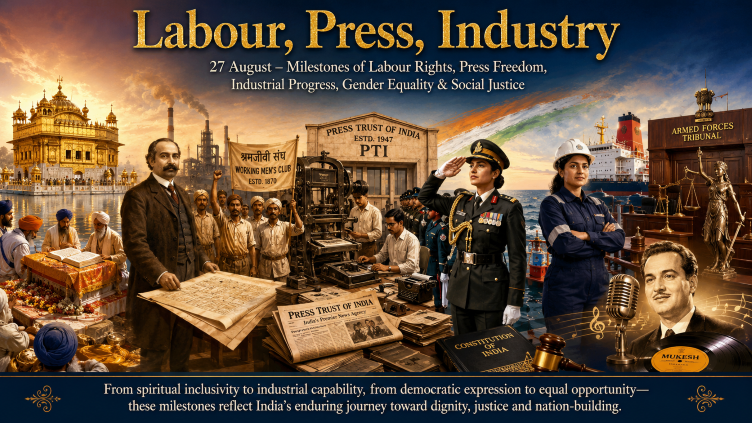
27 August has witnessed several landmark events in Indian history that collectively reflect the nation’s evolving character—spiritual inclusivity, labour rights, industrial self-reliance, press freedom, gender empowerment in defence and social justice.
Spiritual & Cultural Foundations
1604 – Installation of the Adi Granth Sahib at the Golden Temple, Amritsar
Guru Arjan Dev installed the compiled Adi Granth (later Guru Granth Sahib) in the Harmandir Sahib, embodying spiritual pluralism by including hymns from saints of different faiths and castes. This act is central to Sikh identity and India’s broader ethos of syncretism.
Labour, Industry & Nation-Building
1859 – Birth of Dorabjee Tata
Dorabjee Jamshedji Tata, a key figure in building India’s modern industrial base (notably Tata Steel), was born on this day. His work advanced the vision of Indian self-reliance in heavy industry.
1870 – First workers’ union in India (Shramajivi Sangha/Working Men’s Club)
Social reformer Sashi Pada Banerji established India’s first labour Organisation in Calcutta, marking the beginning of organised labour rights and the dignity of work in the national narrative.
Press Freedom & Democratic Voice
1947 – Founding of Press Trust of India (PTI)
Just 12 days after Independence, PTI was set up as India’s own news agency, strengthening sovereign information flow and supporting a free press—vital to democratic character.
Gender & Institutional Milestones
1976 – First woman General in the Indian Armed Forces
Major General (Kumari) Gertrude Ali Ram was appointed Director of the Military Nursing Service, breaking gender barriers in the defence establishment and expanding the idea of national service.
1999 – Sonali Banerjee becomes India’s first female Marine Engineer
This milestone broadened the scope of women’s participation in technically demanding, traditionally male-dominated sectors tied to national infrastructure.
Rule of Law & Social Justice
2008 – First Chairman of the Armed Forces Tribunal
Retired Supreme Court judge A.K. Mathur was appointed the inaugural chairperson, reinforcing institutional mechanisms for justice within the armed forces.
EWS Reservation Proposal (Cabinet Committee on Political Affairs)
On 27 August (year cited in archives), the Cabinet Committee decided to propose 5–10% reservation in central government jobs for economically weaker sections, foreshadowing later constitutional measures for equitable opportunity.
Memory, Music & Public Life
1976 – Death of legendary playback singer Mukesh
Mukesh’s passing marked the end of an era in Indian film music, whose voice shaped the emotional texture of mid-20th century popular culture.
These events, taken together, trace a national character that values spiritual inclusion, workers’ dignity, industrial capability, press independence, gender equity in public institutions and structured pathways to social justice.
26-08-2026
Courage, Compassion, Unity
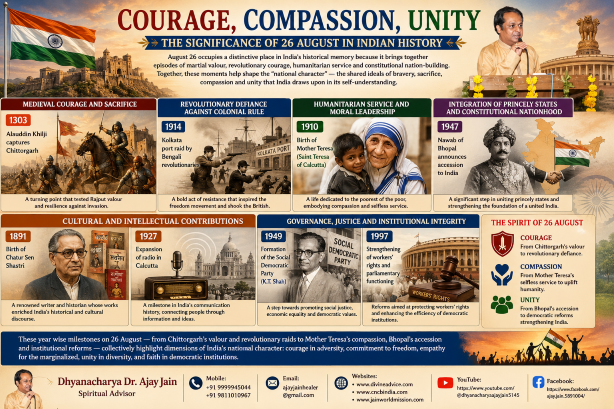
August 26 occupies a distinctive place in India’s historical memory because it brings together episodes of martial valour, revolutionary courage, humanitarian service and constitutional nation-building. Together, these moments help shape the “national character” — the shared ideals of bravery, sacrifice, compassion and unity that India draws upon in its self-understanding.
Medieval Courage and Sacrifice
1303 – Alauddin Khilji captures Chittorgarh
After an eight-month siege, Delhi Sultan Alauddin Khilji took the formidable fort of Chittorgarh on 26 August 1303, defeating Rana Bhim Singh. The episode is remembered in popular memory for the Jauhar (self-immolation) of Rajput women and the fierce resistance of the defenders, symbolising honour, sacrifice and defiance in the face of overwhelming odds.
Revolutionary Defiance against Colonial Rule
1914 – Kolkata port raid by Bengali revolutionaries
On 26 August 1914, Bengali revolutionaries attacked a British arms depot in Calcutta (Kolkata), seizing about 50 Mauser pistols and 46,000 rounds of ammunition to fuel the freedom struggle. This bold act exemplifies the spirit of armed resistance and willingness to risk everything for swaraj, a key strand in India’s nationalist character.
Humanitarian Service and Moral Leadership
1910 – Birth of Mother Teresa (Saint Teresa of Calcutta)
Anjezë Gonxhe Bojaxhiu, later known as Mother Teresa, was born on 26 August 1910. Though Albanian by birth, she became an Indian citizen and devoted her life to serving the poorest of the poor in Kolkata through the Missionaries of Charity. Awarded the Nobel Peace Prize (1979) and India’s Bharat Ratna (1980), she embodies compassion, selflessness and service as core national values.
Integration of Princely States and Constitutional Nationhood
1947 – Nawab of Bhopal announces accession to India
On 26 August 1947, the Nawab of Bhopal declared that the princely state of Bhopal would accede to the Indian Dominion. Coming just days after Independence, this decision contributed to the peaceful integration of princely states and reinforced the idea of a united, pluralistic India — a foundational element of the country’s post-colonial national character.
Cultural and Intellectual Contributions
1891 – Birth of Chatur Sen Shastri
Hindi novelist and thinker Chatur Sen Shastri was born on 26 August 1891. His works engaged with social reform, spirituality and Indian identity, adding to the literary and intellectual currents that shaped modern Hindi consciousness and, by extension, aspects of India’s cultural self-image.
1927 – Expansion of radio in Calcutta
On 26 August 1927, a second radio center was started in Calcutta, extending the reach of broadcasting in India. Radio later became a vital medium for national integration, education and dissemination of information across languages and regions, supporting the idea of a connected, informed citizenry.
Governance, Justice and Institutional Integrity
1949 – Formation of the Social Democratic Party (K.T. Shah)
The Social Democratic Party, led by K.T. Shah, was formed on 26 August 1949, reflecting the vibrant ideological diversity and experimentation in early independent India as it negotiated democracy, socialism, and secularism.
1997 – Strengthening of workers’ rights and parliamentary functioning
On 26 August 1997, the Employee Provident Fund scheme (1952) was amended to ensure that all PF claims were settled within 30 days, reinforcing the state’s commitment to social security and administrative accountability. On the same day, Vice President Krishan Kant took over as Chairman of the Rajya Sabha, underscoring the continuity and stability of India’s parliamentary institutions.
These year wise milestones on 26 August — from Chittorgarh’s valour and revolutionary raids to Mother Teresa’s compassion, Bhopal’s accession and institutional reforms — collectively highlight dimensions of India’s national character: courage in adversity, commitment to freedom, empathy for the marginalized, unity in diversity, and faith in democratic institutions.
25-08-2026
Shaping India’s National Identity
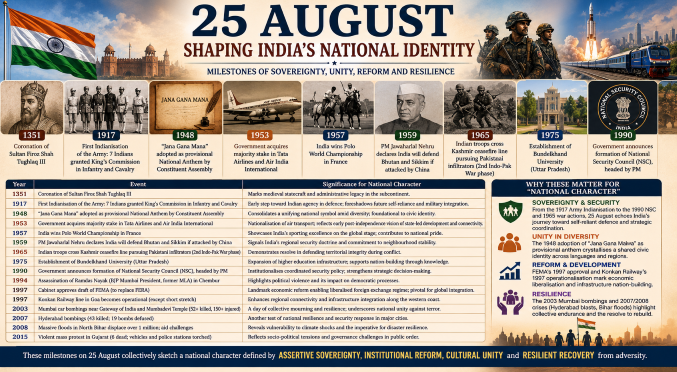
Shaping India’s National Identity
25 August has witnessed several pivotal moments in India’s history—spanning military integration, national symbols, security architecture, economic reform, and collective resilience in the face of tragedy. These events collectively reflect the evolution of India’s national character: sovereignty, unity, reform, and endurance.
Key Historical Events on 25 August in Indian Context
Year | Event | Significance for National Character |
1351 | Coronation of Sultan Firoz Shah Tughlaq III | Marks medieval statecraft and administrative legacy in the subcontinent. |
1917 | First Indianisation of the Army: 7 Indians granted King’s Commission in Infantry and Cavalry | Early step toward Indian agency in defence; foreshadows future self-reliance and military integration. |
1948 | “Jana Gana Mana” adopted as provisional National Anthem by Constituent Assembly | Consolidates a unifying national symbol amid diversity; foundational to civic identity. |
1953 | Government acquires majority stake in Tata Airlines and Air India International | Nationalisation of air transport; reflects early post-independence vision of state-led development and connectivity. |
1957 | India wins Polo World Championship in France | Showcases India’s sporting excellence on the global stage; contributes to national pride. |
1959 | PM Jawaharlal Nehru declares India will defend Bhutan and Sikkim if attacked by China | Signals India’s regional security doctrine and commitment to neighbourhood stability. |
1965 | Indian troops cross Kashmir ceasefire line pursuing Pakistani infiltrators (2nd Indo-Pak War phase) | Demonstrates resolve in defending territorial integrity during conflict. |
1975 | Establishment of Bundelkhand University (Uttar Pradesh) | Expansion of higher education infrastructure; supports nation-building through knowledge. |
1990 | Government announces formation of National Security Council (NSC), headed by PM | Institutionalises coordinated security policy; strengthens strategic decision-making. |
1994 | Assassination of Ramdas Nayak (BJP Mumbai President, former MLA) in Chembur | Highlights political violence and its impact on democratic processes. |
1997 | Cabinet approves draft of FEMA (to replace FERA) | Landmark economic reform enabling liberalised foreign exchange regime; pivotal for global integration. |
1997 | Konkan Railway line in Goa becomes operational (except short stretch) | Enhances regional connectivity and infrastructure integration along the western coast. |
2003 | Mumbai car bombings near Gateway of India and Mumbadevi Temple (52+ killed, 150+ injured) | A day of collective mourning and resilience; underscores national unity against terror. |
2007 | Hyderabad bombings (43 killed; 19 bombs defused) | Another test of national resilience and security response in major cities. |
2008 | Massive floods in North Bihar displace over 1 million; aid challenges | Reveals vulnerability to climate shocks and the imperative for disaster resilience. |
2015 | Violent mass protest in Gujarat (6 dead; vehicles and police stations torched) | Reflects socio-political tensions and governance challenges in public order. |
Why These Matter for “National Character”
- Sovereignty & Security: From the 1917 Army Indianisation to the 1990 NSC and 1965 war actions, 25 August echoes India’s journey toward self-reliant defence and strategic coordination.
- Unity in Diversity: The 1948 adoption of “Jana Gana Mana” as provisional anthem crystallises a shared civic identity across languages and regions.
- Reform & Development: FEMA’s 1997 approval and Konkan Railway’s 1997 operationalisation mark economic liberalisation and infrastructure nation-building.
- Resilience: The 2003 Mumbai bombings and 2007/2008 crises (Hyderabad blasts, Bihar floods) highlight collective endurance and the resolve to rebuild.
These year wise milestones on 25 August collectively sketch a national character defined by assertive sovereignty, institutional reform, cultural unity and resilient recovery from adversity.
24-08-2026
Governance, Trade and Aviation
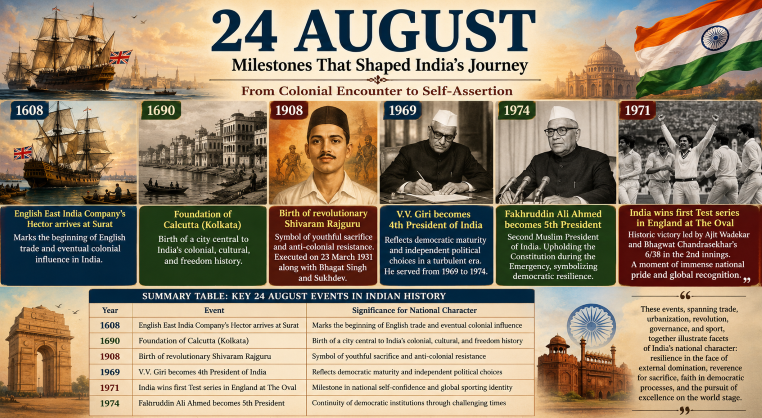
24 August holds a distinctive place in India’s historical memory, marking moments that shaped the nation’s political evolution, revolutionary spirit, economic sovereignty, and cultural confidence. From the first English trading ship’s arrival to landmark presidential tenures and a defining cricket victory, these events collectively reflect India’s journey from colonial encounter to self-assertion.
Year | Event | Significance for National Character |
1608 | English East India Company’s Hector arrives at Surat | Marks the beginning of English trade and eventual colonial influence |
1690 | Foundation of Calcutta (Kolkata) | Birth of a city central to India’s colonial, cultural, and freedom history |
1908 | Birth of revolutionary Shivaram Rajguru | Symbol of youthful sacrifice and anti-colonial resistance |
1969 | V.V. Giri becomes 4th President of India | Reflects democratic maturity and independent political choices |
1971 | India wins first Test series in England at The Oval | Milestone in national self-confidence and global sporting identity |
1974 | Fakhruddin Ali Ahmed becomes 5th President | Continuity of democratic institutions through challenging times |
These events, spanning trade, urbanization, revolution, governance, and sport, together illustrate facets of India’s national character: resilience in the face of external domination, reverence for sacrifice, faith in democratic processes, and the pursuit of excellence on the world stage.
23-08-2026
From National Unity to Lunar Conquest
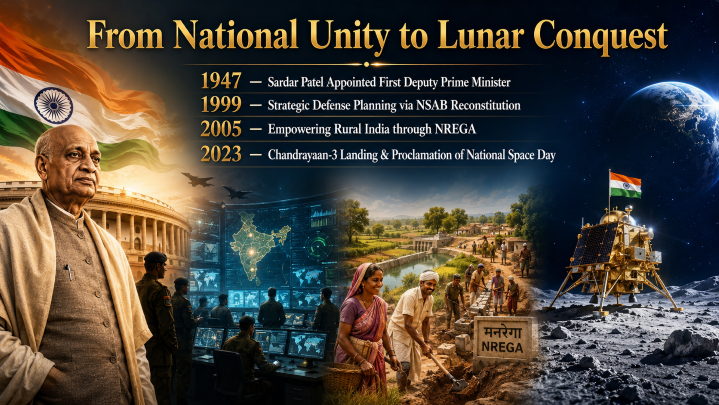
The 23rd of August holds a distinct place in India’s journey, marking powerful transitions across nation-building, social equity, strategic defense and space exploration.
1947 — Sardar Patel Appointed First Deputy Prime Minister: Formalized as India’s first Deputy PM alongside his role as Home Minister, Sardar Vallabhbhai Patel spearheaded the integration of over 560 princely states into a unified Republic, founding modern Indian civil services.
1999 — Strategic Defense Planning via NSAB Reconstitution: In the aftermath of Pokhran-II and Kargil, India reconstituted the National Security Advisory Board, institutionalizing strategic defense planning, nuclear governance, and national security oversight.
2005 — Empowering Rural India through NREGA: Parliament passed the landmark National Rural Employment Guarantee Act (later MGNREGA), legally guaranteeing 100 days of wage employment per year to rural households, creating one of the world’s largest social safety nets.
2023 — Chandrayaan-3 Landing & Proclamation of National Space Day: India made history as the first nation to soft-land near the lunar South Pole. To celebrate this feat of Atmanirbhar Bharat, August 23rd was officially designated as India’s annual National Space Day.
22-08-2026
Building a Stronger Nation
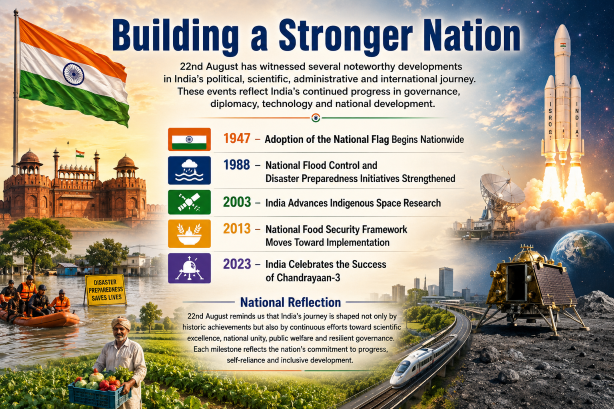
22nd August has witnessed several noteworthy developments in India’s political, scientific, administrative and international journey. These events reflect India’s continued progress in governance, diplomacy, technology and national development.
1947 – Adoption of the National Flag Begins Nationwide
The Event: Following Independence, 22nd August 1947 marked one of the earliest nationwide official implementations of the newly adopted Indian National Flag across government institutions, educational establishments and public offices, symbolising the unity and sovereignty of the Republic in the making.
1988 – National Flood Control and Disaster Preparedness Initiatives Strengthened
The Event: Following severe monsoon flooding across several states, the Government of India initiated major policy discussions and administrative reforms on 22nd August aimed at improving flood forecasting, river management and disaster preparedness, laying the foundation for stronger disaster management mechanisms.
2003 – India Advances Indigenous Space Research
The Event: During August 2003, India’s space program achieved important milestones in strengthening indigenous satellite technology and launch vehicle capabilities, reinforcing the nation’s long-term vision for self-reliance in space science and communication.
2013 – National Food Security Framework Moves Toward Implementation
The Event: In August 2013, Parliament completed significant legislative processes leading to the implementation of the National Food Security framework, expanding legal access to subsidised food grains for millions of Indian citizens and strengthening food welfare policies.
2023 – India Celebrates the Success of Chandrayaan-3
The Event: On 22nd August 2023, the nation eagerly awaited the historic lunar landing attempt of Chandrayaan-3, with final preparations completed ahead of the successful landing on 23rd August. The mission symbolized India’s growing leadership in space exploration and scientific innovation.
National Reflection
22nd August reminds us that India’s journey is shaped not only by historic achievements but also by continuous efforts toward scientific excellence, national unity, public welfare and resilient governance. Each milestone reflects the nation’s commitment to progress, self-reliance and inclusive development.
21-08-2026
21st August-Turning Points
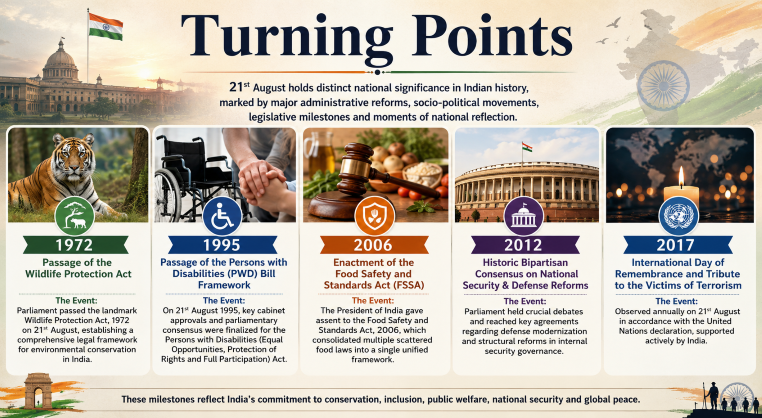
21st August holds distinct national significance in Indian history, marked by major administrative reforms, socio-political movements, legislative milestones and moments of national reflection.
1972: Passage of the Wildlife Protection Act
The Event: Parliament passed the landmark Wildlife Protection Act, 1972 on 21st August, establishing a comprehensive legal framework for environmental conservation in India.
National Impact: This legislation proved to be a cornerstone for ecological preservation in modern India. It enabled the creation of protected national parks and sanctuaries, paved the way for Project Tiger (1973), and laid the groundwork for modern environmental rights and biodiversity conservation across the country.
1995: Passage of the Persons with Disabilities (PWD) Bill Framework
The Event: On 21st August 1995, key cabinet approvals and parliamentary consensus were finalized for the Persons with Disabilities (Equal Opportunities, Protection of Rights and Full Participation) Act.
National Impact: This was a watershed moment for social justice and civil rights in India. It legally mandated equal opportunities, reservation in public employment and accessible public infrastructure for persons with disabilities, shifting the national paradigm from charity to rights-based empowerment.
2006: Enactment of the Food Safety and Standards Act (FSSA)
The Event: The President of India gave assent to the Food Safety and Standards Act, 2006, which consolidated multiple scattered food laws into a single unified framework.
National Impact: The law led to the establishment of the Food Safety and Standards Authority of India (FSSAI). It revolutionized public health administration by enforcing strict quality control, hygiene standards, and regulatory compliance for food production and distribution nationwide.
2012: Historic Bipartisan Consensus on National Security & Defense Reforms
The Event: Parliament held crucial debates and reached key agreements regarding defense modernization and structural reforms in internal security governance.
National Impact: This reinforced national defense preparedness and highlighted bipartisan political unity when addressing core issues of national security, intelligence sharing, and border protection.
2017: International Day of Remembrance and Tribute to the Victims of Terrorism
The Event: Observed annually on 21st August in accordance with the United Nations declaration, supported actively by India.
National Impact: Having faced the brunt of cross-border terrorism for decades, India observes this day to honor victims, recognize the sacrifices of security personnel, and reiterate its unwavering global stance against terrorism in all its forms.
20-08-2026
Shaping Modern India
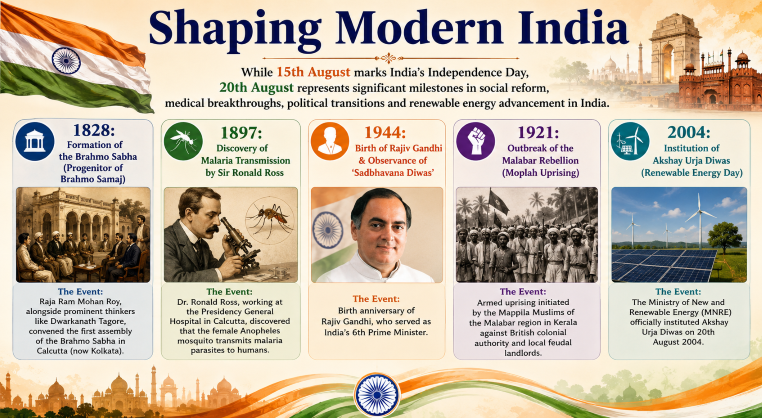
While 15th August marks India’s Independence Day, 20th August represents significant milestones in social reform, medical breakthroughs, political transitions and renewable energy advancement in India.
1828: Formation of the Brahmo Sabha (Progenitor of Brahmo Samaj)
The Event: Raja Ram Mohan Roy, alongside prominent thinkers like Dwarkanath Tagore, convened the first assembly of the Brahmo Sabha in Calcutta (now Kolkata).
National Impact: This moment catalyzed the Bengal Renaissance and modern Indian socio-religious reform. The movement combated orthodoxy, idol worship and social evils like Sati and caste discrimination, laying the intellectual foundation for modern Indian humanism and constitutional reform.
1897: Discovery of Malaria Transmission by Sir Ronald Ross
The Event: Dr. Ronald Ross, working at the Presidency General Hospital in Calcutta, discovered that the female Anopheles mosquito transmits malaria parasites to humans.
National Impact: This scientific breakthrough earned Ross the Nobel Prize in Medicine (1902) and fundamentally altered public health management across India and the developing world. Today, 20th August is observed globally as World Mosquito Day to mark this milestone.
1944: Birth of Rajiv Gandhi & Observance of ‘Sadbhavana Diwas’
The Event: Birth anniversary of Rajiv Gandhi, who served as India’s 6th Prime Minister.
National Impact: Commemorated annually across the nation as Sadbhavana Diwas (Harmony Day). It serves as an occasion for citizens to pledge support for emotional oneness, national integration and communal harmony without distinction of caste, religion or language.
1921: Outbreak of the Malabar Rebellion (Moplah Uprising)
The Event: Armed uprising initiated by the Mappila Muslims of the Malabar region in Kerala against British colonial authority and local feudal landlords.
National Impact: The rebellion emerged in the backdrop of the Khilafat and Non-Cooperation Movements. It became a watershed moment in the history of freedom struggle dynamics, agrarian reforms and political discourse in South India.
2004: Institution of Akshay Urja Diwas (Renewable Energy Day)
The Event: The Ministry of New and Renewable Energy (MNRE) officially instituted Akshay Urja Diwas on 20th August 2004.
National Impact: Designed to promote awareness about sustainable energy sources (solar, wind, hydroelectricity), this annual initiative accelerated India’s transformation into a global powerhouse in green energy and climate action commitments.
19-08-2026
Strength and Wisdom
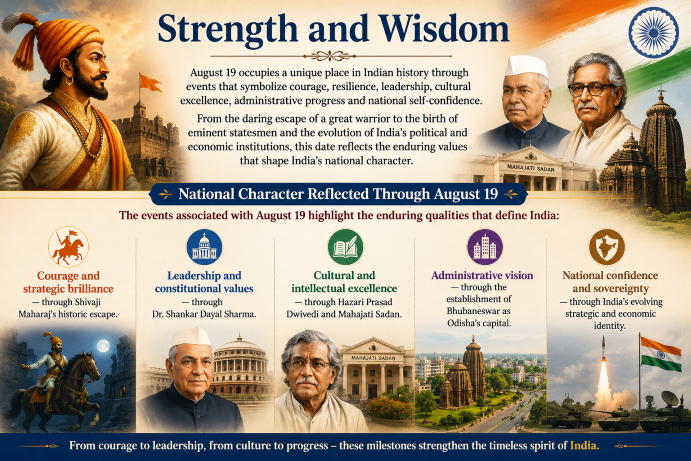
August 19 occupies a unique place in Indian history through events that symbolize courage, resilience, leadership, cultural excellence, administrative progress and national self-confidence. From the daring escape of a great warrior to the birth of eminent statesmen and the evolution of India’s political and economic institutions, this date reflects the enduring values that shape India’s national character.
1600 – Akbar Captures Ahmednagar
On 19 August 1600, Mughal Emperor Akbar captured the fort of Ahmednagar after a prolonged campaign in the Deccan.
The event reflected the importance of strategic governance, administrative expansion and political integration in medieval India.
1666 – Shivaji Maharaj’s Daring Escape from Agra
On 19 August 1666, Chhatrapati Shivaji Maharaj escaped from the captivity of Emperor Aurangzeb in Agra by concealing himself in baskets of sweets and fruits, according to traditional historical accounts.
This remarkable episode became a symbol of courage, strategic thinking, self-confidence and the indomitable spirit of freedom.
1757 – First East India Company Rupee Minted in Calcutta
On 19 August 1757, the East India Company minted its first one-rupee coin at the Calcutta Mint.
The event marked the growing consolidation of British economic authority in India, foreshadowing profound political and financial changes.
1907 – Birth of Hazari Prasad Dwivedi
On 19 August 1907, renowned scholar, novelist, and literary critic Hazari Prasad Dwivedi was born.
His writings enriched Indian literature and promoted India’s philosophical and cultural heritage, strengthening the nation’s intellectual character.
1918 – Birth of Dr. Shankar Dayal Sharma
On 19 August 1918, Shankar Dayal Sharma was born.
As the ninth President of India, he exemplified constitutional values, public service and democratic leadership.
1939 – Foundation of Mahajati Sadan
On 19 August 1939, Rabindranath Tagore laid the foundation stone of Mahajati Sadan in Kolkata at the invitation of Subhas Chandra Bose.
The institution symbolized national unity, cultural awakening, and the spirit of India’s freedom movement.
1949 – Bhubaneswar Becomes the Capital of Odisha
On 19 August 1949, Bhubaneswar officially became the capital of Odisha, replacing Cuttack.
The decision reflected India’s commitment to planned urban development and efficient state administration after Independence.
1999 – India’s Firm Nuclear Policy
On 19 August 1999, India’s draft nuclear doctrine attracted international attention following the 1998 nuclear tests.
The episode demonstrated India’s determination to safeguard its national security while pursuing responsible strategic autonomy.
National Character Reflected Through August 19
The events associated with August 19 highlight the enduring qualities that define India:
Courage and strategic brilliance — through Shivaji Maharaj’s historic escape.
Leadership and constitutional values — through Dr. Shankar Dayal Sharma.
Cultural and intellectual excellence — through Hazari Prasad Dwivedi and Mahajati Sadan.
Administrative vision — through the establishment of Bhubaneswar as Odisha’s capital.
National confidence and sovereignty — through India’s evolving strategic and economic identity.
August 19 is more than a date in history—it is a reflection of India’s enduring spirit. From heroic resistance and cultural renaissance to democratic leadership and national development, the events of this day illustrate how courage, wisdom, vision and resilience have continuously shaped the National Character of India. Together, they remind us that a nation’s true strength lies not only in its achievements but also in the values that inspire those achievements.
18-08-2026
Courage, Knowledge and Nation Building
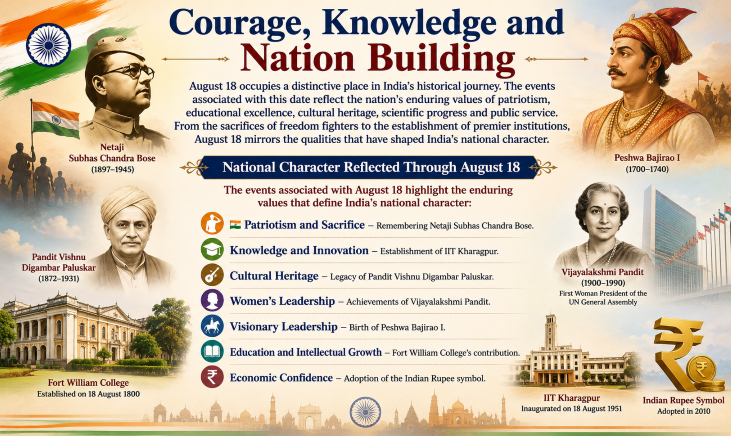
August 18 occupies a distinctive place in India’s historical journey. The events associated with this date reflect the nation’s enduring values of patriotism, educational excellence, cultural heritage, scientific progress and public service. From the sacrifices of freedom fighters to the establishment of premier institutions, August 18 mirrors the qualities that have shaped India’s national character.
1700 – Birth of Peshwa Bajirao I
Peshwa Bajirao I, one of the greatest military commanders of the Maratha Empire, was born on 18 August 1700.
His leadership, strategic brilliance and unwavering commitment to protecting Indian interests symbolize courage, patriotism and visionary leadership.
1800 – Establishment of Fort William College
On 18 August 1800, Governor-General Lord Wellesley established Fort William College in Calcutta.
Although founded during the colonial period, the institution played a significant role in the development of Indian languages and administrative education, contributing to India’s literary and intellectual heritage.
1872 – Birth of Pandit Vishnu Digambar Paluskar
The renowned Hindustani classical musician Pandit Vishnu Digambar Paluskar was born on this day.
Despite losing his eyesight at a young age, he revolutionized music education and made classical music accessible to the public.
His life exemplifies perseverance, cultural pride and dedication to preserving India’s artistic traditions.
1900 – Birth of Vijayalakshmi Pandit
Vijayalakshmi Pandit, freedom fighter, diplomat and the first woman President of the United Nations General Assembly, was born on 18 August 1900.
Her achievements showcased India’s commitment to women’s empowerment, diplomacy and global leadership.
1945 – Netaji Subhas Chandra Bose’s Final Journey
On 18 August 1945, Netaji Subhas Chandra Bose was reported to have been critically injured in a plane crash in Taihoku (Taipei). The circumstances of his reported death remain one of modern India’s enduring historical mysteries.
Netaji continues to symbolize fearless patriotism, sacrifice and the spirit of national freedom.
1951 – Inauguration of IIT Kharagpur
On 18 August 1951, Indian Institute of Technology Kharagpur was inaugurated as India’s first IIT.
This landmark institution laid the foundation for world-class engineering education and scientific innovation, representing India’s commitment to knowledge, excellence and technological advancement.
2008 – Implementation of the Sixth Pay Commission in Uttar Pradesh
On 18 August 2008, the Uttar Pradesh Government announced the implementation of the Sixth Pay Commission recommendations for state employees.
The decision reflected efforts toward improving public administration and employee welfare.
2010 – Adoption of the Indian Rupee Symbol
In 2010, Indian technology company TVS Electronics introduced one of the first keyboards featuring the newly adopted ₹ (Indian Rupee) symbol.
This represented growing national confidence and the strengthening of India’s economic identity on the global stage.
National Character Reflected Through August 18
The events associated with August 18 highlight the enduring values that define India’s national character:
- 🇮🇳 Patriotism and Sacrifice – Remembering Netaji Subhas Chandra Bose.
- Knowledge and Innovation – Establishment of IIT Kharagpur.
- Cultural Heritage – Legacy of Pandit Vishnu Digambar Paluskar.
- Women’s Leadership – Achievements of Vijayalakshmi Pandit.
- Visionary Leadership – Birth of Peshwa Bajirao I.
- Education and Intellectual Growth – Fort William College’s contribution.
- Economic Confidence – Adoption of the Indian Rupee symbol.
August 18 is more than a date in the calendar; it is a reflection of India’s journey toward freedom, knowledge, leadership, cultural excellence and national pride. The milestones commemorated on this day remind us that the nation’s strength is built through visionary leaders, dedicated educators, courageous freedom fighters and institutions that inspire generations. Together, these events embody the enduring values of India’s national character—courage, wisdom, innovation, service and unity.
17-08-2026
Shaping the NationShaping the Nation
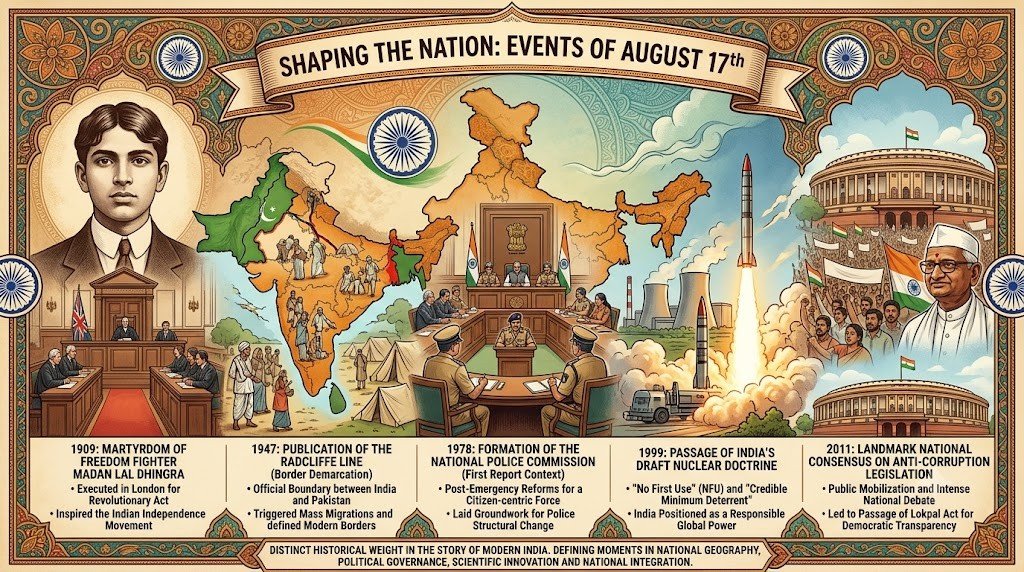
Here is a chronological overview of significant events of national character in Indian history that occurred on 17th August:
While August 15th marks India’s Independence, 17th August holds distinct historical weight in the story of modern India. This date is marked by defining moments in national geography, political governance, scientific innovation and national integration.
1909: Martyrdom of Freedom Fighter Madan Lal Dhingra
The Event: Freedom fighter Madan Lal Dhingra was executed at Pentonville Prison in London at the age of 25 for assassinating Curzon Wyllie, a British official.
National Impact: Associated with the India House organization led by Shyamji Krishna Varma and Veer Savarkar, Dhingra’s martyrdom inspired generations of Indian revolutionaries. His revolutionary act focused global attention on the Indian independence movement from the very heart of the British Empire.
1947: Publication of the Radcliffe Line (Border Demarcation)
The Event: The official boundary demarcation between India and the newly created Pakistan—known as the Radcliffe Line—was publicly announced on 17th August 1947, two days after Independence.
National Impact: Drawn by Sir Cyril Radcliffe, the boundary formally divided Punjab and Bengal. The announcement triggered one of the largest mass migrations in human history and defined the geopolitical map and sovereign borders of modern India.
1978: Formation of the National Police Commission (First Report Submission Context)
The Event: The post-Emergency reforms led to the active operationalization and key deliberations of India’s National Police Commission (NPC), which began laying the groundwork for police structural reform.
National Impact: This marked a pivotal shift in post-colonial governance, focusing on transforming the Indian police force from a colonial instrument of administration into a modern, citizen-centric law enforcement system grounded in constitutional rights.
1999: Passage of India’s Draft Nuclear Doctrine
The Event: The National Security Advisory Board (NSAB) presented the proposed Draft Nuclear Doctrine to the Government of India following the 1998 Pokhran-II tests.
National Impact: This document established India’s core strategic security principles: “No First Use” (NFU) and maintaining a “Credible Minimum Deterrent.” It positioned India as a responsible, mature nuclear power on the global stage while safeguarding national sovereignty.
2011: Landmark National Consensus on Anti-Corruption Legislation
The Event: Following intense nationwide public mobilization surrounding Anna Hazare’s anti-corruption movement, key parliamentary proceedings and civil society negotiations reached a crucial turning point on 17th August.
National Impact: This public movement galvanized national debate on legislative accountability, eventually leading to the passage of the Lokpal and Lokayuktas Act, strengthening democratic transparency and institutional oversight in India.
16-08-2026
Watershed Moments in Indian History
While 15th August marks India’s Independence, 16th August holds significant national weight in Indian history, marked by pivotal political transitions, territorial integration and historical watershed moments.
Here is a chronological overview of major yearwise events of national character that occurred on 16th August:
1932: Announcement of the Communal Award
The Event: British Prime Minister Ramsay MacDonald announced the controversial Communal Award.
National Impact: The award extended separate electorates to minority communities, including the “Depressed Classes” (Scheduled Castes). Mahatma Gandhi vehemently opposed treating the Depressed Classes as politically separate from Hindu society, leading to his fast-unto-death in Yerwada Jail. This culminated in the landmark Poona Pact between Gandhi and Dr. B.R. Ambedkar.
1946: Direct Action Day & The Great Calcutta Killings
The Event: The All-India Muslim League, led by Muhammad Ali Jinnah, observed “Direct Action Day” to press its demand for a separate Muslim homeland.
National Impact: The call triggered widespread riots and mass violence in Calcutta (now Kolkata), causing thousands of casualties in what came to be known as “The Great Calcutta Killings”. The violence rapidly spread across other provinces, proving to be a decisive catalyst toward the inevitable Partition of India.
1962: De Jure Transfer of Puducherry to the Indian Union
The Event: France officially ceded full sovereignty over its Indian territories (Puducherry, Karaikal, Mahe, and Yanam) to India through the exchange of instruments of ratification.
National Impact: While de facto administrative control was handed over in November 1954, 16th August marked the legal (de jure) integration of French-controlled enclaves into the Republic of India. The day is commemorated annually in Puducherry as De Jure Transfer Day.
2011: Mass Mobilization for Anti-Corruption Reforms
The Event: Social activist Anna Hazare was detained by Delhi Police on the morning of 16th August ahead of his planned fast for the Jan Lokpal Bill.
National Impact: His arrest triggered spontaneous nationwide public outrage and street protests. Sent to Tihar Jail, Hazare turned the site into the center of a mass anti-corruption movement, pressuring Parliament to adopt landmark legislative accountability measures.
2018: Passing of Former Prime Minister Atal Bihari Vajpayee
The Event: Bharat Ratna Atal Bihari Vajpayee, three-time Prime Minister of India and co-founder of the Bharatiya Janata Party (BJP), passed away at the age of 93.
National Impact: The nation observed seven days of state mourning for one of modern India’s most iconic statesmen, known for initiating economic reforms, elevating India’s nuclear status (Pokhran-II), and advancing national infrastructure initiatives.
15-08-2026
15th August - The Journey of a Sovereign India
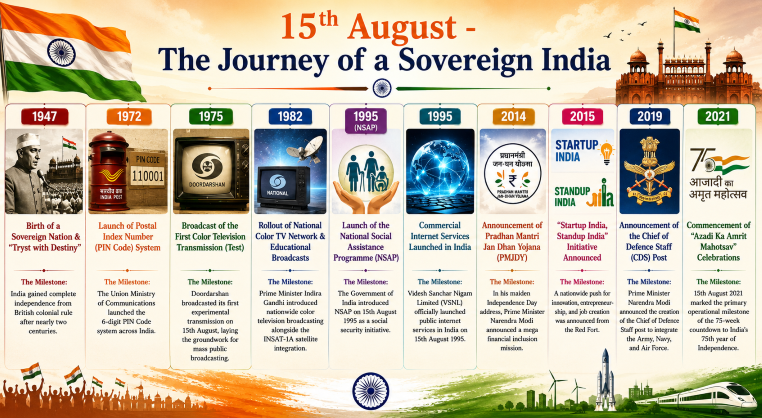
1947: Birth of a Sovereign Nation & “Tryst with Destiny”
The Milestone: India gained complete independence from British colonial rule after nearly two centuries.
National Impact: At the stroke of midnight, Pandit Jawaharlal Nehru delivered his iconic “Tryst with Destiny” address. On 15th August 1947, he unfurled the Indian Tricolour at the Red Fort, establishing the annual tradition of the Prime Minister addressing the nation.
1972: Launch of Postal Index Number (PIN Code) System
The Milestone: The Union Ministry of Communications launched the 6-digit PIN Code system across India.
National Impact: Developed by Shriram Bhikaji Velankar, the system standardized mail delivery across India’s vast geography, connecting rural and urban regions digitally long before the internet era.
1975: Broadcast of the First Color Television Transmission (Test)
The Milestone: Doordarshan broadcasted its first experimental transmission on 15th August, laying the groundwork for mass public broadcasting.
National Impact: It marked the beginning of national audio-visual media, which played a pivotal role in promoting national integration, rural development and information access.
1982: Rollout of National Color TV Network & Educational Broadcasts
The Milestone: Prime Minister Indira Gandhi introduced nationwide color television broadcasting alongside the INSAT-1A satellite integration.
National Impact: This brought the Independence Day Red Fort address in color directly into millions of homes for the first time, unifying the country through national media programming.
1995: Launch of the National Social Assistance Programme (NSAP)
The Milestone: The Government of India introduced NSAP on 15th August 1995 as a social security initiative.
National Impact: It established a countrywide safety net for elderly citizens, widows, and persons with disabilities living below the poverty line.
1995: Commercial Internet Services Launched in India
The Milestone: Videsh Sanchar Nigam Limited (VSNL) officially launched public internet services in India on 15th August 1995.
National Impact: This event catalyzed India’s information technology boom and laid the foundational infrastructure for the modern Digital India ecosystem.
2014: Announcement of Pradhan Mantri Jan Dhan Yojana (PMJDY)
The Milestone: In his maiden Independence Day address, Prime Minister Narendra Modi announced a mega financial inclusion mission.
National Impact: Launched officially days later, PMJDY led to the opening of over 500 million zero-balance bank accounts, drastically reducing financial exclusion and enabling direct benefit transfers (DBT).
2015: “Startup India, Standup India” Initiative Announced
The Milestone: A nationwide push for innovation, entrepreneurship, and job creation was announced from the Red Fort.
National Impact: This initiative established India as one of the world’s largest startup ecosystems, shifting national youth priorities toward entrepreneurship and technological innovation.
2019: Announcement of the Chief of Defence Staff (CDS) Post
The Milestone: Prime Minister Narendra Modi announced the creation of the Chief of Defence Staff post to integrate the Army, Navy, and Air Force.
National Impact: This marked the most significant restructuring of the Indian Armed Forces’ top command since 1947, enhancing joint warfighting capabilities and defense planning.
2021: Commencement of “Azadi Ka Amrit Mahotsav” Celebrations
The Milestone: 15th August 2021 marked the primary operational milestone of the 75-week countdown to India’s 75th year of Independence.
National Impact: A nationwide mass-participation movement (Jan Bhagidari) was launched to showcase India’s democratic journey, cultural heritage, and vision for Viksit Bharat (Developed India).
06-03-2026
Peace to Join Pieces
His mission, encapsulated in the phrase “Peace to Join Pieces,” is a call for global unity and spiritual integration in a world he views as increasingly fragmented.
At its core, this mission suggests that human society is currently “in pieces”—divided by ego, religious intolerance, and social conflict. According to Dr. Jain, peace is not just a destination but the “glue” required to bring these fractured elements back together.
Core Philosophy of “Peace to Join Pieces”
During his addresses (notably at the Constitution Club in New Delhi), Dr. Jain has emphasized several key pillars of this mission:
Unity Over Division: He believes that the urgency of the modern era is to “join pieces to gain peace.” This refers to bridging the gaps between different faiths, social classes, and nations.
“Know Yourself to Know Others”: A central mantra of his teaching is that external peace is impossible without internal self-awareness. By understanding one’s own soul, an individual can empathize with the “unheard heartbeats” of others.
The Power of Connection: He advocates for fostering friendships among all individuals, regardless of their background, viewing every person as a part of a single cosmic whole.
Practical Application of the Mission
Dr. Jain promotes this mission through several spiritual and social avenues:
Sambhav Dharma: He teaches the “Sambhav Sutras”—principles of balance and equanimity—which encourage people to remain “calm-minded” in the face of conflict and to understand the perspectives of others. Through Sambhav Sutra of Sambhav Dharma Dhyanacharya advocates the need of a common religion that plays a key role in making people realize their inner hidden possibilities of being at peace, be compassionate, be non- violent, Be truthful etc.
Spiritual Tools: He utilizes a variety of disciplines including Meditation, Vastu, Astrology, and Chakra Healing to help individuals clear mental “clutter,” making them more capable of contributing to a peaceful society.
Global Outreach: His mission is not restricted to India; he travels extensively (USA, UK, France, Middle East etc.) to conduct workshops that focus on “Freedom From Fear” (The FFF Effect) and spiritual enlightenment.
Social Activism: Beyond spirituality, he works for the upliftment of the needy, viewing social service as a vital “piece” of the puzzle in achieving global harmony.
Some Recognitions and Awards
His contributions to building a cohesive national identity have been recognized by various state and central organizations:
- Sadbhavna Samman (2014): For promoting communal harmony.
- Mahatma Gandhi National Excellence Award (2019): For his commitment to non-violence and social service.
- Doctorate in Spiritualism: Awarded for over 43 years of service to all sects of people.
In recognition of his 43+ years of service and his efforts to promote peace, he was recently awarded a Doctorate in Spiritualism by Chicago Open University (2024). He continues to advocate that India’s unique contribution to the world should be the practice of peace to counter “the fast-growing world of hatred.”