
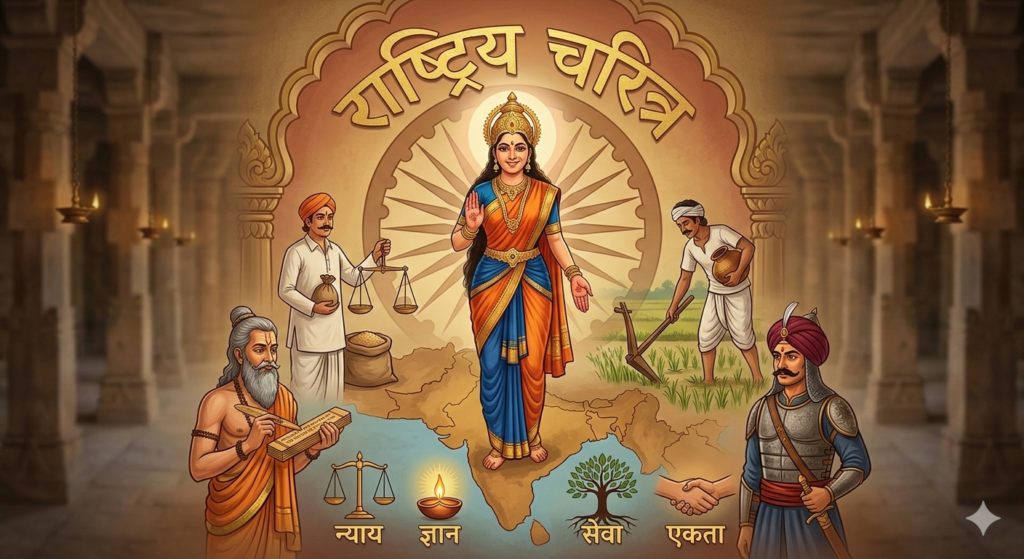
In Hinduism, the concept of “National Character” isn’t found in a single political manifesto but is woven through the ancient Vedic philosophy of Dharma (righteous duty) and Rashtra (the nation/collective entity).
The Hindu perspective views a nation not just as a piece of land with a border, but as a living, spiritual organism.
- The Foundation: Dharma and Satya
The bedrock of national character in Hindu scripture is the alignment of individual conduct with universal order.
- The Vedas: The Atharva Veda contains the Bhumi Sukta (Hymn to the Earth), which defines the relationship between the citizen and the land. It suggests that a nation’s strength is derived from the character of its people:
“Mata Bhumih Putroham Prithivyah” — The Earth is my mother, and I am her son.
- The Mahabharata: In the Shanti Parva, Bhishma explains that a nation’s decline is not caused by fate, but by the erosion of Dharma (ethics) and Satya (truth) among its leaders and citizens.
- Rashtra-Dharma: Duty Towards the Nation
The scriptures emphasize that individual salvation is linked to collective well-being. National character is seen as the sum of the “Swadharma” (individual duty) of every citizen.
- The Bhagavad Gita: While often read as a spiritual guide, its core message of Nishkama Karma (selfless action) is the ultimate blueprint for national service. When citizens perform their duties without selfish attachment to the results, the “National Character” becomes resilient and incorruptible.
- The Manusmriti and Arthashastra: These texts emphasize Danda (discipline/justice). A strong national character requires a society that values discipline, respects the law, and protects the vulnerable.
- Unity in Diversity (Ekātmatā)
A unique aspect of Hindu thought regarding national character is the “Rig Vedic” principle:
“Ekam Sat Vipra Bahudha Vadanti” — Truth is one, but the wise call it by many names.
This creates a national character defined by tolerance and pluralism. Unlike rigid ideological states, the Hindu perspective suggests that a strong nation is one that can harmonize diverse thoughts, languages, and customs under a single moral umbrella.
Core Attributes of National Character
Based on these texts, we can categorize the ideal “National Character” into four pillars:
Pillar | Scriptural Root | Modern Implication |
Selflessness | Tyaga (Renunciation) | Prioritizing the public good over personal gain. |
Bravery | Veerta | The courage to defend the nation’s values and borders. |
Knowledge | Vidya | A commitment to education, science, and truth. |
Compassion | Daya | Ensuring the welfare of the last person in line (Antyodaya). |
- The Organic State (Viraat Purusha)
The Purusha Sukta of the Rig Veda describes society as a single body. This implies that for a healthy national character, no part of society can be neglected. If the “feet” (labor) are hurting, the “head” (intellect) cannot function. This promotes a sense of social organicism—the idea that every citizen is vital to the nation’s health.
Arthashastra, written by Chanakya (Kautilya)
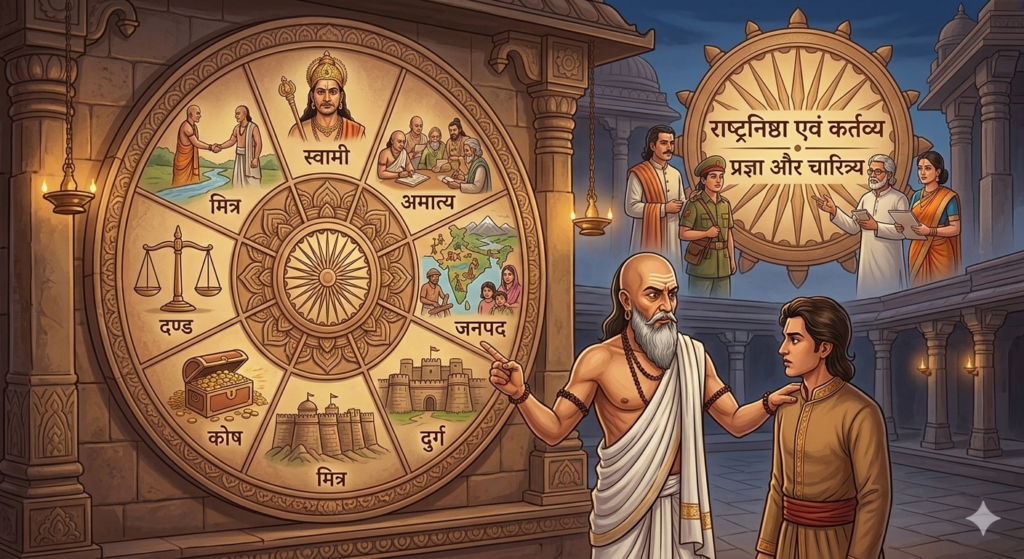
To explore the Arthashastra, written by Chanakya (Kautilya), we must look at it as more than a book of politics; it is a manual for building a resilient national character through Dharma and Danda (discipline).Chanakya’s philosophy suggests that the strength of a nation is not in its treasury or its walls, but in the character and ethical conduct of its citizens and rulers.
- The Concept of Raja-Dharma (Leadership Character)
Chanakya posits that the “National Character” starts at the top. If the leader is disciplined, the subjects will be disciplined.
- Self-Conquest (Indriya-Jaya): Before a citizen or leader can serve the state, they must conquer their own senses (lust, anger, greed, vanity, and overjoy).
- The Happy Citizenry: Chanakya famously stated:
“In the happiness of his subjects lies the king’s happiness; in their welfare his welfare.”
This creates a national character of mutual accountability.
- The Seven Pillars of the State (Saptanga Theory)
Chanakya described the nation as an organism with seven vital organs. For a healthy national character, all seven must function ethically:
- Swami (The King/Leader): The head or the vision.
- Amatya (The Ministers/Bureaucracy): The eyes or the wisdom.
- Janapada (The Territory and People): The legs or the foundation.
- Durga (The Fortifications): The arms or the protection.
- Kosha (The Treasury): The mouth or the sustenance.
- Danda (The Army/Justice): The mind or the discipline.
- Mitra (The Allies): The ears or the external relations.
- Civic Duties and the “Social Contract”
3. The Arthashastra outlines specific expectations for the “National Character” of the common citizen:
- Economic Integrity: Citizens were expected to be honest in trade. Chanakya viewed corruption as a “poison” that destroys the fabric of the nation from within.
- Civic Vigilance: It was the duty of every citizen to be aware of the state’s security. A passive citizen was seen as a liability; an active, informed citizen was the nation’s greatest asset.
- Universal Education (Vinaya): He emphasized that a nation of uneducated people cannot maintain a high character. Education was the tool to instill Vinaya (humility and discipline).
- Justice and the Rule of Law
National character in the Arthashastra is maintained through Dandaniti (the science of government/punishment). Chanakya argued that without the “rod of justice,” the strong would devour the weak (Matsya Nyaya or the Law of the Fish).
- A just state creates a character of security and trust among its people, allowing them to pursue spiritual and material growth without fear.
Summary of National Values in Arthashastra
|
Value |
Chanakya’s Perspective |
|
Discipline |
The root of all success; starts with self-control. |
|
Loyalty |
Loyalty to the concept of the state, not just a person. |
|
Practicality |
Ideals are useless unless they can be implemented for the public good. |
|
Vigilance |
A strong nation is always alert to internal and external threats. |
Chanakya believed that a nation’s “soul” is its character. When the people lose their sense of duty and ethics, the empire falls, regardless of how much gold is in the treasury.