
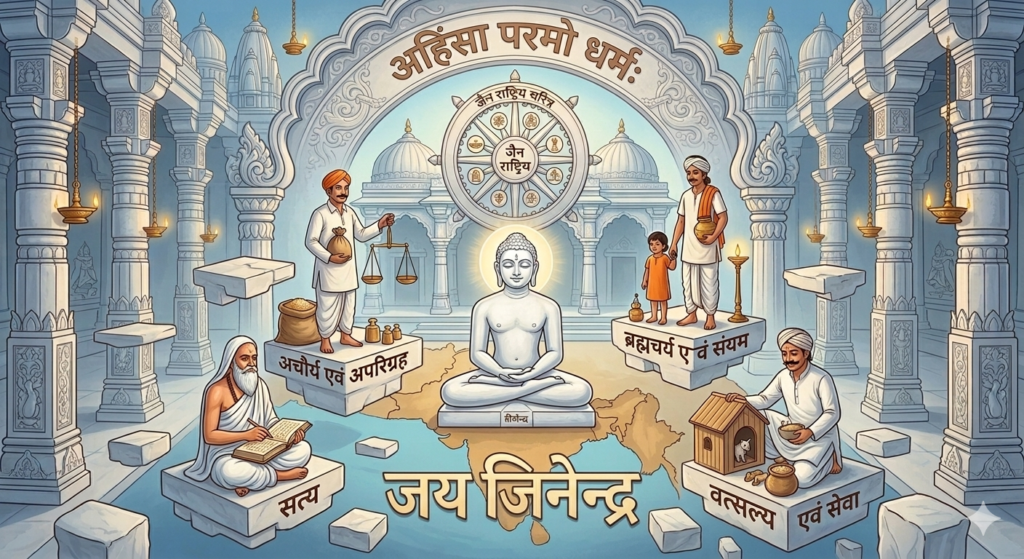
In Jainism, the concept of National Character is rooted in the transformation of the individual. According to Jain philosophy, a nation is not merely a political entity but a collective of souls (Jivas). Therefore, the character of a nation is the direct reflection of the purity, self-discipline and compassion of its citizens.
The Jain perspective focuses on the internal conquest of the self as the foundation for external peace and national strength.
- The Core Pillar: Ahimsa (Non-Violence)
The most significant contribution of Jainism to national character is the principle of Ahimsa. In the Acharanga Sutra, it is stated:
“All breathing, existing, living, sentient creatures should not be slain, nor treated with violence, nor abused, nor tormented, nor driven away.”
- National Implication: A nation with a Jain-influenced character is one that seeks peaceful coexistence, diplomacy over conflict and protection of all life forms, including the environment and animals. This creates a “National Character” of global stewardship and non-aggression.
- Anekantavada: Intellectual Pluralism
The doctrine of Anekantavada (many-sidedness) is essential for a diverse nation. It teaches that truth is multifaceted and no single point of view is complete.
- Scriptural Basis: The Tattvartha Sutra emphasizes Right Knowledge (Samyak Jnana).
- National Implication: This fosters a character of tolerance and democracy. It encourages citizens to respect differing opinions, religions and cultures, preventing the internal friction that weakens a nation’s social fabric.
- Aparigraha: Non-Possessiveness
The principle of Aparigraha teaches the limitation of worldly possessions and desires.
- National Implication: In a modern context, this translates to economic integrity and environmental sustainability. A national character built on Aparigraha fights corruption and greed. It encourages the equitable distribution of resources and discourages the exploitative consumerism that leads to social inequality.
- The “Shravaka-Dharma” (Duties of a Citizen)
The Ratnakaranda Sravakachara outlines the code of conduct for householders (Shravakas). These virtues form the “Micro-Character” of a citizen:
Virtue | Scriptural Root | National Impact |
Satya (Truth) | Samyak Darshana | Builds a society based on trust and transparent governance. |
Achaurya (Non-stealing) | Asteya | Ensures tax compliance, honesty in trade and respect for public property. |
Brahmacharya (Self-Control) | Sanyam | Creates a disciplined society focused on higher goals rather than base impulses. |
- The Concept of Sangha and Seva
Jainism emphasizes the Sangha (community). The national character is seen through the lens of Vatsalya (selfless affection for fellow beings).
- Jiva Daya: The Jain focus on “mercy to all living beings” extends to social welfare. Historically, Jain influence in India has led to the establishment of hospitals (Aushadhalaya), educational institutions (Gyan-Bhandars) and shelters (Pinjrapoles).
- National Strength: A nation that cares for its weakest members develops a “Moral Power” that is far more enduring than military or economic power alone.
From a Jain perspective, National Character is Personal Character writ large. If every citizen follows the Anuvratas (small vows)—being honest, non-violent and limited in greed—the nation naturally becomes a beacon of peace (Shanti) and prosperity (Pragya).