
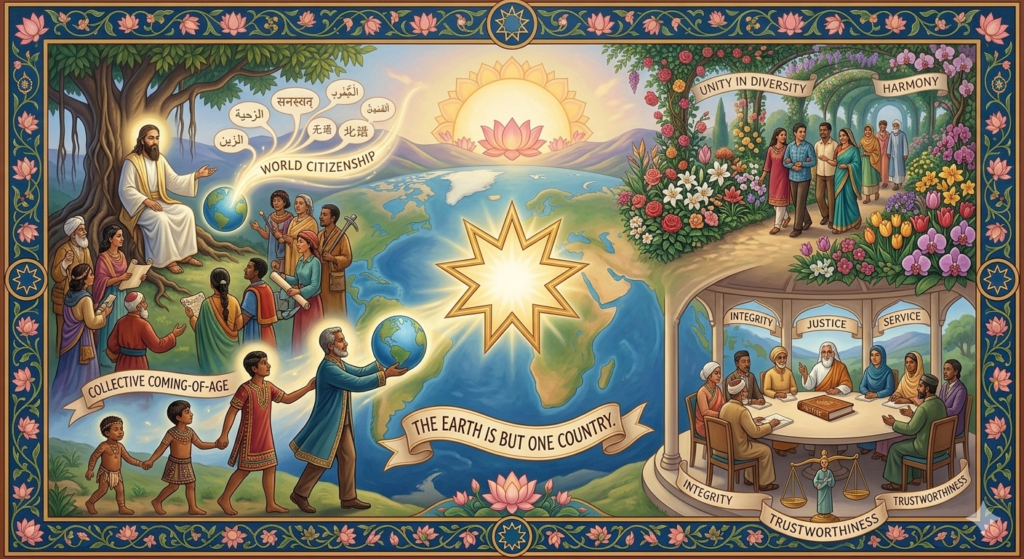
In the Bahá’í Faith, the concept of “National Character” is reframed through the lens of World Citizenship and the Oneness of Humanity. While Bahá’í writings uphold the value of a “sane and intelligent patriotism,” they emphasize that a nation’s true character is defined by its ability to contribute to the welfare of the entire human race.
The primary sources for these principles are the writings of Bahá’u’lláh (the Founder), ‘Abdu’l-Bahá, and Shoghi Effendi.
- The Global Pivot: “The Earth is But One Country”
The most definitive statement on national identity in Bahá’í scripture comes from Bahá’u’lláh in the Tablets of Bahá’u’lláh. He challenges the traditional, often competitive nature of nationalism:
“It is not his to boast who loveth his country, but it is his who loveth the world. The earth is but one country, and mankind its citizens.” — Bahá’u’lláh
From this perspective, a nation’s character is not measured by its military or economic dominance over others, but by its integration into a unified global family.
- Sane Patriotism vs. Unbridled Nationalism
Bahá’í teachings distinguish between a healthy love for one’s homeland and the “excessive nationalism” that leads to conflict. Shoghi Effendi, in The Promised Day is Come, explains that loyalty to one’s nation is a “lesser loyalty” that must be subordinated to the “paramount claims of humanity as a whole.”
- Legitimate Patriotism: Loving one’s culture, heritage, and land.
- National Character Goal: A nation that sees its own prosperity as being inextricably linked to the prosperity of its neighbors.
- Unity in Diversity (Wáhdat-i-Tanawwu’)
A central pillar of national character in the Bahá’í view is the celebration of diversity. In The Secret of Divine Civilization, ‘Abdu’l-Bahá suggests that a nation’s strength comes from the harmonious blending of different ethnic, religious, and social groups.
- The Garden Analogy: Just as a garden is more beautiful when it contains flowers of different colors and shapes, a nation’s character is enriched by the unique contributions of all its diverse citizens.
- Abolition of Prejudice: A nation with a strong character is one that has systematically worked to eliminate all forms of prejudice—racial, religious, and national.
- Characteristics of Just Leadership
In The Secret of Divine Civilization, written as a letter to the rulers and people of Persia, ‘Abdu’l-Bahá outlines the moral qualities required for a nation’s “character” to be considered “divine”:
- Integrity and Trustworthiness: Leaders and citizens must be absolutely honest.
- Justice: The foundation of a stable state. “The light of men is Justice. Quench it not with the contrary winds of oppression and tyranny.” (Bahá’u’lláh)
- Service to the Common Good: The purpose of governance is to elevate the condition of the people, especially the poor and marginalized.
Summary Table: Bahá’í Pillars of National Character
Principle | Holy Book/Source | National Application |
Oneness of Mankind | Gleanings from the Writings of Bahá’u’lláh | Transcending tribalism for global unity. |
Unity in Diversity | Paris Talks | Protecting minority rights and cultural heritage. |
Trustworthiness | The Kitáb-i-Aqdas | The “greatest ornament” of a nation’s people. |
World Citizenship | Tablets of Bahá’u’lláh | Prioritizing global peace over national gain. |
- Collective Coming-of-Age
Bahá’í writings describe the current era as the “collective coming-of-age” of the human race. Just as an individual matures from childhood to adulthood, the Bahá’í perspective suggests that nations must mature from isolation and competition toward a cooperative global commonwealth.