
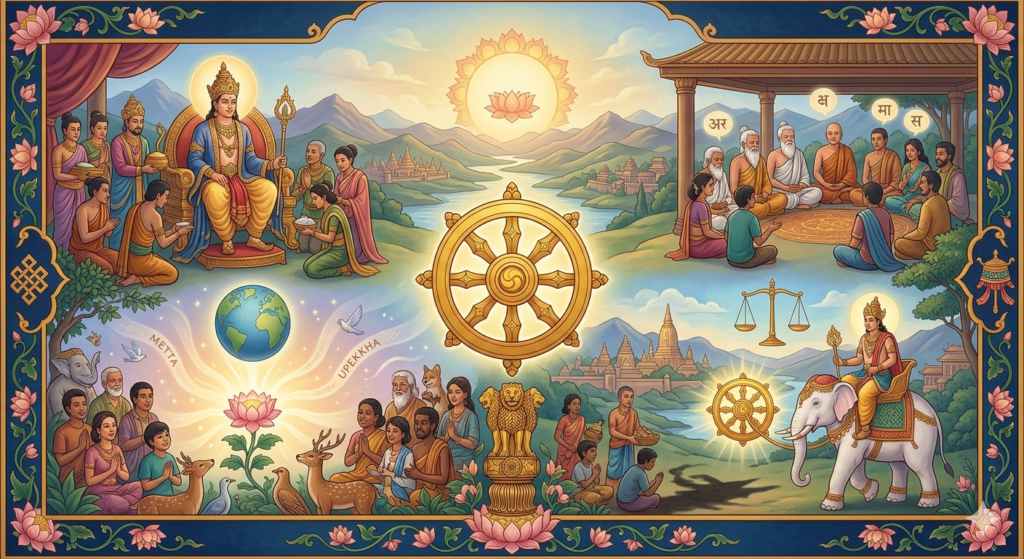
Buddhism doesn’t typically use the term “National Character” in the modern geopolitical sense, as the Buddha’s teachings focus heavily on universal truths that transcend borders. However, the Pali Canon (the Tipitaka) and various Mahayana sutras provide a blueprint for what a society’s collective identity should look like.
In the Buddhist perspective, a nation’s character is simply the “macro” reflection of the “micro” (the individual’s mind).
- The Ten Royal Virtues (Dasa-Raja-Dhamma)
The most direct reference to “National Character” comes from the Jataka Tales, which outline the ten qualities a leader—and by extension, the citizenry—should embody to ensure a stable state.
- Dana (Generosity): A national identity rooted in giving rather than hoarding.
- Sila (Morality): Maintaining a high standard of ethical conduct.
- Pariccaga (Self-sacrifice): The willingness to give up personal gain for the greater good.
- Ajjava (Integrity): Honesty and sincerity in all dealings.
- Tapa (Self-control): Discipline over one’s impulses.
When these virtues are practiced, the “character” of the nation becomes one of peace and prosperity.
- Social Cohesion and the Seven Conditions of Welfare
In the Maha-parinibbana Sutta, the Buddha outlines seven principles for the Vajjian republic to prevent decline. These principles define a strong national character through procedural harmony:
- Meeting in full and frequent assemblies.
- Meeting in harmony and dispersing in harmony.
- Acting according to established traditions (not changing laws arbitrarily).
- Respecting elders and listening to their counsel.
- Protecting the vulnerable (especially women and children).
- Respecting spiritual sites and traditions.
- Providing protection and support for spiritual teachers.
“As long as these conditions are met, the Vajjians can be expected to prosper and not decline.” — The Buddha
- The “Cakkavatti” Ideal (The Wheel-Turning Monarch)
The Cakkavatti-Sihanada Sutta (Digha Nikaya 26) presents a fascinating look at how national character erodes. It describes a kingdom where the ruler fails to provide for the poor. This leads to poverty, which leads to theft, which leads to violence, and eventually, the total collapse of social morality.
From this, Buddhism posits that a nation’s character is economically rooted. A moral national character cannot exist in a vacuum of extreme inequality or desperation.
- Universalism vs. Nationalism
Buddhism warns against “Identity View” (Sakkaya-ditthi). While a nation can be a “righteous community” (Sangha in a broad sense), attachment to national identity can become a form of “ego” if it leads to the exclusion or harm of others.
The Metta Sutta (Sutta Nipata 1.8) encourages radiating loving-kindness toward all beings, without distinction of country or race:
Metta = Universal Goodwill – Discriminatory Attachment
Summary Table: Buddhist Pillars of a Nation
Concept | Holy Book Reference | Focus |
Dasa-Raja-Dhamma | Jataka Tales | Moral leadership and ethics. |
Aparihaniya Dhamma | Maha-parinibbana Sutta | Democratic process and harmony. |
Cakkavatti | Digha Nikaya | Socio-economic justice and non-violence. |
Metta | Sutta Nipata | Universal compassion over tribalism. |