
Defining Social Bodies
Difining Social Bodies
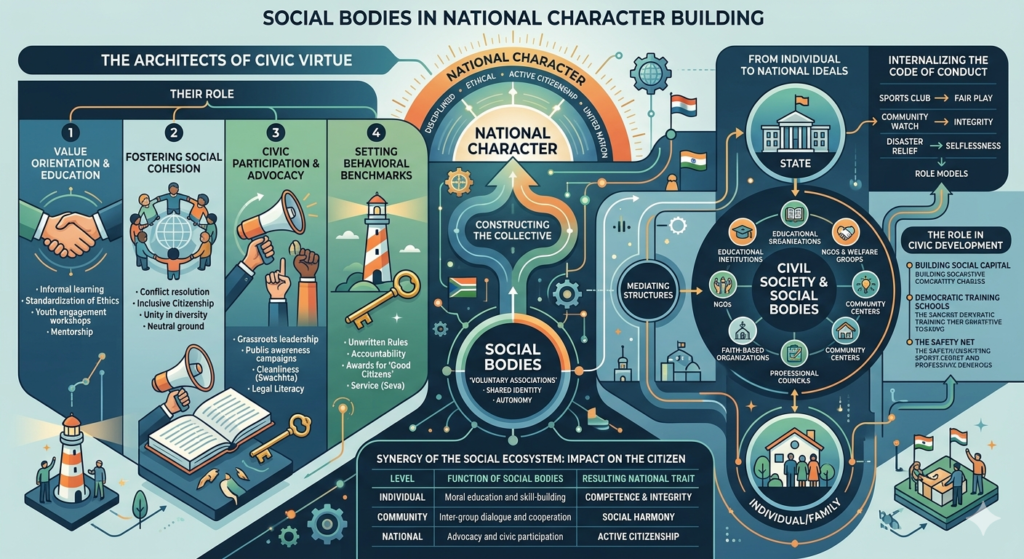
In sociology and civic development, social bodies (often referred to as “mediating structures” or “civil society”) are the organized groups and associations that exist between the individual/family and the state. They are the collective entities through which people pursue shared interests, values, and purposes.
In the context of National Character Building, these bodies act as the “foundational soil” where personal ethics are transformed into national virtues.
- Defining Social Bodies
Social bodies are not just groups; they are functional institutions that provide structure to public life. They are characterized by:
- Voluntary Association: People join them by choice (e.g., NGOs, clubs, professional guilds).
- Shared Identity: Members are bound by a common goal or belief system.
- Autonomy: They operate independently of the government, though they may collaborate with it.
Core Examples:
- Educational Institutions: Schools and universities that teach civic literacy.
- Non-Governmental Organizations (NGOs): Focused on social welfare, environment, or human rights.
- Faith-Based Organizations: Groups that provide moral frameworks and community support.
- Professional Councils: Bodies that set ethical standards for doctors, engineers, and teachers.
- Community Centers: Local hubs for youth engagement and elder care.
- The Role in Civic Development
Civic development is the process of building a society’s capacity to solve its own problems. Social bodies drive this through:
- Social Capital: They build trust between strangers. When people work together in a neighborhood watch or a local charity, they develop “social glue” that makes the whole country more stable.
- Democratic Training: These groups act as “schools for democracy.” By participating in a committee or a local council, individuals learn how to debate, vote, and lead.
- The Safety Net: They often provide services the state cannot, such as local disaster relief or specialized vocational training.
- National Character Building
National character is the collective personality of a country. Social bodies are the primary architects of this personality through:
Internalizing the “Code of Conduct”
While laws tell you what you cannot do, social bodies teach you what you should do. They turn abstract concepts like “integrity” or “discipline” into daily habits. For example, a sports club builds the character trait of “fair play,” which later translates to “political fairness” in the adult citizen.
Creating Unity Through Neutrality
In a nation with many religions or languages, neutral social bodies—like a Council for National Character-Building—provide a shared platform. They encourage Civic Unity, where the focus shifts from “my group” to “our nation.”
Moral Leadership
Social bodies identify and elevate “Role Models.” By celebrating ethical leaders at the local level, they set a benchmark for what a successful and respected citizen looks like, discouraging corruption and apathy.
The impact of social bodies on the development of a nation can be understood as a progressive transformation that begins with the Individual and culminates in a unified national identity. At the most fundamental level, these organizations focus on the individual through moral education and skill-building, which cultivates a foundation of personal competence and integrity. These internal virtues ensure that every person is equipped with the ethical framework necessary to contribute positively to society.
As these individuals interact within the Community level, social bodies facilitate inter-group dialogue and cooperation. By bridging gaps between diverse groups and fostering mutual understanding, these institutions create social harmony, turning a collection of different people into a cohesive and peaceful local society.
Finally, at the National level, the influence of these bodies manifests through organized advocacy and civic participation. By encouraging people to engage with national issues and take responsibility for the country’s direction, social bodies foster a culture of active citizenship. This multi-tiered approach ensures that a nation’s character is built not from the top down, but from a grounded, ethical, and engaged populace.
Role of Social Bodies
The construction of a national character is not solely the responsibility of the state; it is a collaborative process heavily reliant on social bodies. These organizations—ranging from NGOs and educational institutions to religious groups and community councils—act as the bridge between individual ethics and national identity.
Their role can be broken down into four primary functions:
- Value Orientation and Education
Social bodies serve as the primary vehicles for “informal” and “non-formal” education. While schools provide academic knowledge, social organizations often focus on the moral and ethical framework of a citizen.
- Standardization of Ethics: They help define a collective “Code of Ethics” that transcends individual backgrounds, focusing on universal values like integrity, empathy, and civic duty.
- Youth Engagement: By targeting the younger demographic through workshops and mentorship, these bodies ensure that the next generation inherits a sense of responsibility toward the nation.
- Fostering Social Cohesion
In a diverse society, social bodies act as “neutral ground” for interfaith and intercultural dialogue.
- Conflict Resolution: Community councils and peace committees work to resolve local tensions before they escalate, maintaining the social stability required for character building.
- Inclusive Citizenship: They promote the idea that national character is built on unity in diversity, encouraging citizens to respect different traditions while adhering to a shared national vision.
- Civic Participation and Advocacy
National character is reflected in how citizens interact with their government and environment. Social bodies catalyze this interaction.
- Grassroots Leadership: They identify and train local leaders who prioritize community welfare over personal gain.
- Public Awareness: By campaigning for issues like environmental protection, cleanliness (Swachhta), and legal literacy, they transform passive residents into active, informed citizens.
- Setting Behavioral Benchmarks
Social bodies often establish the “unwritten rules” of a society. Through awards, public recognition, and community standards, they highlight what constitutes a “good citizen.”
- Accountability: They hold individuals and institutions accountable to a higher moral standard, creating a social environment where corruption and apathy are discouraged.
- Service (Seva): By organizing blood drives, disaster relief, or educational charities, they bake the concept of selfless service into the cultural fabric.
The Synergy of the Social Ecosystem
For national character-building to be effective, these bodies must operate with transparency and neutrality. When social organizations remain free from polarizing influences, they become the most powerful tool for creating a disciplined, ethical, and united nation.