
03-06-2026
The Milestones of 3rd June
In the tapestry of Indian history, 3rd June stands out as a day that deeply tested, shaped, and reflected the “National Character” of India—defining its resilience, intellectual depth, spiritual grounding and democratic fiber.
Here is a chronological journey of important historical milestones on this day, curated through the lens of India’s cultural and political identity.
1901 — The Voice of Cultural Awakening
The Birth of Gopinath Bordoloi – Forging the Inclusive Character of the Northeast
Gopinath Bordoloi, an eminent freedom fighter and the first Chief Minister of Assam, was born.
Bordoloi stands as a pillar of unity and integration. When the British layout threatened to group Assam into a Muslim-majority block during partition (which would have alienated the region), Bordoloi’s unwavering resolve—backed by Mahatma Gandhi—saved Assam’s integration with mainland India. His life exemplified the pluralistic, fiercely defensive character of India’s northeastern frontier.
1915 — Intellectual Resilience Against Imperialism
Rabindranath Tagore’s Knighthood – The Paradox of Global Honor and Swadeshi Soul
The British Crown conferred a Knighthood on Asia’s first Nobel Laureate, Rabindranath Tagore.
While the title was an acknowledgment of Indian intellectual brilliance on the global stage, it later became a canvas for the ultimate expression of Indian self-respect. Just four years later, following the brutal Jallianwala Bagh massacre of 1919, Tagore famously renounced this very Knighthood. This act solidified a core trait of the Indian national consciousness: choosing human dignity and national empathy over colonial validation.
1947 — The Ultimate Test of National Fortitude
The Mountbatten Plan (June 3 Plan) – The Painful Birth of a Sovereign Democracy
Lord Mountbatten, the last Viceroy of India, presented the official blueprint for the partition of British India into two independent nations: India and Pakistan.
This is perhaps the most defining political event associated with June 3rd. It was a moment of profound grief and broken geographical reality. Yet, the true national character of India shone brightest in its aftermath. Instead of collapsing into total chaos, India absorbed millions of refugees, immediately chose a secular and democratic constitution, and focused on building a modern, self-reliant scientific republic from the ashes of division.
1974 — The Artistic Conscious of a Nation
The Demise of Ramdhari Singh ‘Dinkar’ – The Voice of Righteous Rebellion
India lost its celebrated Rashtrakavi (National Poet), Ramdhari Singh ‘Dinkar’.
Dinkar’s poetry acts as a mirror to the Indian socio-political soul. His verses from masterpieces like Rashmirathi and Kuruashetra didn’t just praise the past; they challenged authority and woke up the masses. His famous line, “Singhasan khali karo ki janta aati hai” (Vacate the throne, for the people are coming), became the definitive anthem of Indian democratic dissent during the anti-Emergency movements of the 1970s.
2014 — Breaking the Ultimate Glass Ceiling
Sumitra Mahajan Appointed Speaker – Affirming Gender Parity in Democratic Spaces
Senior politician Sumitra Mahajan was chosen as the Speaker of the Lok Sabha (the Lower House of Parliament).
Following Meira Kumar, Mahajan’s appointment marked the first time India saw two consecutive women leading the highest chair of the world’s largest democracy. This milestone highlighted a steadily evolving national trait: a progressive societal push toward cementing gender leadership within constitutional frameworks.
A Core Takeaway:
From the pain of the June 3 Plan to the profound literary legacy of Rashtrakavi Dinkar, the events of this day remind us that India’s national character is not passive. It is a dynamic blend of deep resilience, democratic defiance, and an innate capacity to heal and rebuild.
02-06-2026
Shaping India’s National Identity
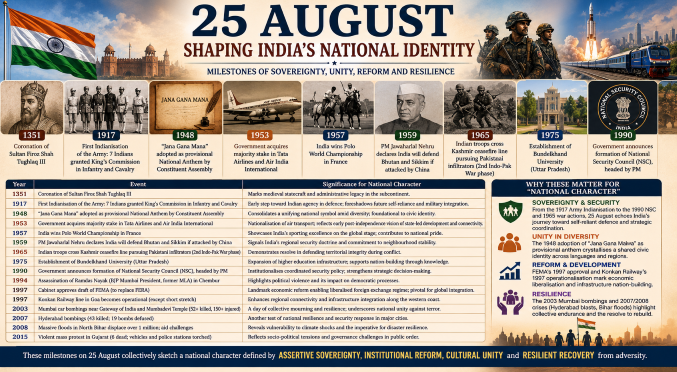
The national character of India is not fixed; it is a living, evolving ethos shaped by the constant interplay of civilizational resistance, spiritual depth, constitutional evolution and artistic genius. June 2nd stands out as a unique date in the subcontinental calendar, serving as a microcosm of this journey.
The significant historical milestones on this day have deeply influenced India’s collective identity.
Chronology of Historical Milestones
1756 — The Siege of Fort William: Resilience Against Colonial Expansion
Siraj-ud-Daulah, the young Nawab of Bengal, forced the surrender of Fort William in Calcutta (now Kolkata), driving out the British East India Company.
This early, decisive resistance against commercial exploitation and foreign military encroachment laid the historical foundation for the anti-colonial sentiment. It proved that the indigenous spirit would firmly challenge unchecked external authority.
1908 — The Arrest of Sri Aurobindo: Spiritual Nationalism and Fortitude
Following the Alipore Bomb Case (Manicktala), the British colonial government arrested Sri Aurobindo Ghose, a fiery radical nationalist leader. During his subsequent imprisonment, his philosophy transitioned from revolutionary politics to deep spiritual nationalism.
Sri Aurobindo’s synthesis of Sanatana Dharma (eternal values) with political liberation fundamentally shaped the Indian philosophy of struggle. It introduced the idea that the fight for freedom was not merely a political battle, but a sacred duty (Sadhana) rooted in self-realization and moral courage.
1947 — Lord Mountbatten’s Partition Announcement: The Trial of Unity
On this day, Viceroy Lord Louis Mountbatten formally presented the final plan for the partition of British India into two independent dominions, India and Pakistan, to Indian political leaders.
This structural trauma tested the secular, pluralistic core of the emerging Indian state. In the crucible of massive displacement and communal tragedy, India’s national character resolved to reject a theological state model, firmly committing itself instead to a diverse, multi-religious democratic framework.
1943 & 1956 — The Birth of Ilaiyaraaja and Mani Ratnam: Cultural Pluralism
June 2nd marks the birthdays of two titans of Indian cinema—musical maestro Ilaiyaraaja (1943) and master director Mani Ratnam (1956).
The collective national character is heavily informed by its cultural expressions. These two visionaries decentralized Indian popular culture from a purely Hindi-centric narrative, weaving Southern aesthetics into the broader national consciousness. Their collaborations showed that India’s unity lies in its deep, multi-lingual artistic diversity.
2014 — The Formation of Telangana: Federalism and Democratic Aspiration
Telangana officially became the 29th state of India, fulfilling a decades-long mass public struggle for self-determination and regional equity within the Union.
The peaceful creation of a new state via constitutional means proved the maturity of Indian democracy. It showed that the national character supports regional identities and decentralized governance, reinforcing that local socio-economic aspirations can be successfully met through parliamentary institutions.
“National character is not a creation of a day; it is the slow growth of centuries, nurtured by the sacrifices of the past and the aspirations of the future.”
01-06-2026
The Indian Spirit: A Historical Journey Through June 1st
June 1st holds a fascinating place in Indian history, marking transitions that reflect the evolution of India’s National Character. In this context, “National Character” represents the shared values, psychological resilience, intellectual depth and pursuit of self-reliance (Atmanirbharta) that define the nation.
Here is a chronological journey through June 1st, exploring how specific historical milestones shaped and reflected India’s identity.
1842: Breaking Glass Ceilings Under Colonial Rule
Event: Birth of Satyendranath Tagore, the first Indian to join the Indian Civil Service (ICS).
At a time when the British administration firmly believed Indians were incapable of higher governance, Satyendranath (the elder brother of Rabindranath Tagore) shattered the racial glass ceiling. His breakthrough proved that Indian intellect could compete with and best the elite bureaucracy of the British Empire. His legacy instilled a sense of national self-worth and confidence in the hearts of a colonized population.
1874: The Fall of the Exploitative Shadow
Event: The British East India Company was formally dissolved by an Act of Parliament.
The definitive end of the enterprise that systematically drained India’s wealth marks a dark chapter, but more importantly, it underscores the survival of the civilization. Despite a century of corporate-state subjugation, India’s core socio-cultural identity could not be erased. This historical closure symbolizes the indomitable resilience of a civilization destined to reclaim its sovereignty.
1916: The Clarion Call of Sovereign Pride
Event: Bal Gangadhar Tilak famously roared, “Swaraj is my birthright, and I shall have it!” during a historic speech at Ahmednagar.
www.indiatoday.in
Tilak’s words revolutionized the freedom struggle. He shifted the national narrative from “begging for political crumbs” via petitions to demanding absolute freedom as an inherent right. This moment fundamentally redefined the modern Indian character—transforming it from passive endurance to unyielding, fearless political assertion.
1930: Engineering Pride on the Tracks
Event: The debut of the Deccan Queen, India’s first deluxe luxury train, running between Bombay (now Mumbai) and Pune.
www.livemint.com
While built during British rule, the Deccan Queen quickly became an Indian icon, driven, maintained and heavily utilized by Indians. It symbolized India’s rapid embrace of modern industrial engineering and infrastructure. The train became a moving metaphor for a changing nation—dynamic, progressive and highly organized.
1945: Sowing the Seeds of Scientific Atmanirbharta
Event: The Tata Institute of Fundamental Research (TIFR) was established in Mumbai by Dr. Homi J. Bhabha with support from the Tata Trust.
Founded just two years before independence, TIFR is the bedrock of India’s nuclear and advanced scientific programs. Dr. Bhabha’s vision perfectly mirrors a core pillar of modern India’s character: scientific temper and self-reliance. It proved that a newly emerging, economically bruised nation had the audacity to gaze into the future of quantum physics and cosmic rays.
The Takeaway: June 1st captures the essence of a nation that moved from colonial subjugation to intellectual defiance, engineered its own infrastructure, established world-class scientific institutions and consolidated its status as a robust, sovereign democracy.
31-05-2026
The Triumph of Integrity and Vitality
May 31st represent a significant chapter in the evolution of the Indian consciousness, highlighting deep spiritual non-violence, foundational economic shifts and an unyielding commitment to public health. It marks a celebration of historic balance, where cultural restraint meets progressive adaptation to protect the nation’s well-being.
1725: Birth of Maharani Ahilyabai Holkar
Born on this day, the visionary queen of the Malwa kingdom, Maharani Ahilyabai Holkar, remains a beacon of the Dharmic and Administrative Character of India. Renowned for her humility and brilliant governance, she pioneered the architectural and spiritual revival of India by rebuilding destroyed temples, dharamshalas and ghats across the subcontinent, from Somnath to Kashi. Her legacy defines a leadership style rooted in selfless service, justice and cultural preservation.
World No Tobacco Day (Global Action, National Health Character)
Observed annually on May 31st, this day holds immense significance within the framework of India’s healthcare and community development campaigns. It reflects the Disciplined and Conscious Character of the nation as grassroots awareness movements, educational institutions and policy frameworks unite to eliminate substance dependency, aiming to protect the vital energy and moral fiber of India’s youth.
2019: Structural Realignment of Economic and Welfare Leadership
On May 31, 2019, crucial portfolios for the newly sworn-in Union Council of Ministers were formally allocated, establishing a strategic framework for economic growth, national security, and social welfare. This transition underscored the Stable and Constitutional Character of the Indian State, demonstrating an efficient, rule-based governance model ready to address contemporary national priorities.
2020: Transition to ‘Unlock 1.0’ (The Resilient Post-Pandemic Turn)
On this day in 2020, following the rigorous phases of the nationwide lockdown, the Government of India issued the historic guidelines for ‘Unlock 1.0.’ This step marked a calculated transition toward reviving economic activity while maintaining strict health protocols. This phase beautifully illustrated the Adaptable, Patient and Cooperative Character of the Indian citizenry, balancing collective survival with economic self-reliance.
Reflection on National Character
May 31 reminds us that a nation’s true strength is found in its internal governance—both of the state and of the self. From the magnificent, protective legacy of Ahilyabai Holkar to modern collective efforts toward healthier lifestyles and disciplined economic recovery, the Indian character consistently harmonizes ancient righteousness with practical resilience.
30-05-2026
The Voice of Truth and Democratic Integration
May 30th is a landmark day in the journey of the Indian consciousness, signifying the power of expression, cultural synthesis and the democratic evolution of the state. It marks the celebration of India’s linguistic pride, its first steps into native journalism and the formal territorial integration of its vibrant regions.
The Voice of Truth and Democratic Integration
1826: The Dawn of Hindi Journalism (Udant Martand)
On this historic day, India’s first Hindi-language newspaper, Udant Martand (The Rising Sun), was published from Calcutta (now Kolkata) by Pt. Jugal Kishore Shukla. This monumental event laid the foundation for Hindi Journalism Day (Hindi Patrakarita Diwas). It deeply influenced the Awakened and Expressive Character of the nation, providing a powerful vernacular medium that later fueled the flame of the freedom struggle and character-building across regional borders.
1987: Goa Attains Full Statehood
On May 30, 1987, Goa ceased to be a Union Territory and was officially recognized as the 25th state of the Indian Union. This milestone completed a long journey of decolonization and integration that began with its liberation in 1961. This event reflects the Inclusive and Harmonious Character of India, demonstrating how distinct cultural heritages blend beautifully into the larger canvas of Indian democracy while preserving local identity.
2019: Affirmation of the Democratic Mandate
On this day in 2019, the Union Council of Ministers took the oath of office following one of the largest democratic exercises in human history—the 2019 General Elections. This recurring cycle of peaceful transition reinforces the Democratic and Law-Abiding Character of India, where the collective will of the people remains the supreme guiding force of the nation.
2020: Announcement of the ‘Rozgar Setu’ Initiative (Post-Pandemic Character)
In late May 2020, amidst the peak of global uncertainty, crucial state-level framework models like the ‘Rozgar Setu’ were initiated to map the skills of returning migrant workers and connect them with local businesses. This phase highlighted the Empathetic and Resourceful Character of India, turning a massive humanitarian challenge into an organized effort toward grassroot economic re-skilling.
Reflection on National Character
May 30 stands as a testament to the fact that a nation’s true identity is shaped by the Power of its Voice and the Strength of its Unity. From the first ink of Hindi journalism to the complete integration of Goa into our democratic fabric, the Indian spirit continues to thrive on dialogue, diversity, and an unyielding commitment to collective progress.
29-05-2026
Echoes of the Soil and Spirit
History is more than a collection of dates; it is a mirror reflecting a nation’s core identity. For India, May 29th serves as a unique lens into the evolution of its National Character—a living mosaic forged through historical trials, cultural triumphs, and philosophical choices.
When we look at this specific day across the centuries, we discover the vital building blocks of the Indian psyche:
1658: The Battle of Samugarh
The Vulnerability of Fractional Leadership and the Struggle for Syncretism
On May 29, 1658, a decisive battle for the Mughal throne took place near Agra. Dara Shikoh—the liberal, pluralistic crown prince who translated the Upanishads into Persian—was defeated by his deeply conservative younger brother, Aurangzeb.
This day reminds all of a critical pivot in India’s complex history. Had Dara Shikoh won, the state’s approach to India’s pluralistic fabric might have been entirely different. Instead, the battle stands as a historical lesson on how internal division and a lack of tactical unity can alter a nation’s socio-cultural destiny. It reinforces the modern Indian character’s deep emphasis on preserving secularism, constitutional fraternity, and internal cohesion.
1953: The Conquest of Mount Everest
Resilience, Indomitable Spirit, and International Partnership
On May 29, 1953, Tenzing Norgay, alongside New Zealander Edmund Hillary, became the first humans to stand on the summit of Mount Everest (8,848 meters).
While it was a global triumph, for a newly independent India, Tenzing Norgay’s feat became an incredible point of pride. Born into hardship, his relentless perseverance, humility, and quiet strength perfectly mirrored the character of a young, resilient nation trying to find its footing on the world stage. It proved to a post-colonial India that no peak—literal or metaphorical—was out of reach if met with grit and determination.
1972: The Passing of Prithviraj Kapoor
Cultural Renaissance, Social Conscience, and the Arts
On May 29, 1972, the patriarch of Indian cinema and theater, Prithviraj Kapoor, passed away. Beyond his iconic acting roles, he was the force behind Prithvi Theatres—a traveling troupe that toured India performing plays about secularism, social reform, and humanism during the tumultuous years surrounding Independence.
Kapoor’s legacy highlights a key facet of the Indian character: using art as a vehicle for national integration. His work prioritized a combined Indian identity over regional divisions, reminding us that India’s artistic community has historically stepped up to heal and unite the public consciousness during times of pain and partition.
28-05-2026
Soul of Modern India
Analyzing historic dates through the lens of a “National Character” provides a unique perspective on India’s evolving identity. Rather than just viewing these events as chronological data points, we can interpret them as structural pillars that define the resilience, pluralism, industrial self-reliance and democratic evolution of India.
The most prominent year wise historic events for India on May 28th are detailed below, explored through their deep impact on the country’s national psyche.
May 28, 1883 — The Conception of Cultural Nationalism
The Birth of Vinayak Damodar Savarkar
Born in Bhagur, Nashik, V.D. Savarkar became one of the most influential and fiercely debated ideologues in Indian history. He was a revolutionary freedom fighter who later popularized the concept of Hindutva (coined earlier by Chandranath Basu) to define an essentialist cultural identity for the subcontinent.
Savarkar’s legacy represents a core ideological pillar of India’s complex socio-political fabric. His vision of a unified, self-defending cultural geography pushed back against colonial subjugation, forming a school of thought that emphasizes indigenous pride and strength. This event highlights a persistent dualism in the Indian national character: the ongoing dialogic tension between civic nationalism and cultural nationalism.
May 28, 1903 — The Birth of Shantanurao Laxmanrao Kirloskar
S.L. Kirloskar was a pioneering industrialist who spearheaded the rapid expansion of the Kirloskar Group, shaping India’s foundational manufacturing capabilities before and after independence.
Long before the modern terminology of “Atmanirbhar Bharat” (Self-Reliant India) entered the mainstream, leaders like Kirloskar proved that Indian innovation could match global engineering standards. His efforts engineered a vital facet of the national character: resourcefulness and economic resilience. He helped transform India from a colonially drained agrarian society into an indigenous industrial powerhouse, proving that self-reliance is built on domestic manufacture.
May 28, 1923 The Birth of N.T. Rama Rao (NTR)
Born on this day, Nandamuri Taraka Rama Rao transitioned from a legendary, larger-than-life actor in Telugu cinema to one of India’s most influential regional mass leaders and political figures.
NTR’s meteoric political rise on a platform of regional self-respect (Telugu Vari Atma Gauravam) reflects a quintessential truth of the Indian democratic character: its profound pluralism and federal vitality. His legacy codified the idea that India’s national strength lies not in a centralized monolith, but in honoring and fiercely protecting its diverse regional identities, languages, and cultures.
May 28, 1964 — The Cremation of Jawaharlal Nehru
A day after his passing on May 27, India’s first Prime Minister, Jawaharlal Nehru, was cremated at Shantivan in New Delhi on May 28, as millions converged to mourn.
This structural transition was a profound test for the young Republic. While western observers skeptically asked “After Nehru, who?”, predicting the fracturing of the nation, India executed a peaceful, orderly, and deeply democratic transition of power. This historic milestone cemented an irreplaceable aspect of the Indian character: its unwavering faith in constitutional democracy, showing that the institutions of the Republic were resilient enough to survive the loss of its founding giants.
May 28, 2023 — The Inauguration of the New Parliament House
In a grand ceremony, the new, state-of-the-art Parliament building in New Delhi was officially dedicated to the nation by Prime Minister Narendra Modi.
Architecturally moving away from the colonial-era Lutyens complex, the inauguration of the new Parliament building symbolized a literal and psychological decolonization of India’s sovereign space. Infused with indigenous art, architectural motifs from across the states, and the symbolic installation of the Sengol (scepter of righteous governance), this event underscores a modern-day shift in the national character: an assertive, self-confident India that bridges ancient civilization ethos with a 21st-century global vision.
The Underlying Thread:
When we look at May 28th across the centuries, we see the evolutionary arcs of India’s national character on display. It moves seamlessly from ideological debates on identity (1883), to the construction of economic backbone (1903), the celebration of cultural plurality (1923), the testing of institutional endurance (1964), and finally, a modern physical manifestation of decolonized sovereignty (2023).
27-05-2026
The Transition of Leadership, Democratic Resilience and Institutional Strength
In the context of the National Character of India, 27th May is a solemn yet profoundly significant day. It represents the ultimate test of a nation’s institutional maturity—the moment when a young republic faced its first great leadership vacuum and transitioned seamlessly without losing its democratic anchor. It also tracks the unyielding spirit of resistance by national icons during the freedom struggle.
1857: The Capture of Nana Sahib at Kanpur During the unfolding heat of the First War of Independence, revolutionary leader Nana Sahib consolidated forces at Kanpur. This reflects the “Defiant and Sovereign Character” of India’s early freedom fighters, who weaponized local resistance against the overarching might of the East India Company.
1930: Mass Arrests of Nationalist Icons (Salt Satyagraha) On this day, top leaders like Maulana Abul Kalam Azad and Jayaprakash Narayan were arrested during the Salt Movement, while cities like Mumbai erupted in massive civil disobedience. This event illustrates the “Unflinching and Self-Sacrificing Character” of the masses, proving that jail sentences could not deter the collective pursuit of Swaraj.
1952: Institutionalizing the National Language The Government of India officially authorized the use of the Hindi language (in Devnagari script) alongside English for high-level state appointments, including those of State Governors and Supreme Court Judges. This milestone highlights the “Cultural and Constitutional Character”—a conscious effort to weave indigenous identity into the formal fabric of Indian governance.
1964: The Passing of Pandit Jawaharlal Nehru India’s first Prime Minister and a principal architect of the modern nation passed away after 16 years in office. His death marked the end of an era. In terms of National Character, this moment birthed the “Resilient Democratic Character.” Despite global predictions that India would fracture without Nehru, the nation smoothly transitioned power to Acting PM Gulzarilal Nanda and later Lal Bahadur Shastri, solidifying India’s deep-rooted commitment to constitutional democracy over individual-centric rule.
1999: The Brave Skies of Kargil (Operation Safed Sagar) Just a day after launching air operations, the Indian Air Force faced adversity as it lost two fighter aircraft during intense high-altitude combat in the Kargil sector. The character displayed here is the “Valiant and Unwavering Soldierly Character”—where setbacks on the battlefield only reinforced the military’s steel resolve to reclaim national territory, regardless of the cost.
2024: Advanced Technological Mastery at Night The Indian Air Force achieved a major tactical milestone by successfully executing a Night Vision Goggles (NVG)-aided landing of a C-130J Super Hercules transport aircraft at the high-altitude Kargil airstrip. This modern event defines the “Technologically Adaptive Character” of modern India—transforming past conflict zones into theaters of absolute strategic readiness and cutting-edge capability.
The “National Character” Context
May 27th beautifully encapsulates India’s journey from vulnerability to institutional immortality. The day reminds us that while leaders change (1964) and tactical challenges arise on the borders (1999), the National Character of India remains unshakeable because it relies on institutional strength, democratic continuity, and the continuous evolution of its strategic capabilities.
26-05-2026
Sovereign Choice, Collective Aspiration, and Valiant Resilience
In evaluating the “National Character” of India, 26th May stands as a profound reminder of the country’s trajectory through historical adversity, defense of its borders and the evolution of its democratic mandates. This day tracks the shift from historical vulnerability to an era of unyielding strategic strength and grassroots empowerment, highlighting the nation’s constant pursuit of unity and self-determination.
1739: The Treaty of Partition (Nadir Shah and the Mughals)
Following the crushing defeat at the Battle of Karnal, the weakened Mughal administration was forced to sign a treaty on this day, formally ceding territories west of the Indus River (effectively separating Afghanistan from the empire) to the Persian ruler Nadir Shah. In terms of National Character, this dark chapter defines the “Lessons of Fragmented Character”—a historical warning that internal division and a lack of centralized national cohesion inevitably invite foreign exploitation and territorial loss.
1999: The Launch of Operation Safed Sagar (Kargil War)
On May 26, 1999, the Indian Air Force launched Operation Safed Sagar, commencing its first-ever ground-attack airstrikes at high altitudes to flush out Pakistani infiltrators from the icy peaks of Kargil. This milestone underscores the “Uncompromising Strategic Character”—the willingness of India’s armed forces to scale untamed heights and employ decisive, innovative military might to safeguard every inch of its territorial integrity.
1999: The Record-Breaking Cultural Sync (Dravid-Ganguly Partnership)
On the very same day the nation fought on the borders, India’s cricketing icons Sourav Ganguly and Rahul Dravid forged a historic, record-shattering 318-run partnership against Sri Lanka during the World Cup. This moment reflects the “Unifying Cultural Character”—where sports act as a psychological anchor, bringing a diverse population together in absolute solidarity and excellence, even amidst the anxieties of a border conflict.
2014: A Historic Democratic Mandate
On the evening of May 26, 2014, a massive paradigm shift occurred in Indian politics as a decisive, development-oriented mandate culminated in the oath-taking ceremony at the Rashtrapati Bhavan. This event represents the “Aspirational Democratic Character”—demonstrating the maturity of the Indian electorate to utilize the ballot box to demand transparency, pro-active governance, and a collective leap toward national transformation.
The “National Character” Context
May 26th encapsulates the transition from historical vulnerability to ultimate self-reliance. It shows that while India remembers the steep price of past fragmentations (1739), its modern character is firmly defined by the valor of its defenders in the sky (1999) and the absolute supremacy of its democratic choices on the ground (2014). It is a day that demands constant vigilance, internal unity, and dedicated hard work to preserve the sovereignty won by generations of sacrifices.
25-05-2026
Milestones of the Indian National Character
The date of May 25 marks significant historical milestones that showcase India’s resilient spirit in the freedom struggle, its rich literary and cultural heritage, and its ongoing journey of democratic and social development.
1886: Birth of Rash Behari Bose Born on this day in Subaldaha, Bengal, Rash Behari Bose was a mastermind behind the Ghadar Conspiracy and later founded the Indian Independence League in East Asia. He eventually handed over the leadership of the movement to Netaji Subhas Chandra Bose. His life epitomizes the global dimensions of the Indian freedom struggle and the unyielding spirit of sacrifice.
1899: Birth of Kazi Nazrul Islam Affectionately known as Bidrohi Kobi (The Rebel Poet), Kazi Nazrul Islam was born on this day. His revolutionary poetry, songs (Nazrul Geeti), and writings fiercely opposed British colonialism, religious bigotry, and social inequality. His legacy remains an inspiring testament to the secular, egalitarian, and fiercely expressive dimensions of the Indian national character.
1924: Trial of the Kanpur Bolshevik Conspiracy Case Ends A critical moment in India’s revolutionary labor movement. On this day, British authorities sentenced pioneering Indian communists and nationalists—including Shripad Amrit Dange and Nalini Gupta—to prison. This trial accidentally catalyzed the growth of organized working-class resistance, displaying a collective national character that refused to be silenced by colonial suppression.
1942: Netaji Subhas Chandra Bose and the Berlin Address During his exile in Germany around late May 1942, Netaji Subhas Chandra Bose officially began broadcasting regularly through the Azad Hind Radio in Berlin. His powerful call to arms stirred an intense spirit of patriotism and unity across the Indian diaspora and within the homeland, solidifying the national resolve for complete independence.
1999: Launch of Operation Safed Sagar (Kargil Conflict Prep) As tensions mounted on the icy peaks of Kargil, the Indian Air Force acted in close coordination with the Indian Army around this date, preparing for full-scale operations to flush out infiltrators. This collective military mobilization demonstrated the unparalleled courage, strategic adaptability, and defensive resolve of the nation.
2014: Democratic Transition and Governance On the eve of the swearing-in ceremony of a new Union Government following the massive 2014 General Elections, final administrative steps were taken on May 25. This transition highlighted the immense strength, discipline, and maturity of the world’s largest democratic process.
24-05-2026
Intellectual Awakening, Martyrdom and Democratic Accountability
May 24th marks several defining moments that have woven themselves into the fabric of India’s national character. These events reflect a commitment to education, the fiery spirit of revolution, the power of artistic resistance and the relentless pursuit of social and democratic accountability.
Here are the historical year-wise events of May 24th in the context of India’s national character:
1875: Foundation of Muhammadan Anglo-Oriental College (now Aligarh Muslim University)
Sir Syed Ahmed Khan, a pioneering educationalist and social reformer, established this institution in Aligarh.
AMU’s founding symbolized India’s early commitment to dynamic modern education as a tool for community empowerment and social change. It reflected an intellectual resilience and the realization that intellectual liberation must precede political independence.
1896: Birth of Kartar Singh Sarabha
One of the youngest martyrs of the Indian freedom struggle, Kartar Singh Sarabha, was born on this day in Ludhiana.
He was a key leader of the Ghadar Movement, advocating armed rebellion. His execution at age 19 symbolized the ferocious courage, selflessness and extreme sacrifice inherent in the Indian spirit to defy imperial dominance at any cost.
1956: Conclusion of Buddha Jayanti Celebrations (2500th Anniversary)
The nationwide celebrations marking the 2500th anniversary of Lord Buddha’s enlightenment and birth concluded, attended by leaders like Prime Minister Nehru.
This reaffirmed India’s civilizational identity as a land of peace (Ahimsa), compassion and spiritual synthesis. By honoring this milestone, the young Republic signaled its ancient commitment to pluralism and humanitarian values as a beacon for global harmony.
1990: Formation of the Jan Morcha (People’s Front)
V.P. Singh announced the launch of the Jan Morcha, a coalition political movement that eventually led to a new government.
This highlighted the resilience and vibrancy of Indian Democracy. It demonstrated the inherent democratic character of the people who demand transparency and political alternative, proving that the national soul is fundamentally committed to accountability and participatory governance.
1992: Ratification of the 73rd and 74th Constitutional Amendments
While passed in 1993, the essential steps towards strengthening decentralized governance—Panchayats and Municipalities—gathered major momentum around this date in 1992.
This monumental shift towards Panchayati Raj (local self-governance) enshrined the democratic principle of decentralization. It reflected a national trust in empowerment at the grassroots, believing that true democracy thrives on the participation of the common person in decision-making.
2001: Swearing-in of J. Jayalalithaa as Chief Minister
After a major legal battle, J. Jayalalithaa was sworn in as the Chief Minister of Tamil Nadu for the second time.
This emphasized the principle of Constitutional Supremacy and Judicial Overview. It showcased the dynamic and sometimes complex interaction between electoral mandates and legal frameworks, reinforcing that even political figures must adhere to the nation’s fundamental laws.
2014: Launch of the ‘Swachh Bharat’ Abhiyan Pilot Project
A small, symbolic clean-up initiative was launched around this time at India Gate, paving the way for the nationwide Swachh Bharat campaign.
This reflected a cultural shift towards civic responsibility and collective action. It signaled a new nation character—one that takes ownership of its environment, cleanliness, and public spaces as a vital component of dignity and self-respect.
23-05-2026
The Spirit of Undaunted Exploration, Electoral Trust and Indigenous Mastery
The 23rd of May shines in Indian history as a testament to human endurance, the staggering scale of democratic faith and the continuous pursuit of indigenous self-reliance.
In the framework of National Character, this day beautifully illustrates the blend of Sahas (unyielding courage), Loktantrik Vishwas (democratic trust) and Kushalata (indigenous skill).
1984: Bachendri Pal Scales Mount Everest
On May 23, 1984, just one day before her 30th birthday, Bachendri Pal became the first Indian woman to reach the summit of Mount Everest.
Hailing from a humble rural background in Uttarakhand, her journey to the top of the world was a victory over steep economic, social, and physical adversities.
This milestone fundamentally reshaped the narrative surrounding women in Indian adventure sports and leadership. It infused the national character with a fresh sense of gender egalitarianism and grit. Her triumph proved that the modern Indian spirit was ready to conquer the highest peaks of human endeavor, inspiring generations of Indian women to dismantle traditional limitations.
2009: Launch of India’s First Indigenous Search and Rescue Satellite
On this day, the Indian Space Research Organisation (ISRO) successfully integrated advanced transponders that operationalized India’s dedicated satellite-aided Search and Rescue (SAR) tracking system.
This critical technology allowed India to independently detect distress signals from crippled ships and aircraft across the vast Indian Ocean Region (IOR).
This event underscores India’s scientific character—using space technology not for space-race vanity, but for tangible humanitarian relief and disaster management. It reinforced the trait of Vasudhaiva Kutumbakam by offering safety networks not just to Indian vessels, but to international maritime traffic across regional waters.
2019: The Verdict of the Largest Democratic Exercise in Human History
On May 23, 2019, the counting of votes for the 17th Lok Sabha general elections concluded, declaring the results of an election where over 600 million citizens cast their ballots.
Utilizing millions of indigenous Electronic Voting Machines (EVMs) and VVPATs across diverse terrains—from the high Himalayas to remote islands—the massive logistical exercise culminated in a swift, decisive, and universally accepted democratic mandate.
This day mirrors the sheer political maturity embedded in the Indian character. While foreign observers often question how a nation of such immense diversity remains unified, the peaceful completion and collective acceptance of this historic verdict proved that the ballot box remains India’s ultimate sacred instrument of change.
Civilizational Focus: The Spirit of Continuous Discovery
May 23rd serves as a reminder that the Indian National Character is not static. Whether it is a woman standing atop the world’s highest peak, a satellite watching over the oceans, or hundreds of millions of voters shaping the nation’s political destiny, this day celebrates the active, evolving and resilient spirit of modern India.
22-05-2026
A Tapestry of Indian Fortitude
Beyond the significant milestones of May 21st, May 22nd emerges as another distinct chapter in the historical narrative of India, revealing further facets of its national character. This date brings into focus India’s commitment to social reform, its resilience in the face of natural adversity and its unwavering pursuit of self-reliance across diverse domains.
1872: Enactment of the Special Marriage Act
On May 22, 1872, the Special Marriage Act, originally drafted by social reformer Keshab Chandra Sen, was enacted. Though its original form applied only to certain non-religious marriages and was later significantly amended, its introduction marked a crucial moment in the journey towards legalizing marriages outside the rigid framework of religious personal laws. It laid early groundwork for secularism in personal matters.
This legislation, a direct outcome of the Indian Renaissance and its push for rational thought and social justice, reflects India’s national character of inclusivity and a progressive, reformist zeal. It represents an early, important step toward personal liberty and a secular national identity, values deeply intertwined with India’s long-term democratic aspirations.
1958: Dedication of the first India-made Atomic Reactor Control System
While India’s first atomic reactor, Apsara, went critical in 1956, it was on May 22, 1958, that the indigenously designed and built control system for Apsara was officially dedicated at the Bhabha Atomic Research Centre (BARC). This system, built entirely within the country, marked the beginning of India’s self-reliance in reactor technology.
This achievement is a cornerstone of India’s post-independence national character of technological self-sufficiency and intellectual rigor. It was not just about building a machine; it was about demonstrating India’s capacity to master complex science. This spirit of self-reliance (Atmanirbharta) and strategic foresight continues to drive India’s energy and defense sectors today.
1999: The Launch of Operation Safed Sagar during the Kargil Conflict
On May 22, 1999, the Indian Air Force launched Operation Safed Sagar, the first major deployment of air power during the Kargil War. This crucial operation, fighting at unprecedented altitudes against entrenched enemies, was pivotal in reclaiming Indian territories in the high Himalayas.
This event exemplifies India’s national character of unflinching courage, resilience and a staunch refusal to tolerate aggression. While India remains deeply committed to peace (Shanti), this operation showed the nation’s profound resolve to defend its sovereignty and territorial integrity at all costs, proving that peace is maintained not through appeasement, but through strength.
2011: NREGA Reaches 100% of Rural India
On May 22, 2011, it was announced that the coverage of the National Rural Employment Guarantee Act (NREGA, later MGNREGA), India’s landmark social security measure guaranteeing work to rural households, had been extended to every single rural district across the country, marking 100% geographic inclusion.
This milestone reflects India’s national character of deep-seated compassion, social justice and a commitment to upliftment of the grassroots. The implementation of one of the largest social welfare programs in the world underscores India’s unwavering resolve to combat poverty and ensure that progress is inclusive, providing dignity of labor and economic security to its most vulnerable citizens.
21-05-2026
Tragedy, Triumph and Temper
Observing history through the lens of National Character allows us to see how a country’s core values—such as resilience, cultural pride, intellectual curiosity and a deep-seated commitment to peace—are forged and tested over time.
May 21st holds a highly unique space in Indian history. It is a day marked by profound tragedy that reshaped the nation’s security posture, balanced by incredible milestones in global diplomacy, science, and cultural representation.
1920: Establishment of the Indian Red Cross Society
On May 21, 1920, the Indian Red Cross Society (IRCS) was formally incorporated under Act XV of 1920. Born out of the need to provide relief during emergencies and disasters, its establishment highlighted an integral aspect of India’s National Character: humanitarianism, empathy, and the philosophy of “Vasudhaiva Kutumbakam” (the world is one family). Over the past century, this institution has reinforced the nation’s voluntary spirit, stepping up during pandemics, natural disasters, and wars to alleviate human suffering without discrimination.
1981: The Conception of India’s First Antarctic Expedition
On May 21, 1981, India officially launched its pathbreaking tryst with the frozen continent, culminating in the first successful Indian Expedition to Antarctica later that year. This milestone showcased India’s intellectual self-reliance and forward-looking scientific temper. By sending a team to one of the most hostile environments on Earth, India asserted its status as a serious global player in scientific research, paving the way for permanent research stations like Dakshin Gangotri, Maitri, and Bharati.
1991: The Assassination of Prime Minister Rajiv Gandhi & The Birth of National Anti-Terrorism Day
On May 21, 1991, India’s youngest former Prime Minister, Rajiv Gandhi, was tragically assassinated by a suicide bomber from the LTTE during an election rally in Sriperumbudur, Tamil Nadu.
This tragic event profoundly tested the democratic resilience of the country. Instead of succumbing to chaos, the nation rallied together to protect its democratic framework. In his memory, the Government of India designated May 21st as National Anti-Terrorism Day.
Every year on this day, government offices and citizens take a solemn pledge affirming India’s traditional adherence to non-violence (Ahimsa) and tolerance. It highlights India’s unyielding stance against forces of terror, proving that unity and peace remain non-negotiable pillars of the Indian identity.
1994: Sushmita Sen Wins Miss Universe
On May 21, 1994, 18-year-old Sushmita Sen made history in Manila by becoming the first-ever Indian to be crowned Miss Universe. Just days later, Aishwarya Rai won Miss World, signaling a massive cultural shift.
This achievement was about far more than physical beauty; it symbolized a newly liberalized India entering the global stage with eloquence, confidence and grace. Sen’s victory redefined the global perception of the modern Indian woman—intelligent, independent, fiercely articulate, and deeply rooted in her values. It inspired an entire generation of young Indians to believe they could conquer the global stage.
2010: Successful Vertical Launch of the Supersonic BrahMos Cruise Missile
On May 21, 2010, the Indian Navy successfully executed the vertical launch version of the BrahMos supersonic cruise missile from the warship INS Ranvir in the Bay of Bengal.
This event exemplifies India’s evolving national character regarding strategic autonomy and technological prowess. Developed via a joint venture with Russia, the success of BrahMos proved India’s capability to build world-class, state-of-the-art defense systems, ensuring that its commitment to peace is always backed by the strength to defend its borders.
20-05-2026
The Resolute Anchor
The 20th of May is a day that highlights the National Character of tactical resistance, civilizational perseverance and the pursuit of truth. From the dawn of European maritime arrival to the modern era’s democratic transitions, this date reflects India’s ability to adapt and defend its core identity.
1498: The Arrival of Vasco da Gama at Calicut
Vasco da Gama reached the shores of Kappad, near Calicut (Kozhikode), marking the first recorded direct sea route from Europe to India. This event was a turning point that tested the national character of diplomatic hospitality and strategic suspicion. The Zamorin of Calicut’s initial reception and subsequent wariness of Portuguese demands reflected an ancient Indian tradition of openness tempered by a fierce defense of commercial and sovereign autonomy.
1787: The Siege of Lalsot
During the Maratha-Rajput wars, the Battle of Lalsot concluded around this date. It showcased the national character of regional valor and military coordination. The Rajput forces, particularly the Kachhwahas of Jaipur and Rathores of Jodhpur, demonstrated an unwavering commitment to defending their ancestral lands against the expanding power of the Maratha confederacy under Mahadaji Shinde.
1900: The Climax of the ‘Munda Ulgulan’ Resistance
In the wake of the Great Tumult led by Birsa Munda, May 1900 saw the intensified British crackdown on the Munda rebels. This period epitomizes the character of tribal resilience and spiritual defiance. The movement was not just a fight for land (Abua Dishun) but a fight for the preservation of the soul and dignity of the forest-dwelling communities against colonial exploitation.
1930: The Dharasana Satyagraha
Following Mahatma Gandhi’s arrest during the Salt March, the non-violent raid on the Dharasana Salt Works reached a critical stage around this time. Thousands of Satyagrahis, led by Sarojini Naidu, marched toward the salt pans. This event is a hallmark of the national character of disciplined fortitude. Protesters were brutally beaten by police but refused to raise a hand in retaliation, a display of moral courage that shocked the global conscience and weakened the British claim to moral authority.
1972: The Birth of the ‘Simla Agreement’ Context
Following the 1971 war, the diplomatic groundwork for the Simla Agreement was being heavily deliberated in May 1972. This period reflects the national character of magnanimity in victory. Despite a decisive military win, India’s focus remained on establishing a framework for durable peace and bilateralism, emphasizing the civilizational preference for dialogue over perpetual conflict.
1991: The ‘Last Day’ of an Era
May 20, 1991, was the final day of the first phase of the 10th General Elections. This moment represents the national character of democratic endurance. Despite a climate of intense political volatility, the Indian citizenry’s participation in the electoral process reaffirmed the country’s commitment to the ballot box as the ultimate arbiter of the nation’s destiny.
Reflection on National Character
The 20th of May teaches us that the Indian character is defined by Patience and Persistence. Whether it was the Zamorin dealing with the first European traders or the Satyagrahis at Dharasana, the common thread is a deep-seated belief in the right to self-determination and a refusal to abandon one’s principles under pressure.
19-05-2026
The Pillars of Enterprise, Sovereignt and Creative Intellect
The 19th of May brings into focus key moments that shaped India’s strategic self-reliance, indigenous industrial backbone and its deep artistic and literary conscience.
In the matrix of National Character, this day strongly reflects the principles of Atma-Nirbharata (self-reliance), Suraksha (vigilance and defense), and Srijan (creative intellect).
1904: The Passing of Jamsetji Tata
Character Trait: Atma-Nirbharata (Visionary Self-Reliance) and Nation-Building
On May 19, 1904, the “Father of Indian Industry,” Jamsetji Nusserwanji Tata, passed away.
He established the foundational blueprint for India’s heavy industry (Tata Iron and Steel Co.), clean energy and world-class educational institutions (Indian Institute of Science) long before India gained independence.
Jamsetji’s philosophy defined a crucial tenet of the modern Indian economic character: philanthropic capitalism. For him, enterprise was not merely a tool for private wealth, but a mechanism to elevate the nation. His vision proved that the Indian character possessed the industrial genius to break free from colonial economic exploitation.
1961: The Intensification of the Goa Liberation Movement
Character Trait: Integrity of Sovereignty and Anti-Colonial Resolve
On May 19, 1961, mass political mobilization and the United Front movement reached a fever pitch in Goa, explicitly demanding the complete withdrawal of Portuguese colonial forces.
This critical escalation of public pressure directly paved the way for the Indian government to launch Operation Vijay later that December, formally ending 450 years of Portuguese rule.
This milestone reflects India’s uncompromising stand on territorial integrity and complete decolonization. It demonstrated that the national character would not tolerate foreign enclaves on its sacred soil, cementing the fact that India’s freedom struggle was incomplete until every single corner of the subcontinent breathed free air.
1971: Commissioning of INS Virbahu
Character Trait: Strategic Depth and Maritime Vigilance (Suraksha)
On this day, the Indian Navy commissioned its first-ever dedicated submarine base, INS Virbahu, at Visakhapatnam.
Acting as the “Mother of Submarines,” this base provided integral operational, logistical, and technical support to India’s growing underwater fleet, coming right on the cusp of the pivotal 1971 Indo-Pak War.
The establishment of INS Virbahu marks a transition in the national defense character. It showed a country shifting from a purely land-centric defensive mindset to recognizing its vast maritime responsibilities, building a blueprint for blue-water naval dominance to protect ocean-bound trade and territorial waters.
1934 & 1979: The Lifecycle of Literary Giants (Birth of Ruskin Bond / Passing of Acharya Hazari Prasad Dwivedi)
Character Trait: Srijan (Intellectual Integrity and Cultural Synthesis)
May 19th intertwines the destiny of two monumental literary figures: the birth of the beloved Indian-Anglian author Ruskin Bond (1934) and the passing of the towering Hindi scholar, novelist, and essayist Acharya Hazari Prasad Dwivedi (1979).
Dwivedi breathed new life into historical fiction and Sanskrit criticism, while Bond beautifully captured the soul of India’s mountains and simple rural lives in English prose.
This dual alignment highlights the inclusive and deeply contemplative side of the Indian character. It proves that India’s identity thrives on linguistic plurality—where an organic attachment to ancient roots (Dwivedi) and a compassionate observation of contemporary Indian life through a global language (Bond) seamlessly coexist.
18-05-2026
Milestones of India’s National Character
The 18th of May is a stellar date in the chronological canvas of India. It marks moments where the country shifted its geopolitical destiny, demonstrated incredible spiritual and mental restraint and birthed avenues of creative expression.
In the framework of National Character, this day beautifully illustrates the blend of Atma-Vishwas (self-reliance), Sanyam (restraint), and Atma-Shuddhi (self-purification).
1912: The Release of Shri Pundalik
On May 18, 1912, the first Indian feature-length film, Shri Pundalik, directed by Dadasaheb Torne, was released at the Coronation Cinematograph in Bombay.
While Raja Harishchandra (1913) is technically regarded as the first full-fledged indigenous silent feature film, Shri Pundalik laid the absolute foundation for Indian cinematography.
This event marks the birth of India’s unique voice in visual storytelling. The choice of a devotional story about a saint highlighted a core aspect of the Indian character—using modern technology not to blindly mimic the West, but to preserve, package and celebrate roots and spiritual folklore.
1933: Mahatma Gandhi’s 21-Day Fast for Self-Purification
At noon on May 18, 1933, Mahatma Gandhi commenced a grueling 21-day fast dedicated to the cause of the Harijans (Untouchables) and for the “purification of himself and his associates.”
Recognizing the immense gravity of his step, the British government released him from prison unconditionally on the very same evening.
This event encapsulates the spiritual cornerstone of the Indian freedom struggle. It proved that the Indian National Character, under Gandhi, did not view power merely through political victory, but through moral rectitude. Winning Swaraj (self-rule) was meaningless without internal societal reform and the eradication of social evils like untouchability.
1974: Operation ‘Smiling Buddha’ (Pokhran-I)
On this historic morning, India successfully blasted its first underground nuclear device in the deserts of Pokhran, Rajasthan, becoming the 6th nation in the world to achieve nuclear capability.
Led by phenomenal scientists like Raja Ramanna, Homi Sethna, and P.K. Iyengar under Prime Minister Indira Gandhi, the test was purposefully categorized as a “Peaceful Nuclear Explosion” (PNE).
This is perhaps the defining 18th May event for modern India. It perfectly mirrors a unique National Character: strong but non-aggressive. While it announced India’s refusal to accept nuclear apartheid by Western powers (Strategic Autonomy), the choice of the code name “Smiling Buddha” on the day of Buddha Purnima emphasized India’s ancient philosophy of peace. India sought the weapon not to terrorize, but to ensure it could never be blackmailed or colonized again.
Global Connection: International Museum Day
Coincidentally, May 18th is also celebrated globally as International Museum Day. For a civilizational state like India, this day aligns seamlessly with the national duty of Sanskriti Rakshana (preservation of heritage)—safeguarding thousands of years of art, history, and philosophical evolution for the generations to come.
17-05-2026
Leadership and Resilience
The 17th of May
in Indian history represents a tapestry of administrative genius, revolutionary
fervor and global athletic achievement. It is a day that highlights the
“National Character” through themes of resilience against
exploitation, the pursuit of sovereign leadership, and the uncompromising
spirit of sporting excellence.
1540:
Sher Shah Suri Defeats Humayun (Battle of Kannauj)
Sher Shah Suri
achieved a decisive victory over the Mughal Emperor Humayun at the Battle of
Kannauj (also known as the Battle of Hardoi). Following this victory, he was
crowned the ruler of Hindustan.
Sher Shah
Suri’s reign redefined Indian governance through his legacy of building the Grand
Trunk Road and standardizing the currency system (the Rupee). His
leadership represents a character of pragmatic nation-building and
administrative foresight that still serves as a blueprint for Indian
infrastructure and commerce.
1769: East
India Company Restrictions on Bengal Weavers
On this day,
the East India Company imposed severe restrictions on the weavers of Bengal.
This was a deliberate attempt to ruin the thriving local textile industry to
favor manufactured goods from England.
This dark
chapter forged a national character of economic resilience and eventual Self-Reliance
(Atmanirbharta). It served as the early catalyst for the Swadeshi
spirit—a collective realization that economic sovereignty is the cornerstone of
true independence.
1857:
Bahadur Shah Zafar II Declared Emperor of India
During the
First War of Indian Independence, the Indian military fighting against the
British officially declared Bahadur Shah Zafar II as the Emperor of India.
This moment
symbolizes National Unity beyond religious or regional lines. By
choosing a single titular head, the revolutionaries displayed a character of collective
identity and a shared vision for a sovereign India free from foreign rule.
1949:
Decision to Remain in the Commonwealth
Post-independence
India officially decided to continue its membership in the Commonwealth of
Nations.
This reflects
the Collaborative and Mature Character of the young Republic. It
demonstrated India’s ability to maintain its absolute sovereignty while
fostering strategic global relationships, emphasizing a policy of principled
engagement.
2010:
Indian Boxers Sweep Commonwealth Championship
In a historic
achievement, Indian boxers won all six gold medals at the Commonwealth Boxing
Championship. Winners included Vijender Singh, Dinesh Kumar, Paramjit Samota,
Amandeep, Suranjoy and Jai Bhagwan.
National
Character Context: This day is etched in gold as it represents the Rising
Aspirations and Grit of modern India. It showcases a national character
that refuses to settle for anything less than global dominance in the field of
sports, driven by raw talent and disciplined training.
16-05-2026
The Will of the People of India
The 16th of May stands as a day of democratic choice, political transition and administrative evolution in Indian history. It marks moments where the nation’s “National Character”—defined by the will of the people and the integrity of the state—was tested and reaffirmed.
1946: Announcement of the Cabinet Mission Plan
On this day, the British Cabinet Mission (Pethick-Lawrence, Stafford Cripps and A.V. Alexander) announced their plan for the future of India.
National Character Context: The plan initially rejected the idea of Partition and proposed a united federal structure. This event reflects the Collaborative Character of India’s leadership at the time—a relentless pursuit to maintain a unified, pluralistic identity despite mounting communal pressures.
1975: Sikkim Becomes the 22nd State of India
Following a historic referendum where the people of Sikkim overwhelmingly voted to join the Indian Union, the 36th Amendment Act was ratified, making Sikkim a full state of India on May 16.
National Character Context: This reflects the Integrative and Democratic Character of India. It was not an expansion through conquest but through the consent of the governed, proving that the Indian Union is a family of diverse identities joined by mutual trust.
1996: Atal Bihari Vajpayee Sworn in as Prime Minister
For the first time, Atal Bihari Vajpayee took the oath as the 10th Prime Minister of India, leading a government that lasted 13 days.
National Character Context: This moment exemplifies Political Grace and Constitutional Integrity. Vajpayee’s resignation, when he lacked the numbers, reinforced the character of Indian democracy: that power is a mandate of the people, not a possession of the politician. It marked the rise of a new era of coalition-based character in Indian politics.
2014: General Election Results – A Shift in Mandate
The results of the 16th Lok Sabha elections were declared on May 16, 2014, granting a single party a full majority for the first time in 30 years.
National Character Context: This reflects the Decisive Character of the Indian electorate. It showed a shift toward a mandate for development and national assertiveness, proving the maturity of the Indian voter in seeking stability and clear governance.
1911: Commissioning of the Tallah Water Tank
Completed on this day in Calcutta, it was then the largest overhead water tank in the world.
National Character Context: This represents the Engineering Resilience of early 20th-century India. It reflects a character that values public utility and collective welfare, laying the groundwork for the modern Indian cities we inhabit today.
2008: Supreme Court Upholds OBC Quotas
The Supreme Court of India refused to stay the Calcutta High Court’s decision on a specific quota case but reinforced the principle of 27% OBC reservations in central educational institutions.
National Character Context: This highlights the Justice-Oriented Character of the Indian state. It reflects the ongoing national dialogue to balance “merit” with “social equity,” ensuring that the character of Indian education remains inclusive of all social strata.
15-05-2026
Revolutionary Sacrifice, Military Honor
The 15th of May serves as a poignant date in Indian history, reflecting a “National Character” defined by a blend of revolutionary sacrifice, military honor and civilizational resilience.
In the Indian context, National Character is often defined by the qualities of Tyaga (sacrifice), Swaraj (self-rule), and Punrutthan (resurgence). Here are the key year-wise events of May 15th that embody these values:
1907: Birth of Sukhdev Thapar
Character Trait: Revolutionary Selflessness and Brotherhood
Sukhdev Thapar, a cornerstone of the Indian independence movement, was born on this day in Ludhiana.
Alongside Bhagat Singh and Rajguru, Sukhdev formed the core of the Hindustan Socialist Republican Association (HSRA). His life represents the “Young India” of the early 20th century—fearless, intellectually driven, and willing to embrace the gallows for the sake of national dignity. His birth on this day reminds us of the radical sacrifice that shifted the Indian character from passive resistance to active defiance.
1993: Passing of Field Marshal K.M. Cariappa
The first Indian Commander-in-Chief of the Indian Army passed away on May 15, 1993.
Field Marshal Cariappa (affectionately known as “Kipper”) was instrumental in transforming a colonial military into a national institution.
He established the “National Character” of the Indian Armed Forces: strictly apolitical, disciplined, and fiercely loyal to the Constitution. His legacy ensures that the Indian military remains a pillar of democracy, a trait that distinguishes India from many of its neighbors.
Beyond these national events, May 15th is also the International Day of Families. In the Indian ethos, the concept of Vasudhaiva Kutumbakam (The World is One Family) remains a core tenet of our national character, bridging the gap between local traditions and global citizenship.
14-05-2026
The Sovereign Shield
The 14th of May in Indian history highlights a National Character of heroic resistance, the visionary pursuit of justice, and the unwavering defense of cultural identity. It is a day that spans from the birth of legendary warriors to the modern consolidation of the Indian Union.
1657: The Birth of Chhatrapati Sambhaji Maharaj
Born on this day at Purandar Fort, the second Chhatrapati of the Maratha Empire represents the national character of supreme sacrifice and indomitable courage. His reign was a constant struggle to defend the vision of Swarajya. His refusal to convert or bow before Aurangzeb, despite extreme torture, remains a foundational symbol of cultural and religious integrity in the Indian consciousness.
1764: The Sikh Victory at Sirhind
On this day, the Dal Khalsa, under the leadership of Jassa Singh Ahluwalia and Baba Ala Singh, conquered Sirhind. This victory was a response to the tyranny of Zain Khan and reflected the character of righteous retribution and collective resilience. It marked a significant step toward the establishment of sovereign Sikh rule and the protection of the oppressed.
1857: The Spread of the Great Revolt to Meerut and Delhi
Following the initial spark on May 10, by May 14, the news of the mutiny had solidified across Northern India. This period reflects the character of unified defiance. For the first time, disparate groups—soldiers, peasants, and dispossessed royalty—found a common cause, proving that the desire for self-rule was a shared national pulse across diverse backgrounds.
1878: The Birth of J.B. Kripalani
Known as “Acharya Kripalani,” he was a staunch Gandhian and a fierce critic of corruption. His life reflects the national character of principled dissent and ethical leadership. From the Non-Cooperation Movement to his role as the President of the Indian National Congress during the transfer of power in 1947, he epitomized the “conscience keeper” of the nation.
1954: The Presidential Order on Jammu & Kashmir
On May 14, 1954, the “Constitution (Application to Jammu and Kashmir) Order” was issued. This was a critical step in the legal and political integration of the state into the Indian Union. It reflects the national character of sovereign consolidation, striving to bring all parts of the diverse subcontinent under a single constitutional umbrella.
1975: Sikkim Joins the Union
On this day, the President of India signed a constitutional amendment that officially made Sikkim the 22nd state of India. This transition, backed by a popular referendum in Sikkim, reflects the national character of democratic expansion and regional aspiration, where a Himalayan kingdom chose to embrace the Indian democratic framework.
Reflection on National Character
“The 14th of May reminds us that the Indian identity is protected by the shield of the warrior (Sambhaji Maharaj) and the pen of the intellectual (Bose). Whether it is the physical defense of our borders or the legal integration of our states, the common thread is a commitment to a unified, sovereign, and dignified India.”
13-05-2026
Milestones of May 13
The date of May 13 is marked by pivotal moments in India’s democratic evolution, its emergence as a strategic global power and the birth of influential figures who shaped its cultural and intellectual identity.
1952: First Session of the Indian Parliament
A landmark day for Indian democracy, as both the Rajya Sabha (Upper House) and the Lok Sabha (Lower House) held their first sessions in independent India. This established the formal functioning of the world’s largest representative democracy.
1952: Pandit Jawaharlal Nehru’s New Ministry
Following India’s first general elections, Pandit Jawaharlal Nehru was sworn in again as Prime Minister, forming a new Union Ministry to lead the young republic.
1962: Transition of Presidential Leadership
On this day, Dr. Sarvepalli Radhakrishnan was sworn in as the second President of India, succeeding Dr. Rajendra Prasad, who retired after serving as the first President. Simultaneously, Dr. Zakir Hussain became the Vice President.
1967: India’s First Muslim President
Dr. Zakir Hussain was sworn in as the third President of India, becoming the first Muslim to hold the nation’s highest office.
1998: Pokhran-II Nuclear Tests (Phase 2)
Following the initial tests on May 11, India conducted two additional sub-critical nuclear tests at Pokhran on May 13. These tests solidified India’s status as a nuclear-weapon state, demonstrating significant strategic and technological self-reliance despite international sanctions.
1953: Commissioning of INS Garuda
The Indian Navy’s first air station, INS Garuda, was commissioned at the naval base in Cochin, marking a significant step in the modernization of India’s maritime defense capabilities.
12-05-2026
The Pillars of Care and Integrity
May 12th is a day that highlights the nurturing, resilient, and compassionate facets of the Indian spirit. It marks a celebration of those who care for the nation’s health and those who have historically stood for institutional integrity and social reform.
International Nurses Day
While global in origin, this day holds immense significance in India to honor the National Character of Selfless Service. Indian nurses are globally recognized for their dedication and skill. On this day, the President of India often confers the National Florence Nightingale Awards to nursing professionals for their exemplary devotion to duty. It reflects the Compassionate and Nurturing Character that serves as the backbone of the nation’s healthcare system.
1875: Birth of Krishna Chandra Bhattacharya
Born on this day, K.C. Bhattacharya was a profound Indian philosopher whose work focused on “Swaraj in Ideas”. He argued that true independence is not just political but intellectual and spiritual. His legacy contributes to the Philosophical and Decolonized Character of modern Indian thought, encouraging the nation to find its own unique voice in the global discourse.
1993: Establishment of the National Human Rights Commission (NHRC)
During this period in May 1993, the administrative and legal frameworks for the NHRC were being finalized following the President’s ordinance. This milestone reinforced the Just and Ethical Character of the Indian State, signaling a formal commitment to the protection of individual liberties and human dignity within the democratic framework.
2008: Landmark Verdict on Environmental Protection
On May 12, 2008, significant judicial observations were made regarding the protection of forest lands and the rights of indigenous communities. This reflects the Ecological and Fair Character of India, balancing industrial progress with the ancient Indian value of living in harmony with nature.
2020: Announcement of Atmanirbhar Bharat Abhiyaan (Preparation)
While the formal speech occurred around this date, the early weeks of May 2020 marked the strategic shift toward Self-Reliance during the global crisis. This policy pivot reshaped the Resilient and Industrious Character of India, fostering a national movement toward indigenous manufacturing and economic independence.
Reflection on National Character
“May 12 reminds us that the strength of a nation lies in its ability to Care and its courage to Think Independently. Whether it is the nurse at the bedside or the philosopher at his desk, the Indian character is defined by a deep-seated commitment to humanity and the pursuit of truth.”
11-05-2026
The Radiance of Self-Reliance
May 11th is a day that resonates with the power of indigenous innovation and the indomitable spirit of Indian scientific excellence. It marks the moment when the nation formally asserted its technological sovereignty and celebrated its capacity for self-reliance.
1998: Operation Shakti (Pokhran-II)
A defining moment in modern Indian history. On this day, India successfully conducted a series of five nuclear bomb test explosions at the Pokhran Test Range. This event, led by Dr. A.P.J. Abdul Kalam and a team of visionary scientists, transformed India’s National Character into one of a Strategic Power. It signaled to the world that India possesses the scientific maturity and political will to safeguard its own security.
1998: The Birth of National Technology Day
To commemorate the success of the Pokhran-II tests, the Government of India officially declared May 11 as National Technology Day. Since then, it has been observed annually to honor the contributions of scientists, engineers, and innovators. It reflects the Innovative and Resilient Character of the nation, encouraging the youth to pursue excellence in STEM fields to solve indigenous challenges.
1998: Maiden Flight of Hansa-3
On the same historic day in 1998, India’s first indigenous two-seater trainer aircraft, Hansa-3, took its maiden flight in Bangalore. Developed by the National Aerospace Laboratories (NAL), this achievement showcased India’s growing prowess in aviation technology and its Self-Assertive Character in the aerospace sector.
1998: Successful Test of the Trishul Missile
Adding to the trifecta of technological triumphs on May 11, 1998, India successfully test-fired the Trishul missile. As a short-range, quick-reaction surface-to-air missile developed under the Integrated Guided Missile Development Programme (IGMDP), it reinforced the Disciplined and Protective Character of India’s defense research.
1951: Restoration of the Somnath Temple
A significant day for India’s cultural and spiritual identity. On May 11, 1951, the installation of the Jyotirlingam at the reconstructed Somnath Temple was performed by India’s first President, Dr. Rajendra Prasad. Despite political debates at the time, the event symbolized the Revivalist and Resilient Character of India, marking the restoration of a site that had faced numerous destructions over centuries.
Reflection on National Character
“May 11 is the day when the Intellectual Might of our scientists met the Spiritual Resilience of our heritage. It reminds us that a nation’s character is forged in the labs of innovation as much as in the temples of tradition. It is a day that celebrates our transition from a silent observer to a confident leader on the global stage.”
10-05-2026
The Dawn of Revolutionary Spirit and National Awakening
In the context of India’s National Character, 10th May is perhaps one of the most pivotal dates in history. It marks the transition from fragmented resistance to a collective, organized struggle for self-rule. This day celebrates the “Revolutionary Character”—the moment the nation found its voice to challenge systemic oppression and envision a unified destiny.
Key Historical Events (Year-wise)
- 1857: The Outbreak of the First War of Independence On this day, Indian sepoys at Meerut openly revolted against the British East India Company, marching toward Delhi. This event is the cornerstone of India’s “Revolutionary Character.” It was the first time that soldiers, peasants, and royalty transcended regional and religious boundaries to fight for Swadharma (self-duty) and Swaraj (self-rule).
- 1857: The Martyrdom of Kotwal Dhan Singh Gurjar Leading the rebellion in Meerut, Dhan Singh Gurjar played a crucial role in liberating prisoners and challenging colonial authority on this night. His leadership reflects the “Grassroots Character” of India—where local heroes rose to lead the masses toward a national cause.
- 1993: Passing of Santosh Yadav (First Woman to Scale Everest Twice) While the climb occurred in May, the recognition of this feat on the anniversary of national struggle highlights the “Aspirational Character.” Santosh Yadav became the first woman in the world to scale Mount Everest twice, symbolizing the resilience and boundless potential of the Indian spirit.
- 1994: Nelson Mandela’s Inauguration (India’s Global Solidarity) On May 10, 1994, Nelson Mandela was inaugurated as South Africa’s first Black president. India was the first country to break trade relations with apartheid South Africa and among the strongest supporters of the ANC. This date reinforces India’s “Empathetic Character”—a nation that views its own freedom as incomplete without the freedom of all oppressed peoples (Vasudhaiva Kutumbakam).
- 2001: Death of Sudhakarrao Naik The passing of the former Chief Minister of Maharashtra and Governor of Himachal Pradesh. His career in public service during turbulent times reflects the “Administrative Character”—the commitment to maintaining constitutional order and national stability.
The “National Character” Context
May 10th is a day of Sacrifice and Unity. It serves as a reminder that the “National Character” was not gifted; it was forged in the fire of 1857. This date teaches us the importance of collective action and the courage to stand against injustice, principles that continue to guide India’s path toward becoming a global moral leader.
09-05-2026
Indomitable Courage and Intellectual Reform
In the tapestry of India’s “National Character,” 9th May is a day that celebrates the convergence of warrior-like resilience and intellectual statesmanship. It marks the birth of two titans—one a symbol of unyielding physical courage and the other a pioneer of constitutional reform—showing that India’s character is forged both on the battlefield and in the halls of wisdom.
Key Historical Events (Year-wise)
- 1540: Birth of Maharana Pratap The birth of Maharana Pratap Singh, the 13th Rajput king of Mewar. Known for his legendary resistance against the Mughal Empire, particularly at the Battle of Haldighati, he became an eternal epitome of bravery and resilience. His life represents the “Defiant Character” of India—the refusal to surrender one’s sovereignty even in the face of overwhelming odds.
- 1753: Maharaja Surajmal’s March on Delhi The powerful Jat ruler Maharaja Surajmal launched an attack on Delhi on this day. His strategic brilliance and military might solidified the “Protective Character” of the regional powers during a turbulent era, ensuring the defense of cultural and territorial interests.
- 1866: Birth of Gopal Krishna Gokhale Born on this day, Gopal Krishna Gokhale was a senior leader of the Indian National Congress and a mentor to Mahatma Gandhi. A proponent of social reform and moderate politics, Gokhale’s legacy defines the “Intellectual Character” of India—advocating for change through constitutional means, education, and deep moral reasoning.
- 1933: Suspension of the Civil Disobedience Movement On May 9, 1933, Mahatma Gandhi announced the suspension of the Civil Disobedience Movement for six weeks, calling on the British government to withdraw its harsh ordinances. This strategic pause highlights the “Ethical Character” of the freedom struggle, where the focus was as much on the purity of the means and “self-purification” as it was on the political end goal.
- 1981: Passing of Durgabai Deshmukh The “Iron Lady” of India, Durgabai Deshmukh, passed away on this day. A freedom fighter, social reformer, and member of the Constituent Assembly, she was instrumental in women’s empowerment and education. Her life exemplifies the “Social Reform Character”—the relentless drive to uplift the downtrodden and build a more equitable nation.
- 1986: Passing of Tenzing Norgay The legendary mountaineer Tenzing Norgay, one of the first two individuals to reach the summit of Mount Everest, passed away on this day. His achievement embodies the “Aspirational Character” of India—the spirit of exploration and the courage to conquer the world’s highest peaks.
The “National Character” Context
May 9th reflects a balance of Kshatradharma (the duty of the warrior) and Brahma-vidya (the pursuit of knowledge). Whether through the sword of Maharana Pratap or the reformist pen of Gopal Krishna Gokhale, this day reminds us that India’s National Character is built upon.
08-05-2026
Spiritual Upliftment and National Resilience
The history of 8th May in India is deeply intertwined with the “National Character”—the collective spirit of self-sacrifice, spiritual depth and the pursuit of social justice. From the ascetic fasts of Mahatma Gandhi to the birth of modern spiritual leaders, this day highlights India’s enduring commitment to internal reform and moral strength.
Key Historical Events (Year-wise)
- 1915: The Sacrifice of Bhai Balmukund A poignant moment in the Indian independence movement, freedom fighter Bhai Balmukund was executed by the British on this day for his involvement in the Delhi-Lahore Conspiracy Case. His martyrdom reflects the “Revolutionary Character” of India—where young lives were willingly offered for the dream of a sovereign nation.
- 1916: Birth of Swami Chinmayananda The birth of Swami Chinmayananda Saraswati, a legendary spiritual leader and teacher of the Bhagavad Gita. His work revitalized the “Philosophical Character” of the country, transforming ancient Vedic wisdom into a practical tool for modern living through the Chinmaya Mission.
- 1933: Mahatma Gandhi’s 21-Day Fast On May 8, 1933, Mahatma Gandhi began a 21-day fast for “self-purification” and to launch a year-long campaign for the Harijan Movement. This event is a pillar of India’s “Moral Character,” demonstrating the use of non-violent, personal suffering as a tool to prick the collective conscience of society against the evil of untouchability.
- 1959: Nehru’s Firm Stance on Sovereignty Amidst rising tensions with China, Prime Minister Jawaharlal Nehru sent a stern message on this day, warning China against threatening rhetoric toward India. This represents the “Diplomatic Character”—a nation that values peace but remains uncompromising on territorial integrity and self-respect.
- 2010: Sacrifice in the Line of Duty Eight CRPF personnel were martyred in a Naxalite landmine blast in Chhattisgarh. This somber anniversary honors the “Protective Character” of the Indian security forces, who face internal and external threats to maintain the nation’s democratic fabric.
The “National Character” Context
When we look at May 8th, we see a recurring theme of Introspection and Fortitude. Whether it is Gandhi fasting for social equality or Swami Chinmayananda teaching the essence of the Self, the day serves as a reminder that India’s true strength lies in its Internal Reform and Spiritual Integrity.
07-05-2026
Enlightenment and Identity
The date of 7th May is deeply intertwined with the “National Character” of India, highlighting themes of cultural enlightenment, intellectual rigour and a visionary approach to both the arts and global exploration.
1861: Birth of the “Bard of Bengal” (Rabindranath Tagore)
Perhaps the most significant event on this day is the birth of Rabindranath Tagore in Calcutta. A polymath who reshaped Bengali literature and music, Tagore became the first non-European to win the Nobel Prize in Literature (1913). His contribution to the national character is immeasurable; he penned the national anthems of both India (Jana Gana Mana) and Bangladesh (Amar Shonar Bangla), embodying a spirit of universal humanism and spiritual depth that continues to define India’s cultural identity.
1952: Foundations of Modern Tourism (Recognition of an Industry)
On 7th May 1952, India took a pivotal step toward recognizing the economic and cultural power of its diverse heritage by establishing the Ministry of Tourism and Civil Aviation. This move transitioned tourism from a mere leisure activity to a key pillar of national economic development and cultural exchange. Today, this is commemorated as National Tourism Day, reflecting India’s character as a welcoming land that takes pride in its “Vibrant Tapestry” of landscapes and traditions.
2017: A Cinematic Milestone (Baahubali 2: The Conclusion)
On this day in 2017, the film Baahubali 2: The Conclusion officially became the highest-grossing Indian film of its time. While a modern achievement, its success underscored a shift in the national character—showcasing the global reach of Indian storytelling and the immense potential of its indigenous creative industries to captivate audiences worldwide.
National Character Note: The events of 7th May celebrate a nation that is equally comfortable with ancient scholarship (P.V. Kane), spiritual-literary depth (Tagore), and modern economic vision (Tourism). It is a day that reflects India’s ability to draw strength from its past while reaching out to the world with confidence.
Operation Sindoor was a major tri-service military operation launched by the Indian Armed Forces on the night of May 7, 2025.
It was a precision-strike campaign conducted in response to a devastating terrorist attack in Pahalgam on April 22, 2025, where 26 civilians (including 25 Indians and one Nepali citizen) were killed by the terror group “The Resistance Front” (TRF).
Key Details of Operation Sindoor
- Timing: The strikes were executed on the night of May 7–8, 2025.
- Objectives: The primary goal was to dismantle terrorist infrastructure. Indian forces targeted nine key terror launchpads and headquarters, including Muridke (LeT) and Bahawalpur (JeM), located in Pakistan and Pakistan-occupied Jammu and Kashmir (PoJK).
- Nature of the Strike: Described by the Ministry of Defence as “focused, measured, and non-escalatory,” the operation used stand-off weapons like SCALP cruise missiles and HAMMER precision-guided bombs launched from Indian territory to avoid crossing the Line of Control (LoC).
- Scale: It is considered the most expansive military operation against terror infrastructure since 1971, involving a coordinated effort between the Army, Navy, and Air Force.
- Strategic Impact:
- Indus Waters Treaty: In a significant move, India placed the treaty in abeyance, signaling that “blood and water cannot flow together.”
- Border Closure: The Attari-Wagah border was closed, and bilateral trade with Pakistan was suspended.
- Naming: The name “Sindoor” (vermilion) was chosen as a tribute to the victims of the Pahalgam attack, specifically symbolizing the lives of the widows affected by the tragedy.
The operation marked a decisive shift in India’s counter-terrorism doctrine toward a policy of zero tolerance and “equal intensity” response in the same domain.
06-05-2026
Resilience and Legacy
1889: Foundation of the Asiatic Society of Mumbai Museum
On 6th May 1889, the Asiatic Society of Mumbai laid the foundation stone for a museum to preserve and display historical artifacts. Now part of the Society’s library, it houses some of India’s most significant cultural treasures, including one of the only two known original copies of Dante’s Divine Comedy and numerous rare manuscripts and coins. This event highlights India’s long-standing commitment to preserving its historical, intellectual, and cultural heritage.
1944: The End of Mahatma Gandhi’s Detention (Aga Khan Palace)
Following nearly two years of imprisonment, Mahatma Gandhi was released from the Aga Khan Palace in Pune on 6th May 1944. Detained after launching the Quit India Movement in 1942, his release (primarily on health grounds) marked a major moment, as the British government realized it could no longer suppress the momentum of India’s demand for “Purna Swaraj” (Complete Independence). This day stands as a powerful symbol of non-violent persistence against colonial authority.
1967: Dr. Zakir Husain Elected President
On this day, Dr. Zakir Husain was elected the third President of India (serving 1967–1969). A renowned educationist and freedom fighter, he was the first Muslim to hold the highest constitutional office, reflecting India’s core value of secular democracy and its commitment to pluralism. His election reinforced the character of the young Republic as one where merit and service supersede religious or social backgrounds.
2004: Triumphant Conclusion of Operation “Gagan Shakti”
The Indian Air Force (IAF) successfully completed one of its biggest exercises, Operation “Gagan Shakti,” on 6th May 2004. This massive operation involved all commands of the IAF and focused on testing rapid deployment capabilities, network-centric warfare, and air-to-air refueling. Its success demonstrated India’s growing military self-reliance and readiness to safeguard its national sovereignty.
Other Annual Observances
International No Diet Day: While observed globally, this day is often used by Indian health advocates to highlight healthy eating and positive body image, challenging idealized stereotypes that impact mental well-being in a diverse nation.
National Character Note: The events of 6th May resonate with the theme of intellectual commitment (Motilal Nehru), unyielding dedication to freedom (Gandhi’s release), and the pursuit of inclusive leadership (Dr. Zakir Husain). It is a day that underscores India’s dynamic resilience, balancing its rich heritage with the pursuit of modern strength.
05-05-2026
Reform and Reach
As India continues its journey as a global leader in the 21st century, the date of 5th May serves as a vital anchor in the nation’s historical narrative. From the spiritual depth of the Bhakti movement to the modern heights of space technology, this day encapsulates the “National Character” of India—defined by social reform, democratic resilience, and a relentless
1479: The Advent of Social Equity (Sikh Guru Amar Das)
The birth of Guru Amar Das, the third of the ten Sikh Gurus, occurred on this day. His contribution to the national character lies in his fierce pursuit of social equality.
1903: Pioneering Gandhian Education
Born on 5th May, T.S. Avinashilingam Chettiar was a freedom fighter and educationist who embodied the spirit of “Nation Building through Learning.” A devoted Gandhian, he established the Sri Ramakrishna Mission Vidyalaya, focusing on character-building education and rural upliftment, proving that India’s strength lies in the empowerment of its grassroots.
1930: The Resolve of the Salt Satyagraha
In a pivotal moment of the freedom struggle, Mahatma Gandhi was arrested on 5th May 1930, following the Salt March. The British hope that his arrest would stifle the movement backfired; instead, it sparked a nationwide “Hartal” (strike) and the imprisonment of over 100,000 citizens. This event highlighted a core trait of the Indian character: non-violent defiance in the face of systemic oppression.
1953: The Architect of Modern Finance
The passing of R. K. Shanmukham Chetty, the first Finance Minister of independent India, occurred on this day. He was the visionary who presented independent India’s first budget in 1947. His legacy is one of administrative excellence and the stabilization of the Indian economy during the turbulent years following Partition.
1955: Modernizing Social Law
On 5th May 1955, the Indian Parliament took a significant step toward gender justice by accepting the Hindu Marriage Act, which included provisions for divorce. This reflected the evolving character of a young Republic willing to reform ancient customs to ensure the constitutional rights of its citizens, particularly women.
2017: The “South Asia Satellite” (GSAT-9)
Showcasing India’s role as a “Brotherly Big Neighbor,” ISRO successfully launched the South Asia Satellite on 5th May 2017. Prime Minister Narendra Modi described it as a “priceless gift” to neighboring nations. This mission epitomized the Indian philosophy of Vasudhaiva Kutumbakam (The World is One Family), using indigenous technology to foster regional cooperation and shared progress.
Summary of Annual Observances
- International Midwives’ Day: Observed across Indian healthcare sectors to honor the critical role of midwives in maternal health and reducing infant mortality—a key priority for the nation’s social development.
- World Hand Hygiene Day: Promoted by the Ministry of Health to reinforce the “Swachh Bharat” (Clean India) initiative, emphasizing public health as a collective national responsibility.
National Character Note: The events of 5th May reflect a unique blend of spiritual inclusivity (Guru Amar Das), political courage (Gandhi), and scientific altruism (ISRO). It is a day that celebrates India’s ability to look inward for reform while reaching outward for global cooperation.
04-05-2026
Chronicle of Resilience and Progress
The date of 4th May holds profound significance in the annals of Indian history, reflecting themes of resistance against colonial rule, technological modernization and the pursuit of individual excellence. From the fall of the “Tiger of Mysore” to milestones in Indian space exploration, this day showcases the evolving national character of India.
1783: The Rise of the ‘Tiger of Mysore’
Following the death of Haider Ali, Tipu Sultan was formally enthroned as the ruler of Mysore on 4th May 1783. His reign became synonymous with fierce resistance against the British East India Company. Tipu is often remembered for his military innovations, including the pioneer use of Mysorean rockets, which significantly influenced later European rocketry.
1799: The Fall of Seringapatam
In a tragic twist of historical symmetry, exactly 16 years after his enthronement, Tipu Sultan was killed on 4th May 1799, during the Fourth Anglo-Mysore War. He died at the gates of his capital, Seringapatam, defending his kingdom against the British. His death marked a turning point, as it consolidated British control over Southern India and removed one of the most formidable obstacles to colonial expansion.
1854: Foundations of Modern Communication
The first postage stamp in India was officially issued from Calcutta (now Kolkata) on 4th May 1854. This event laid the groundwork for the modern postal system in India, bridging vast geographical distances and fostering a sense of administrative and social unity across the subcontinent.
1959: Strengthening National Sovereignty
In a significant diplomatic move, Prime Minister Jawaharlal Nehru rejected a proposal for a joint defense pact between India and Pakistan against Communist China. This decision reflected India’s firm commitment to the Policy of Non-Alignment and its desire to maintain an independent foreign policy based on national interest rather than Cold War blocs.
1993: Scaling New Heights of Human Endurance
On 4th May 1993, Santosh Yadav became the first woman in the world to successfully climb Mount Everest twice. Her achievement remains a powerful symbol of the grit, determination, and rising empowerment of Indian women on the global stage.
1994: Reaching for the Stars (ASLV-D4)
India’s space program reached a milestone with the successful launch of the ASLV-D4 (Augmented Satellite Launch Vehicle) from Sriharikota. It successfully placed the SROSS-C2 satellite into orbit, marking a critical step in India’s journey toward becoming a global space power.
Summary of Annual Observances
In addition to these historical milestones, 4th May is observed annually across the nation as:
Coal Miners’ Day: To honor the contributions and sacrifices of those working in one of India’s most vital energy sectors.
International Firefighters’ Day: Recognized by Indian emergency services to pay tribute to the bravery of firefighters who risk their lives for public safety.
03-05-2026
Chronicles of India’s Evolution
May 3rd holds a significant place in the narrative of India’s national character, symbolizing a journey of creative awakening, intellectual diplomacy and the relentless pursuit of social and democratic ideals.
The following year-wise events on May 3rd reflect the evolution of the Indian identity:
1896: Birth of V. K. Krishna Menon
One of modern India’s most influential and controversial figures, V. K. Krishna Menon, was born on this day.
National Character Connection: As a primary architect of India’s foreign policy under Nehru, Menon championed the Non-Aligned Movement. His legendary eloquence at the UN (including an 8-hour speech on Kashmir) demonstrated a confident, post-colonial Indian character that refused to be a pawn in the Cold War, asserting the nation’s intellectual and sovereign independence on the global stage.
1913: The Premiere of ‘Raja Harishchandra’
India’s first full-length indigenous feature film, directed by Dadasaheb Phalke, was released at the Coronation Cinematograph in Mumbai.
National Character Connection: This was more than a cinematic milestone; it was a cultural reclamation. By choosing the story of King Harishchandra—an epitome of Truth (Satya) and Sacrifice—Phalke used modern technology to revive ancient Indian values. It sparked the birth of the world’s largest film industry, which remains a primary vehicle for Indian cultural soft power and national storytelling.
1939: Formation of the All-India Forward Bloc
Following ideological differences within the Indian National Congress, Netaji Subhas Chandra Bose founded the Forward Bloc on this day.
- National Character Connection: This event highlighted a significant facet of the Indian struggle: the diversity of thought and the courage to challenge the status quo. It represented a more radical, uncompromising demand for complete independence, reflecting the dynamic and multifaceted nature of Indian nationalism.
1969: Passing of Dr. Zakir Husain
India’s third President and a renowned educationist passed away while in office.
- National Character Connection: Dr. Husain was a symbol of Secularism and Intellectualism. His elevation to the highest office of the land so early in the Republic’s history underscored India’s commitment to being a pluralistic democracy where merit and service to the nation transcended religious identity.
1993: Proclamation of World Press Freedom Day
While an international observance declared by the UN, May 3rd is celebrated across India with great vigor.
- National Character Connection: Press freedom is a cornerstone of the Indian democratic character. India possesses one of the world’s most vibrant and diverse media landscapes. This day serves as a reminder of the Democratic Resilience of the Indian people, who view a free and critical press as essential to holding power accountable—a trait deeply rooted in the fiery journalism of the independence era.
02-05-2026
Architects of the Indian Imagination
May 2nd is a day that celebrates the monumental heights of Indian creativity and the revolutionary spirit that reshaped the nation’s social and political landscape. It highlights a character that is profoundly artistic, intellectually fearless, and committed to social justice.
1952: First Session of the Rajya Sabha
A structural milestone in India’s democratic journey. The Council of States (Rajya Sabha) held its first sitting on May 13, but the formal constitution of the house and the administrative groundwork peaked in early May 1952. This established the Deliberative and Federal Character of the Indian Parliament, ensuring that the diverse voices of the states have a permanent place in national governance.
1999: India-Pakistan “Bus Diplomacy” Aftermath
While the bus service began earlier in the year, May 2, 1999, was a period of high-level diplomatic assessment regarding the Lahore Declaration. It reflected India’s Peace-Loving yet Vigilant Character, showing a nation willing to extend a hand of friendship while remaining prepared to defend its territorial integrity—a balance that would soon be tested in the Kargil conflict.
2011: Landmark Social Audit of MGNREGA
On this day, significant reports were released regarding the social audit of the Mahatma Gandhi National Rural Employment Guarantee Act. This period marked a shift toward a Transparent and Accountable Character in rural governance, empowering citizens to directly monitor the implementation of state welfare schemes.
World Tuna Day, observed annually on May 2nd, is a global event established by the United Nations to raise awareness about the importance of tuna and to promote more sustainable fishing practices. Reflection on National Character
“May 2 celebrates the Visionaries—from Satyajit Ray’s lens capturing the human soul to Zakir Husain’s leadership guiding a young republic. It reminds us that the Indian character is a masterpiece in progress, defined by our ability to create, to lead, and to govern with integrity.”
01-05-2026
Foundations of Progress
May 1st marks a dual identity for India: a day of administrative birth and structural fortification, alongside a deep celebration of the labor that powers the nation’s progress. It reflects a character defined by regional pride, financial discipline, and social justice.
1897: On May 1, 1897, Swami Vivekananda founded the Ramakrishna Mission in Calcutta, a milestone that fundamentally reshaped the spiritual and social fabric of India. This organization was established to carry forward the teachings of his guru, Sri Ramakrishna Paramahansa and it introduced a revolutionary concept to the Indian national character: the theology of service.
1923: The First Celebration of May Day in India
The first formal celebration of May Day (Labour Day) in India took place in Madras (now Chennai), organized by the Labour Kisan Party of Hindustan. The Red Flag, symbolizing the rights and dignity of the working class, was raised for the first time on Indian soil. This event established the Empathetic and Just Character of the nation, acknowledging that the backbone of India lies in the sweat and toil of its laborers.
1960: The Formation of Maharashtra and Gujarat
A landmark day for India’s federal and linguistic identity. Following the Bombay Reorganisation Act, the bilingual state of Bombay was divided into two distinct entities: Maharashtra and Gujarat. This transition honored the Pluralistic and Democratic Character of India, recognizing the deep-rooted cultural and linguistic aspirations of its people while maintaining national unity.
1972: Nationalization of Coal Mines
The Government of India took a decisive step toward economic sovereignty by nationalizing coking coal mines through the Coal Mines (Nationalisation) Act. This move reflected the Self-Reliant and Resource-Conscious Character of the era, aiming to ensure that the nation’s vital energy resources were used for the collective welfare of its citizens rather than private profit.
2016: The Pradhan Mantri Ujjwala Yojana (PMUY), launched on May 1, 2016, stands as a landmark social welfare initiative that reflects the Compassionate Character of the Indian state toward the health and dignity of rural women.
2017: Abolition of the “Red Beacon” (Lal Batti)
In a move to curb the “VIP culture” and promote the idea that “Every Indian is a VIP,” the government banned the use of red beacons on all non-emergency vehicles across the country. This reform significantly influenced the Egalitarian National Character, signaling a shift toward a humbler and service-oriented style of governance and public life.
2021: Expansion of the World’s Largest Vaccination Drive
Amidst the global pandemic, India opened its COVID-19 vaccination drive to all adults (18+) on May 1. This massive logistical feat showcased the Resilient and Collaborative Character of the modern Indian state, demonstrating its capacity to execute large-scale humanitarian missions through indigenous scientific innovation and public health infrastructure.
Reflection on National Character
“May 1 is the bridge between the Dignity of the Worker and the Identity of the Land. From the linguistic birth of states to the honoring of the laborer, it reminds us that India’s character is built on the twin pillars of ‘Shram’ (Hard Work) and ‘Samman’ (Respect).”
30-04-2026
A Legacy of Courage and Judicial Integrity
The date of April 30 holds a profound place in the narrative of India’s national character, symbolizing the transition from revolutionary fervor against colonial rule to the establishment of modern democratic ethics and judicial independence.
1908: The Muzaffarpur Martyrdom and Revolutionary Spirit
One of the most significant events in the Indian independence movement occurred on April 30, 1908. This day marked the Muzaffarpur bombing by young revolutionaries Prafulla Chaki and Kshudiram Bose.
The Intent: Targeting Douglas Kingsford, a British magistrate known for his harsh sentences against Indian nationalists.
The Outcome: Although the attempt tragically resulted in the deaths of two British women instead of the magistrate, the event galvanized the Indian youth.
Significance to National Character: This moment defined the “selfless sacrifice” and “unyielding courage” that became hallmarks of the Indian freedom struggle. It challenged the notion of passive submission and ignited a pan-Indian sentiment of resistance.
1973: The Fundamental Rights Case (Kesavananda Bharati Legacy)
While the landmark judgment of Kesavananda Bharati v. State of Kerala was delivered on April 24, 1973, the period immediately following—culminating around April 30—witnessed a pivotal moment for the Indian judiciary.
Judicial Independence: On April 25, the government bypassed three senior judges to appoint Justice A.N. Ray as Chief Justice, leading to mass resignations and intense national debate by the end of the month.
Significance to National Character: This period reinforced the value of the “Basic Structure Doctrine.” It underscored the national commitment to a “Rule of Law” that stands above political whim, ensuring that the character of the nation remains rooted in constitutional morality rather than executive dominance.
1982: The Bijon Setu Incident
A somber yet crucial date in the history of civil order occurred on April 30, 1982, in Kolkata. Seventeen members of the Ananda Marga were tragically killed in broad daylight.
Significance to National Character: This event remains a touchstone for discussions on “Justice and Human Rights.” It serves as a reminder of the nation’s ongoing struggle to balance diverse ideological beliefs with the necessity of maintaining communal harmony and protecting the sanctity of life under the law.
Modern Context: The Shift Toward National Development
In recent years, April 30 has often served as a deadline for major national fiscal and administrative cycles, reinforcing a character of “Accountability and Governance.”
Digital Integration: It frequently marks the culmination of various government outreach programs aimed at rural development and digital literacy (Gram Swaraj Abhiyan).
Economic Discipline: As the first month of the Indian financial year draws to a close, this date represents the transition from planning to execution in the national budget.
Reflective Note: From the revolutionary sparks in Bihar in 1908 to the complex legal and social evolutions of the 20th century, April 30 serves as a mirror to India’s journey—moving from the struggle for Swaraj (Self-rule) toward the pursuit of Su-raj (Good governance).
29-04-2026
Aesthetics of the Infinite
April 29th is a day that celebrates the visual and rhythmic soul of India. It marks the birth of the artist who brought the gods to the masses and the international recognition of dance as a universal language of the human spirit.
1848: The Birth of Raja Ravi Varma
A monumental day in the history of Indian art. Born in Kilimanoor, Kerala, Raja Ravi Varma became the pioneer who bridged the gap between traditional Indian sensibilities and European academic realism. His most profound contribution to the National Character was the establishment of a lithographic press, which allowed his depictions of Hindu deities and epic scenes from the Mahabharata and Ramayana to reach common households. He democratized art, creating a Unified Visual Identity for a diverse nation.
1916: The Siege of Kut – A Test of Resilience
During World War I, on this day, the 6th Indian Division was forced to surrender at the Siege of Kut (present-day Iraq) after a long and grueling defense. While a military setback for the British Empire, the event highlighted the Unyielding Endurance of Indian soldiers in foreign lands. It serves as a reminder of the historical sacrifices made by Indian troops that eventually paved the way for a more assertive national military identity.
1970: Launch of India’s Second Satellite, Bhaskara-I (Concept Stage)
While the physical launch occurred later, this period in the late 1960s and early 1970s marked intense planning for India’s remote sensing capabilities. On this day, foundational discussions often culminated in the “Bhaskara” project, named after the ancient Indian mathematician. It reflects the Intellectual Continuity of India—applying ancient mathematical wisdom to modern space exploration.
1982: The Inauguration of International Dance Day
While International Dance Day is a global UNESCO observance, it holds deep significance in India, the land of Natya Shastra. Every April 29th, India celebrates its Rhythmic Character, honoring both classical forms like Bharatnatyam and Kathak, and the vibrant folk traditions that define our cultural mosaic. It is a day to recognize dance not just as art, but as a spiritual practice (Sadhana) that builds the moral and physical character of the youth.
redefined what it meant to be an Indian global citizen.
Reflection on National Character
April 29 reminds that the Indian character is painted in the colors of Raja Ravi Varma and moved by the rhythms of Universal Dance. It is a day where the ‘Darshan’ (vision) of the divine meets the ‘Abhinaya’ (expression) of the human soul.
28-04-2026
The Sentinel’s Legacy
April 28th stands as a testament to the Indian character’s journey from the foundational resistance of the 18th century to the sophisticated technological achievements of the 21st century. It is a day that highlights military prowess, social advocacy and scientific ambition.
1758: The Battle of Attock
A landmark event in the expansion of the Maratha Empire. On this day, the Maratha forces, led by Raghunath Rao and Malhar Rao Holkar, defeated the Afghan forces to capture the Fort of Attock. This victory brought the Maratha flag to the Indus River, symbolizing a Sovereign Character and the strategic vision to secure the natural boundaries of the Indian subcontinent.
1791: Birth of Hari Singh Nalwa
Born on this day, Hari Singh Nalwa became the legendary Commander-in-Chief of the Sikh Khalsa Army under Maharaja Ranjit Singh. Known as the “Tiger Killer,” he was instrumental in expanding the frontier to the Khyber Pass. His life reflects the Valiant Character of India—defined by fearless leadership and the defense of the motherland against external invasions.
1848: Birth of Madhusudan Das
Born in Odisha, “Madhu Babu” was the first graduate and advocate of the state. He was a pioneer in the struggle for the unification of Odisha and a relentless advocate for industrial development and workers’ rights. His legacy showcases the Intellectual and Reformist Character, bridging the gap between traditional law and modern social justice.
1916: Foundation of the Indian Home Rule League
A defining moment in the political awakening of India. Bal Gangadhar Tilak founded the Indian Home Rule League on this day in Belgaum. By demanding “Swaraj” (Self-Rule), Tilak galvanized the masses, marking a shift toward a Self-Assertive National Character that refused to accept colonial subjugation as a permanent reality.
2008: ISRO’s Record-Breaking PSLV-C9 Mission
In a display of modern scientific excellence, the Indian Space Research Organisation (ISRO) successfully launched 10 satellites into orbit in a single mission using the PSLV-C9. This feat not only set a world record at the time but also solidified India’s Innovative Character, proving its capability as a cost-effective and highly reliable leader in global space technology.
Reflection on National Character
“April 28 captures the essence of the Sentinel Spirit—from Hari Singh Nalwa guarding the frontiers to ISRO’s satellites guarding our technological future. It is a day that honors those who secure our borders, our rights, and our place among the stars.”
27-04-2026
Tapestry of Transformation
April 27th is a day that weaves together the threads of ancient sovereignty, the birth of modern scientific revolution and the indomitable spirit of Indian resilience. It highlights a character that is simultaneously grounded in tradition and reaching for the future.
1526: The Ascension of Babur in Delhi
Following the decisive Battle of Panipat, Babur was formally proclaimed the King of Delhi on this day. This marked the beginning of the Mughal Empire, a period that would profoundly redefine India’s administrative, architectural, and cultural landscape. It reflects a Transformative Character, where diverse influences began to merge into a unique Indian synthesis.
1912: Birth of Zohra Sehgal
Born on this day, Zohra Sehgal—the “Grand Old Lady of Indian Cinema”—embodied the Vibrant and Ageless Character of Indian art. From her time with Uday Shankar’s dance troupe to her iconic roles in film, her life was a testament to the power of cultural expression as a bridge across generations and borders.
1920: Manibhai Desai and the Rural Revolution
Birth of Manibhai Bhimbhai Desai, a close associate of Mahatma Gandhi and a visionary in rural development. Often called a pioneer of the White Revolution, he founded the Bharatiya Agro Industries Foundation (BAIF). His life represents the Swaraj Character—the belief that India’s true strength lies in the self-reliance and dignity of its rural heartland.
1954: The First Telegram of Independent India
A technological milestone in nation-building occurred on this day with the dispatch of India’s first official telegram after the restructuring of the postal department. This seemingly simple act was the precursor to a Connected National Character, laying the groundwork for the modern communication infrastructure that unites the vast geography of Bharat.
1960: Foundation of the National Defence College (NDC)
The establishment of the NDC in New Delhi on this day marked a strategic leap in India’s sovereign character. By providing a platform for senior military and civil services officers to study national security and strategy, it reinforced the Disciplined and Strategic Character required to protect the nation’s democratic values.
Reflection on National Character
“April 27 reminds us that the Indian spirit is a blend of Strategic Vision (NDC), Grassroots Resilience (Manibhai Desai), and Artistic Vitality (Zohra Sehgal). It is a day that celebrates the transition from the consolidation of power to the empowerment of the people.”
26-04-2026
Vanguard of Valor and Wisdom
April 26th serves as a day of profound reflection for India, marking the transition from the valiant struggles of the 19th-century freedom fighters to the tragic loss of intellectual giants and the political expansion of the Union.
1858: The Passing of Veer Kunwar Singh
A day of immense significance in India’s struggle for independence. Veer Kunwar Singh, the octogenarian lion of the 1857 Rebellion, breathed his last on this day. Despite his age, he led a brilliant military campaign in Bihar, defeating British forces at Jagdishpur just days before his death. His character epitomizes the unyielding bravery and leadership that fueled the first war of independence.
1920: The Immortality of Srinivasa Ramanujan
India lost its greatest mathematical genius on this day. Srinivasa Ramanujan, whose intuitive grasp of numbers revolutionized global mathematics, passed away at the young age of 32. His life reflects the National Character of intellectual depth and the ability of the Indian mind to touch the infinite, even in the face of profound personal and colonial hardship.
1975: Sikkim Joins the Indian Union
A milestone in the territorial and democratic integrity of India. On April 26, 1975, the Sikkim Assembly’s resolution to join India was formally ratified by the Indian Parliament (via the 36th Amendment Act). Sikkim became the 22nd state of the Republic, showcasing the integrative and pluralistic character of the Indian Union.
2000: World Intellectual Property Day has been observed in India since its global launch on April 26, 2000.
The date was established by the World Intellectual Property Organization (WIPO) to mark the day in 1970 when the WIPO Convention officially came into force. India, as a member state, uses this day to promote the role of intellectual property (IP) rights in encouraging innovation and creativity.
Historical Milestone: April 26, 1970
The choice of April 26 honors the birth of the modern global IP framework. For India, this date aligns with the nation’s long-standing legislative history of protecting original ideas:
- The Patents Act, 1970: Coincidentally, India’s own landmark Patents Act was passed in the same year the WIPO Convention began, forming the bedrock of the country’s IP character.
- Expansion of Rights: Since 2000, India has significantly modernized its laws, including the Trade Marks Act (1999) and the Designs Act (2000), to meet international standards while protecting indigenous knowledge.
Reflection on National Character
“April 26 is a bridge between the physical valor of Kunwar Singh and the intellectual transcendence of Ramanujan. It reminds us that the Indian character is defined as much by the sword of the warrior as it is by the pen of the mathematician and the vision of the social reformer.”
How does this historical lineage influence your current initiatives for national character-building?
25-04-2026
Chronicles of the Indian Spirit
April 25th holds a unique place in India’s historical and cultural journey, spanning from the diplomatic foundations of the 19th century to the modern technological era.
1809: The Treaty of Amritsar
A pivotal moment in the shaping of modern India’s northern boundaries. The British East India Company and Maharaja Ranjit Singh, the founder of the Sikh Empire, signed the Treaty of Amritsar. This pact established the Sutlej River as the boundary between the Sikh Empire and British India, showcasing the early diplomatic resilience and territorial integrity of the Sikh state.
1919: Birth of Hemvati Nandan Bahuguna
Born on this day, H.N. Bahuguna became a towering figure in Indian politics. A veteran freedom fighter and former Chief Minister of Uttar Pradesh, his life reflected the “National Character” of grassroots leadership and secular democratic values. His contributions were vital in post-independence nation-building.
1964: 11th National Film Awards
The film Shahar Aur Sapna won the President’s Gold Medal (now the Golden Lotus). This was a significant cultural milestone as the film explored the lives of the urban poor, reinforcing the Indian cinematic tradition of addressing social justice and the struggles of the common man—a core part of the nation’s empathetic character.
1968: Passing of Ustad Bade Ghulam Ali Khan
India lost one of its greatest musical icons on this day. Known as the “20th Century Tansen,” his mastery of Hindustani classical music transcended religious and regional borders. His legacy embodies the “Ganga-Jamuni Tehzeeb” (syncretic culture) that is fundamental to India’s pluralistic identity.
1982: The Dawn of Color Television
A technological revolution occurred when Doordarshan began its first color test transmission in Delhi. This event modernized the way the nation connected with its culture, news, and history, bridging the gap between urban and rural India through a shared visual medium.
2008: World Malaria Day has been observed in India since its global inception on April 25, 2008.
The day was established by the World Health Organization (WHO) during the 60th World Health Assembly in 2007. It replaced “Africa Malaria Day,” which had been observed since 2001, to recognize that malaria is a global challenge affecting many regions beyond Africa, including South Asia.
24-04-2026
The Power of the People
1571: Birth of Raja Sur Singh of Marwar
The birth of Raja Sur Singh marks a period of strategic alliance and administrative growth in Rajputana history. Serving as a prominent general under the Mughals, his leadership reflected the national character of diplomatic balance—preserving the identity and strength of the Marwar region while contributing to the larger stability of the Indian subcontinent.
1973: The Birth of Sachin Tendulkar
In 1973, India welcomed a boy who would become the “God of Cricket.” Sachin’s career is a masterclass in the national character of unwavering focus and relentless work ethic. For over two decades, he carried the aspirations of a billion people on his shoulders, proving that through discipline and passion, an Indian could dominate the world stage.
1973: The Kesavananda Bharati Judgment
On the same day Sachin was born, the Supreme Court of India delivered its most important judgment in history. By a 7:6 majority, it established the “Basic Structure Doctrine.” This event reflects the national character of constitutional grit—ensuring that while Parliament has the power to amend, it cannot destroy the fundamental “soul” or democratic framework of the nation. It is the ultimate shield of Indian democracy.
1993: The Dawn of Panchayati Raj
On April 24, 1993, the Constitution (73rd Amendment) Act came into effect, giving constitutional status to rural local self-government. Now celebrated as National Panchayati Raj Day, it fulfills Gandhi’s dream of Gram Swaraj. It reflects the national character of decentralized democracy, empowering the common citizen at the very last mile to be the master of their own development.
2011: The Passing of Sathya Sai Baba
The spiritual leader passed away on this day, leaving behind a massive legacy of social work, particularly in free healthcare and education. His life emphasized the national character of service as worship (Seva), fostering a global community dedicated to the Indian spiritual ideal of “Love All, Serve All.”
Reflection on National Character
“The 24th of April is a day of Foundations. From the ‘Basic Structure’ that protects our laws to the ‘Panchayati Raj’ that empowers our villages, and from the ‘Master Blaster’ who inspired our youth to the ‘Rashtrakavi’ who stirred our souls—this day reminds us that India’s strength lies in its roots and its rules.”
23-04-2026
The Spirit of Defiance and Artistry
The 23rd of April is a day in Indian history defined by the National Character of grit, non-violent defiance and intellectual mastery. It represents a journey from the fierce physical resistance of the 1857 era to the moral strength of the Satyagraha movement and the global cultural impact of modern Indian cinema.
1858: Veer Kunwar Singh’s Final Victory
At the age of 80, the legendary leader from Bihar, Veer Kunwar Singh, fought his last great battle against British forces near Jagdishpur. Despite having his arm amputated days earlier, he routed the British troops and recaptured the Jagdishpur Fort. His story is the ultimate personification of indomitable courage—the refusal of the Indian spirit to age or yield under foreign rule.
1858: Birth of Pandita Ramabai
A pioneer in women’s education and social reform, Ramabai was born on this day. Her life represents the character of intellectual rebellion against social dogma. By advocating for widow remarriage and female literacy during a deeply conservative era, she became a foundational voice for gender justice in the Indian consciousness.
1930: The Qissa Khwani Bazaar Massacre
In Peshawar, British troops opened fire on non-violent protesters of the Khudai Khidmatgar (Servants of God) movement led by Khan Abdul Ghaffar Khan (the “Frontier Gandhi”). This event highlighted a powerful national trait: disciplined non-violence. Protesters stood their ground, baring their chests to bullets without retaliating, proving that moral strength could unnerve a colonial empire’s military might.
1987: Supreme Court Judgement on Hindu Widows
In a landmark ruling on this day, the Supreme Court of India conferred absolute ownership of property to Hindu widows under the Hindu Succession Act, 1956. This reflects the evolving national character of legal equity, ensuring that traditional hierarchies are replaced by constitutional rights and dignity for all.
Reflection on National Character
“The 23rd of April reminds us that the Indian character is built on two pillars: the bravery of the warrior (Kunwar Singh) and the conviction of the saint (Ghaffar Khan). Whether it is the sword of 1858 or the camera of 1992, the goal has always been to express the truth of the Indian identity.”
22-04-2026
The Synthesis of Mind and Earth
The 22nd of April in Indian history reflects a National Character of cultural synthesis, intellectual vigor and a modern commitment to global stewardship. It is a day that highlights India’s journey from a land of profound literature and social thought to a modern republic leading the world in environmental consciousness.
1921: Netaji Subhas Chandra Bose Resigns from the ICS
On April 22, 1921, Subhas Chandra Bose formally resigned from the prestigious Indian Civil Service (ICS) to join the freedom struggle. This act defined a defining trait of the Indian spirit: Selfless Sacrifice for the Motherland. By choosing the “crown of thorns” over a comfortable life under British rule, Bose set a precedent for putting national dignity above personal gain.
1958: Admiral Katari Becomes the First Indian Naval Chief
Vice Admiral Ram Dass Katari took over as the first Indian Chief of the Naval Staff on this day. This milestone marked the complete indigenization of leadership in the Indian Navy. It reflected the national character of sovereign self-reliance, ensuring that the defense of India’s vast maritime borders was finally in Indian hands.
1966: The Legacy of M. Visvesvaraya (Remembrance)
While his birth is celebrated as Engineer’s Day, the week surrounding April 22nd often sees tributes to the passing of Sir M. Visvesvaraya (who died in April 1962). He remains the ultimate symbol of scientific precision and ethical engineering, a core part of the modern Indian character that seeks to build a nation through technology and discipline.
1970: India and the First Earth Day
April 22nd is globally recognized as Earth Day. For India, a land where the Prithvi Sukta of the Atharva Veda has for millennia preached “The Earth is my Mother, I am her son,” this day aligns perfectly with our ancient national character of Environmental Guardianship. Modern India has used this day to spearhead global movements like the International Solar Alliance.
2025: The Pahalgaon Attack
The terrorist attack in Pahalgam (often referred to as Pahalgaon) on April 22, 2025, serves as a sobering lens through which to examine National Character. In the face of such senseless violence against innocent civilians, a nation’s identity is not defined by the tragedy itself, but by its collective response.
- Resilience and “Unity in Diversity”
One of the core pillars of the Indian national character is the ability to withstand shocks without fracturing along communal or social lines. In the aftermath of the Pahalgam attack:
- The Local Response: Residents of Jammu and Kashmir often act as the first responders, displaying a “Kashmiriyat” that transcends religious divides to assist victims.
- National Solidarity: The immediate, nationwide condemnation of the act reinforces the idea that an attack on one region is an attack on the whole, strengthening the social fabric rather than tearing it.
- Institutional Fortitude
A nation’s character is reflected in its institutions. The 2025 attack tested the resolve of the state:
Symmetry of Response: The character of a modern democracy is defined by its ability to pursue justice through the rule of law while maintaining a firm hand against insurgency.
Professionalism of the Armed Forces: The swift neutralization of threats and the protection of the remaining pilgrims/tourists reflect a disciplined, professional military character that prioritizes civilian safety.
- The Moral Compass of the Public
National character is also seen in the refusal to succumb to “fear psychosis.”
Defiance through Normalcy: By continuing to visit these regions and supporting the local economy, the public demonstrates a collective bravery. This “quiet defiance” is a hallmark of a nation that refuses to let its lifestyle and values be dictated by extremist elements.
Empathy and Volunteerism: The spontaneous emergence of blood donation drives and financial support for the families of the victims highlights an empathetic national spirit.
Note on National Character: National character is a “living” entity. It is forged in the crucible of crises. While the Pahalgam attack was a moment of profound grief, the subsequent refusal to descend into chaos or communal hatred showcased a mature, resilient, and unified national identity.
Reflection on National Character
“The 22nd of April showcases an India that is deeply rooted yet globally aware. Whether it is Netaji resigning from a colonial post to reclaim dignity, or the nation celebrating Earth Day to protect the planet, the common thread is Dharma (Duty)—to the nation, to humanity, and to the Earth itself.”
21-04-2026
The Steel Frame and the Sovereign Spirit
The 21st of
April is a cornerstone date in the Indian calendar, representing the National
Character of institutional integrity, strategic transition, and the
unwavering pursuit of social reform. It is a day that spans from the end of
medieval dynasties to the birth of the modern “Steel Frame” of the
Indian Republic.
The Pillar
of Governance: 21st April in Indian History
1526: The
First Battle of Panipat
On this day,
the forces of Babur defeated Ibrahim Lodi, marking the end of the Lodi Dynasty
and the beginning of the Mughal Empire. In the context of national character,
this event signifies a strategic shift in warfare and administration,
introducing gunpowder and tactical maneuvers that forced India into a new era
of centralized imperial governance.
1720: Baji
Rao I Appointed as Peshwa
At the young
age of 20, Baji Rao I was appointed the fourth Peshwa of the Maratha Empire.
His ascent defined the national character of youthful leadership and
military expansionism. Known for his unbeaten record in 41 battles, his
vision of Hindupad Padshahi was rooted in the character of defending
indigenous sovereignty.
1947: The
“Steel Frame” Address by Sardar Patel
On April 21,
1947, Sardar Vallabhbhai Patel addressed the first batch of Indian
Administrative Service (IAS) probationers at Metcalfe House, Delhi. He famously
described the civil services as the “Steel Frame of India.”
This moment crystallized a vital national trait: neutrality, integrity, and
the spirit of public service as the backbone of a unified nation.
1980: The
Passing of Manguram (Mangu Ram Mugowalia)
A key figure in
the Ghadar Party and the founder of the Ad-Dharm movement in Punjab, Manguram’s
legacy is one of social egalitarianism. His struggle for the rights of
the marginalized exemplifies the national character of challenging hierarchy
to ensure that freedom truly belongs to the last person in the line.
1996: The
Conquest of the North Pole
Squadron Leader
Sanjay Thapar of the Indian Air Force made history on this day by becoming the
first Indian to parachute onto the North Pole. This feat highlights the modern
national character of technological bravery and global ambition, placing
the tricolor in the harshest environments on Earth.
2006: The
First National Civil Services Day
To commemorate
Sardar Patel’s 1947 speech, the Government of India officially celebrated the
first National Civil Services Day on April 21, 2006. It serves as a yearly
renewal of the character of accountability and excellence in governance,
awarding those who have gone beyond the call of duty for the citizens of India.
Reflection
on National Character
“The 21st
of April reminds us that while empires may fall (1526) and leaders may pass,
the institutional strength of a nation—built on the integrity of its
servants and the bravery of its soldiers—is what ensures its longevity. It is a
day of rededication to the service of the people.”
20-04-2026
The Visionary Path
The 20th of April in Indian history serves as a testament to the National Character of intellectual depth, spiritual devotion, and modern strategic vision. It is a day where the weight of ancient philosophy meets the precision of contemporary science.
Here is the chronological journey of 20th April, framed through the lens of the Indian spirit.
1236: The Passing of Iltutmish
Sultan Iltutmish, the true consolidator of the Delhi Sultanate, passed away on this day. His reign reflected a national character of administrative resilience and meritocracy, notably exemplified by his decision to nominate his daughter, Razia Sultan, as his successor—a revolutionary move for gender and governance in the 13th century.
1712: Coronation of Jahandar Shah
Following the death of Bahadur Shah I, Jahandar Shah ascended the throne. Though his reign was brief, this period of Mughal history highlights the tenacity of political survival during a time of great internal transition, marking the beginning of the shift toward a decentralized Indian landscape.
1914: Birth of Gopinath Mohanty
Born on this day, Mohanty became one of India’s most revered novelists and the first winner of the Sahitya Akademi Award. His work, focusing on the lives of tribal communities in Odisha, epitomizes the national character of empathy and social inclusivity, bridging the gap between mainstream literature and the grassroots of Indian soil.
1954: The Panchsheel Agreement
On April 20, 1954, India and China signed the “Agreement on Trade and Intercourse between the Tibet Region of China and India,” which first codified the Panchsheel (Five Principles of Peaceful Coexistence). This document is a cornerstone of India’s diplomatic character—global peace and mutual respect for sovereignty.
2011: ISRO’s Multi-Satellite Success
On this day, ISRO successfully launched the PSLV-C16, placing three satellites into orbit (Resourcesat-2, Youthsat, and Xat-1). This achievement solidified the national character of technological prowess and cost-effective innovation, proving India’s ability to provide space-based solutions for the world.
2012: The Reach of Agni-V
Though the primary test occurred on the 19th, on April 20, 2012, the world acknowledged India’s entry into the elite club of nations with Intercontinental Ballistic Missile (ICBM) capability. This moment defined the modern character of strategic deterrence and scientific self-reliance.
Reflection on National Character
“From the ancient roots of tribal storytelling to the fiery trails of the PSLV, 20th April reminds us that the Indian character is not static. It is a continuous synthesis of deep-rooted heritage and a forward-looking, scientific temper.”
19-04-2026
The Sovereign Ascent
The 19th of April in Indian history is a day that captures the evolution of the National Character—moving from the shifting tides of medieval dynastic power to the modern era of scientific sovereignty and global sporting pride.
Here are the chronological milestones of 19th April, reflecting the spirit of an evolving India.
1451: The Rise of the Lodi Dynasty
On this day, Bahlol Lodi captured Delhi, marking the end of the Sayyid dynasty and the establishment of the Lodi Sultanate. This transition highlighted the national character of political consolidation and administrative grit, as the Lodis attempted to centralize power and stabilize the fragmented northern heartland of India.
1910: The Martyrdom of Krishnaji Gopal Karve
A fearless member of the Abhinav Bharat Society, Krishnaji Gopal Karve was executed by the British on this day for his role in the Nasik Conspiracy Case (the assassination of Collector Jackson). His sacrifice epitomizes the uncompromising pursuit of liberty, a core trait of the Indian revolutionary movement that prioritized national dignity over personal life.
1950: The Integrity of Syama Prasad Mukherjee
On April 19, 1950, Syama Prasad Mukherjee became the first minister to resign from the Union Cabinet of Independent India due to principled differences over the Liaquat-Nehru Pact. This act established a precedent for political integrity and the courage of conviction, reinforcing the democratic character where principles are held above the security of office.
1971: The Triumph in the West Indies
In a landmark moment for Indian sports, India won its first-ever Test cricket series against the West Indies on this day. Led by Ajit Wadekar and featuring the debut of Sunil Gavaskar, this victory transformed the national character from “underdogs” to confident global competitors, proving that Indian talent could master world-class challenges.
1975: The Launch of Aryabhata
India entered the Space Age on this day with the launch of its first satellite, Aryabhata, named after the legendary 5th-century mathematician. Launched with Soviet assistance, it remains the ultimate symbol of India’s scientific self-reliance (Atmanirbharta) and the vision to look toward the stars to solve earthly problems in communication and weather monitoring.
2001: The Guardians of the Border
In a display of territorial vigilance, the Border Security Force (BSF) successfully reclaimed the village of Pyrdiwah in Meghalaya from occupying forces on this day. This event underscores the modern national character of resolute defense and sovereignty, ensuring the sanctity of the nation’s borders against all incursions.
Reflection on National Character
The journey from 1451 to 1975 shows an India that has consistently evolved—from a land of warring sultanates to a modern republic capable of launching satellites. The common thread is a tenacious will to define our own destiny, whether through the sacrifice of a revolutionary or the calculations of a scientist.
18-04-2026
The Resilient Spirit: 18th April
The 18th of April stands as a significant date in the Indian consciousness, marked by events that underscore the National Character of resilience, sacrifice, and the relentless pursuit of self-rule.
From the spiritual foundations of ancient empires to the revolutionary fire of the freedom struggle, here is the chronological journey of this day in Indian history.
1336: The Foundation of the Vijayanagara Empire
The establishment of the Vijayanagara Empire in South India served as a bastion for the preservation of Indian culture and tradition against external invasions. It reflected a national character of cultural preservation and administrative brilliance, fostering a golden age of art, literature, and architecture.
1858: The Sacrifice of Maharishi Dhondo Keshav Karve (Birth)
Born on this day, Karve was a pioneer in women’s welfare and education. His lifelong dedication to widow remarriage and the establishment of the first women’s university in India epitomizes the character of social reform and gender justice that modern India strives to uphold.
1859: The Martyrdom of Tatya Tope
One of the greatest generals of the 1857 Revolt, Tatya Tope was executed by the British at Shivpuri. His guerrilla warfare tactics and refusal to surrender defined the national trait of indomitable courage and the refusal to bow down to colonial oppression, even in the face of death
1898: Execution of Damodar Hari Chapekar
Damodar Chapekar, along with his brothers, was among the first to spark the revolutionary flame in India by assassinating the oppressive Plague Commissioner Rand. His hanging on this day symbolizes the radical sacrifice and the early spark of militant nationalism in the struggle for dignity.
1917: Gandhi’s Defiance at Champaran
On April 18, 1917, Mahatma Gandhi appeared in court at Motihari after defying British orders to leave Champaran. This was a pivotal moment in the birth of Satyagraha—demonstrating the character of fearless non-violence and the power of moral truth against legal injustice.
1930: The Chittagong Armoury Raid
Led by “Masterda” Surya Sen, a group of 64 revolutionaries carried out a daring raid on the British police and auxiliary armouries in Chittagong. This event remains a hallmark of unified strategic resistance, where students and teachers alike took up arms to proclaim a provisional independent government, proving that the desire for freedom was a collective national pulse.
1951: The Birth of the Bhoodan Movement
Acharya Vinoba Bhave started the Bhoodan (Land Gift) movement in Pochampally, Telangana. This unique movement, where landowners voluntarily gave land to the landless, highlighted the national character of altruism and peaceful social redistribution through the Gandhian philosophy of change of heart.
Note on World Heritage Day: > Since 1982, April 18 is also celebrated globally as the International Day for Monuments and Sites. For India, this day aligns with our national duty to protect our vast civilizational heritage, which serves as the physical anchor for our National Character.
17-04-2026
Milestones of National Character
April 17 holds significance in India’s historical journey, reflecting moments of political awakening, cultural growth and contributions to national identity. The following year-wise events highlight its importance in the context of India’s national character:
1492 – Columbus Agreement Signed (Global Context Influencing India)
On this day, Christopher Columbus signed the Capitulations of Santa Fe with Spain. Though not directly related to India, this agreement eventually led to European exploration, paving the way for colonial interests in India and shaping its future history.
1919 – Aftermath of Jallianwala Bagh and National Awakening
Just days after the tragic Jallianwala Bagh massacre (April 13, 1919), the country saw widespread outrage and protests around April 17. This intensified the Indian freedom struggle and strengthened national unity against colonial rule.
1941 – Establishment of Forward Bloc Activities Abroad
Around this time, Subhas Chandra Bose intensified efforts abroad for India’s independence after his escape from British surveillance earlier in 1941. His activities inspired a spirit of resistance and patriotism.
1971 – Indo-Pak War Context (Bangladesh Liberation Movement)
In April 1971, India began extending support to refugees and freedom fighters during the Bangladesh Liberation War. Around April 17, the provisional government of Bangladesh was formed, marking India’s humanitarian and strategic role in the region.
1983 – India’s Growing Technological Aspirations
During the early 1980s, India accelerated its scientific and technological development, strengthening institutions that would later establish India as a global knowledge power.
2014 – General Elections Phase Begins (Democratic Strength)
In April 2014, India conducted phases of its general elections, showcasing the strength of the world’s largest democracy. Citizen participation around this period reflected the nation’s democratic values and civic responsibility.
The events associated with April 17, whether directly occurring on the day or around it, reflect India’s evolving journey—from colonial influence to independence, and from struggle to democratic strength. Each milestone contributes to shaping the national character of resilience, unity and progress.
16-04-2026
A Chronicle of India’s Evolution, Reform and Resilience
April 16th stands as a significant date in the Indian calendar, marking pivotal moments that have shaped the nation’s infrastructure, its struggle for dignity and its cultural identity.
1848: Birth of Kandukuri Veeresalingam
A pioneer of the Indian Renaissance in Andhra Pradesh, Veeresalingam was a social reformer and writer.
He is remembered as the “Father of the Telugu Renaissance.” His lifelong fight against untouchability, support for widow remarriage and promotion of women’s education reflected the evolving moral fiber of a modernizing India.
1853: The Birth of Indian Railways
The first passenger train in India (and Asia) completed its historic journey from Bori Bunder (Mumbai) to Thane.
While established by the British for colonial logistics, the railways eventually became the “lifelines of the nation.” They physically stitched together the diverse geography of India, enabling the mass movement of people and ideas that fueled the national movement.
1907: Sri Aurobindo on ‘Vande Mataram’
On this day, the daily Bande Mataram published an editorial by Sri Aurobindo Ghosh reflecting on the 32nd anniversary of Bankim Chandra’s song.
Aurobindo used this occasion to cement Vande Mataram as more than just a song—it became a “Mantra” for national awakening, personifying the Motherland and turning patriotism into a spiritual duty.
1919: Gandhi’s Day of Prayer and Fasting
Following the horrific Jallianwala Bagh Massacre (April 13), Mahatma Gandhi declared April 16th as a day of “prayer and fasting” to mourn the victims and protest the Rowlatt Act.
This event marked a shift in the Indian struggle from constitutional pleas to mass Satyagraha (non-violent resistance). It showcased the Indian character’s resilience and the unique ability to turn personal sacrifice and spiritual discipline into a powerful political weapon.
1919: Birth of Marshal of the Air Force Arjan Singh
One of India’s most distinguished military leaders was born on this day.
Arjan Singh remains the only officer of the Indian Air Force to be promoted to five-star rank. His leadership during the 1965 Indo-Pak war epitomizes the professional excellence and gallantry of the Indian Armed Forces.
1966: Passing of Nandalal Bose
The legendary artist and a pioneer of modern Indian art passed away.
Bose was responsible for illustrating the Constitution of India. His work captured the aesthetic essence of Indian civilization, ensuring that the country’s foundational legal document was also a masterpiece of its national heritage.
2004: Sporting Diplomacy at Rawalpindi
The Indian cricket team secured a historic Test series win against Pakistan on this day in Rawalpindi.
In the subcontinent, cricket is often a medium for soft power and national pride. This victory symbolized a confident, emerging India that could perform under immense pressure on international stages.
15-04-2026
Pathways of Progress
India’s journey as a nation is deeply rooted in values such as courage, reform, cultural pride and unity in diversity.
The historical events associated with 15th April, reveal how these ideals have steadily shaped the nation’s character.
In 1469, the birth of Guru Nanak Dev Ji (traditionally celebrated in November but historically linked to April in some calendars) symbolizes the dawn of spiritual awakening. His teachings of oneness, equality and सेवा (service) laid a strong foundation for India’s pluralistic and harmonious culture.
In 1817, the establishment of Hindu College in Calcutta (now Presidency University) marked a turning point in India’s intellectual awakening. This institution became a cradle for modern education and reform, nurturing thinkers who contributed to India’s rationality, reformist spirit and national consciousness.
In 1948, following independence, India was actively shaping its administrative and democratic institutions. This period reflects the country’s commitment to nation-building, governance and unity after colonial rule.
In 1955, the Bandung Conference began, where India played a leading role. This event highlighted India’s commitment to peaceful coexistence, non-alignment and global cooperation, strengthening its identity as a moral voice in world affairs.
During 1980, India continued advancing in science and technology, reinforcing the importance of self-reliance and innovation—key traits of a progressive national character.
By the 1990s and early 2000s, India witnessed rapid globalization and economic reforms. Around 1997–2002, these transformations emphasized adaptability, resilience and global integration, shaping a confident and forward-looking India.
In recent years, 15th April continues to symbolize India’s steady progress in governance, education and international relations. It reflects a nation that balances its ancient wisdom with modern aspirations.
Essence of National Character
The events of 15th April collectively highlight:
- Spiritual unity and equality
- Educational and intellectual growth
- Global responsibility and peace
- Resilience and adaptability
This day reminds us that India’s true strength lies not just in its history, but in its ability to evolve while staying rooted in timeless values.
14-04-2026
Milestones Shaping India’s National Character
India’s national character is shaped not only by grand movements but also by significant moments in history that reflect its core values of justice, equality, resilience and unity. The events associated with 14th April, when viewed year-wise, reveal a deeper narrative of India’s moral and cultural evolution.
In 1891, the birth of Bhimrao Ramji Ambedkar marked the beginning of a transformative era in Indian society. Rising from humble beginnings, Dr. Ambedkar became the chief architect of the Constitution and a champion of social justice. His life symbolizes the spirit of equality, dignity and empowerment, which today form the foundation of India’s democratic identity.
Moving beyond India, the year 1912 witnessed the tragic RMS Titanic sinking. While a global event, it offers timeless lessons in humility, preparedness and the value of human life—principles that resonate deeply with the ethical framework of a responsible nation.
In 1944, India experienced the devastating Bombay Dock Explosion, one of the worst industrial disasters of its time. This tragedy revealed the extraordinary courage and selflessness of firefighters and rescue workers. Their sacrifice is remembered through Fire Service Day, reflecting the enduring values of duty, bravery and national service.
The year 1950, following the adoption of the Constitution, marked the beginning of the practical realization of Dr. Ambedkar’s vision. His contributions started shaping India into a nation governed by the rule of law, reinforcing the ideals of constitutional morality and justice for all.
During the early 1960s, India strengthened its defense capabilities with developments like the induction of INS Vikrant. This phase symbolized the country’s growing emphasis on self-reliance, sovereignty, and national security, essential components of a strong national character.
In 1972, the expansion and strengthening of institutions such as the Indian Institute of Mass Communication highlighted the importance of education and responsible journalism. These efforts contributed to building an informed and जागरूक (aware) citizenry, which is crucial for a vibrant democracy.
By 1995, the formal observance of Fire Service Day on 14th April gained prominence across India. This commemoration honors the sacrifices made during the 1944 tragedy and reinforces the values of service, sacrifice and collective responsibility.
In the early 2000s, particularly around 2002, the nationwide celebration of Ambedkar Jayanti gained increased recognition and participation. This period reflects India’s growing commitment to social inclusion, equality and respect for constitutional ideals.
Today, 14th April is celebrated annually as Ambedkar Jayanti across the nation. It serves as a reminder that India’s strength lies in its diversity and its unwavering dedication to justice and human dignity.
In conclusion, the year-wise events of 14th April collectively portray a journey of transformation—from social inequality to empowerment, from tragedy to resilience, and from awareness to responsible citizenship. This day stands as a moral beacon, guiding India to uphold the principles of equality over discrimination, knowledge over ignorance, and unity over division. It reminds us that the true essence of national character lies in compassion, courage, and an enduring commitment to the greater good.
13-04-2026
Valor, Sacrifice and Harvest
The date of April 12th holds significant weight in
April 13th is a date of profound historical significance in India, representing both a spiritual birth and a national tragedy. It is most notably marked by the celebration of Baisakhi, the traditional harvest festival of the Punjab region.
April 13th is not just a series of dates, but is a testament to the Indian spirit—defined by resilience, supreme sacrifice and the unwavering defense of dharma and sovereignty.
April 13th: A Day of Resilience and National Identity
April 13th stands as a cornerstone in the edifice of the Indian nation. It represents a unique confluence of our spiritual depth, our struggle for dignity and our modern-day valor.
- The Birth of the Khalsa (1699): Strengthening the Moral Fiber
The formation of the Khalsa Panth by Guru Gobind Singh Ji at Anandpur Sahib was a revolutionary moment for the national character.
The Concept of the Saint-Soldier: By initiating the Panj Pyare, the Guru instilled a sense of fearless leadership and equality. This transformed ordinary citizens into “Saint-Soldiers” dedicated to protecting the weak and standing against tyranny.
National Unity: The Khalsa gave India a disciplined identity rooted in Ahimsa (non-violence) toward the innocent, yet readiness for Dharma Yuddha (righteous war) against injustice.
- Jallianwala Bagh (1919): The Crucible of Freedom
The massacre at Amritsar is a somber reminder of the cost of our liberty. It serves as a defining chapter in our collective memory, illustrating the endurance of the Indian spirit under colonial oppression.
Supreme Sacrifice: The blood spilled at Jallianwala Bagh watered the seeds of the Indian Independence Movement. It unified the nation across religious and regional lines, proving that Indian character is forged in the fires of shared suffering and a common goal for Swaraj.
Moral Awakening: The renunciation of titles by leaders like Rabindranath Tagore signaled that national self-respect is far more valuable than any imperial recognition.
- Operation Meghdoot (1984): The Sentinel of the North
In the modern era, April 13th reaffirms our commitment to territorial integrity. The conquest of the Siachen Glacier reflects the grit and determination of the Indian soldier.
Unmatched Fortitude: Operating in the world’s highest and harshest battlefield, our armed forces exemplify the “Service Before Self” ethos.
Sovereignty: Operation Meghdoot is a tribute to the strategic foresight and the unbreakable will of the Indian state to defend its borders, no matter the altitude or the cost.
- Baisakhi: The Celebration of Prosperity and Gratitude
Beyond the battlefield and the protest ground, April 13th celebrates the heart of India—its farmers.
The Spirit of Labor: Baisakhi is the celebration of the Rabi harvest, honoring the hard work of those who feed the nation. It reflects a national character that finds joy in community, gratitude in nature, and hope in every new season.
Cultural Vibrancy: The energy of Bhangra and Gidda symbolizes a nation that, despite historical tragedies, remains eternally vibrant and optimistic.
The Synthesis of a Nation
April 13th is more than a date; it is a mirror reflecting the Indian soul. It teaches us that our national character is built on:
- Spirituality (The Khalsa)
- Sacrifice (Jallianwala Bagh)
- Valor (Siachen)
- Gratitude (Baisakhi)
Together, these events remind us that we are a nation of deep roots and high aspirations, forever guarding our heritage while marching toward a bright future.
Indian history, spanning from the birth of legendary warriors and spiritual leaders to milestones in modern infrastructure and sports.
Significant Historical Events
- 1801: Maharaja Ranjit Singh’s Coronation: Ranjit Singh proclaimed himself the Maharaja of Punjab, marking the official start of the Sikh Empire. He chose this day to coincide with Baisakhi.
- 1913: Gandhi’s Activism: Mahatma Gandhi, writing in Indian Opinion, highlighted the failures of the new Immigration Bill in South Africa. This period also saw Kasturba Gandhi decide to join the Passive Resistance struggle.
- 1978: India’s First Double-Decker Train: To commemorate 125 years of Indian Railways, the Sinhagad Express—the country’s first double-decker train—made its maiden journey from Mumbai (Victoria Terminus) to Pune.
- 1992: Buddha Statue at Hussain Sagar: A massive, single-rock monolithic statue of Gautama Buddha was successfully installed in the middle of Hussain Sagar Lake in Hyderabad.
- 2010: Kabaddi World Cup Victory: The Indian Kabaddi team defeated Pakistan (58–24) to win the very first Kabaddi World Cup held in Ludhiana, Punjab.
12-04-2026
From the Sikh Empire to Modern India
The date of April 12th holds significant weight in Indian history, spanning from the birth of legendary warriors and spiritual leaders to milestones in modern infrastructure and sports.
Significant Historical Events
- 1801: Maharaja Ranjit Singh’s Coronation: Ranjit Singh proclaimed himself the Maharaja of Punjab, marking the official start of the Sikh Empire. He chose this day to coincide with Baisakhi.
- 1913: Gandhi’s Activism: Mahatma Gandhi, writing in Indian Opinion, highlighted the failures of the new Immigration Bill in South Africa. This period also saw Kasturba Gandhi decide to join the Passive Resistance struggle.
- 1978: India’s First Double-Decker Train: To commemorate 125 years of Indian Railways, the Sinhagad Express—the country’s first double-decker train—made its maiden journey from Mumbai (Victoria Terminus) to Pune.
- 1992: Buddha Statue at Hussain Sagar: A massive, single-rock monolithic statue of Gautama Buddha was successfully installed in the middle of Hussain Sagar Lake in Hyderabad.
- 2010: Kabaddi World Cup Victory: The Indian Kabaddi team defeated Pakistan (58–24) to win the very first Kabaddi World Cup held in Ludhiana, Punjab.
11-04-2026
From Revolutionaries to Rockets
April 11th is a date of deep social and political significance in Indian history. It is most notably marked by the birth of two of India’s most influential social reformers and the observation of National Safe Motherhood Day.
Here are the key historical events for April 11th in India:
National Observation: National Safe Motherhood Day is celebrated every year on April 11th to raise awareness about maternal health and ensure that every woman has access to proper care during pregnancy and childbirth.
- Opening of Lakshman Jhula (1930): The iconic iron suspension bridge over the Ganges in Rishikesh was opened to the public. It replaced a previous jute rope bridge and remains a major spiritual and tourist landmark.
- CPI Split (1964): A major turning point in Indian politics occurred when the Communist Party of India (CPI) split into two factions. The breakaway group formed the CPI (Marxist), primarily due to internal ideological differences regarding the Soviet Union and China.
- H.D. Deve Gowda Government (1997): The United Front coalition government led by Prime Minister H.D. Deve Gowda fell after losing a vote of confidence in the Lok Sabha.
- Agni-II Missile Test (1999): India successfully conducted the first test flight of the Agni-II, a strategic intermediate-range ballistic missile, from Wheeler Island off the coast of Odisha.
- Pulitzer Prize for Jhumpa Lahiri (2000/2011): Indian-origin author Jhumpa Lahiri was awarded the Pulitzer Prize for Fiction for her debut short story collection, Interpreter of Maladies. (Note: while the award was announced in 2000, it is often commemorated on this day in literary archives).
10-04-2026
From Vedic Revival to the Space Age
April 10 is a significant date in Indian history, marked by the founding of one of India’s most influential social reforms and milestones in the independence movement.
Significant Historical Events
- 1875: Founding of Arya Samaj – Swami Dayanand Saraswati established the Arya Samaj in Bombay (now Mumbai). This reform movement promoted values based on the authority of the Vedas and played a massive role in the cultural and social awakening of India.
- 1917: Gandhi Arrives in Patna – Mahatma Gandhi arrived in Patna on his way to Champaran. This journey marked the beginning of the Champaran Satyagraha, his first major non-violent movement in India against the British indigo planters.
- 1919: Arrest of Dr. Satyapal and Saifuddin Kitchlew – In Amritsar, the British arrested these two prominent local leaders under the Rowlatt Act. This specific event led to the public protests that tragically culminated in the Jallianwala Bagh Massacre three days later.
- 1930: Raid on INC Headquarters – During the Civil Disobedience Movement, British police raided the headquarters of the Indian National Congress in Bombay.
- 1982: Launch of INSAT-1A – India’s first multipurpose operational satellite was launched. While it had a short functional life, it laid the groundwork for India’s revolution in broadcasting, telecommunications, and meteorology.
- 2001: Tehran Declaration – India and Iran signed this historic document, strengthening strategic cooperation and energy ties between the two nations.
09-04-2026
From Mughals to Milestones
April 9 holds significant weight in Indian history, spanning from the Mughal era and the struggle against British rule to modern political milestones.
Significant Historical Events
- 1669: Aurangzeb’s Decree – Mughal Emperor Aurangzeb issued a general order for the demolition of Hindu schools and temples across the empire.
- 1756: Death of Alivardi Khan – The Nawab of Bengal passed away, leading to the accession of his grandson, Siraj-ud-Daulah, who would later face the British at the Battle of Plassey.
- 1783: Tipu Sultan’s Victory – Tipu Sultan successfully drove British forces out of Bednore (now in Karnataka).
- 1965: Rann of Kutch Conflict – Intense fighting broke out between Indian and Pakistani troops in the Rann of Kutch. This day is now observed by the CRPF as Shaurya Diwas (Valour Day) to commemorate the brave stand at Sardar Post.
- 1974: Tripartite Agreement – India, Pakistan and Bangladesh signed a historic pact in New Delhi to exchange prisoners of the 1971 War.
- 2011: Anna Hazare’s Fast – Social activist Anna Hazare ended his 97-hour “fast unto death” after the Indian government agreed to form a joint committee to draft the Lokpal Bill (anti-corruption law).
08-04-2026
From Rebellion to Diplomacy
April 8 marks some of the most pivotal moments in the Indian freedom struggle, specifically involving two of the nation’s greatest revolutionary icons.
Major Historical Events
- 1857: Execution of Mangal Pandey Mangal Pandey, a soldier in the 34th Bengal Native Infantry, was hanged by the British at Barrackpore. His open rebellion on March 29 against the greased cartridges is widely considered the spark that ignited the Indian Rebellion of 1857 (the First War of Independence). Interestingly, his execution was originally scheduled for April 18, but the British moved it up to April 8 to prevent further unrest.
- 1929: Central Legislative Assembly Bombing Revolutionaries Bhagat Singh and Batukeshwar Dutt threw low-intensity smoke bombs into the Central Legislative Assembly in Delhi. Their goal was not to kill, but “to make the deaf hear”—protesting against the repressive Public Safety Bill and Trade Dispute Bill. After the blast, they threw leaflets and shouted “Inquilab Zindabad” before voluntarily surrendering to use the court trial as a platform for their cause.
- 1950: The Nehru-Liaquat Pact Prime Minister Jawaharlal Nehru and Pakistani PM Liaquat Ali Khan signed the Delhi Pact. This bilateral agreement aimed to protect the rights of minorities in both countries and provide a framework for refugees to return to dispose of their property following the Partition.
07-04-2026
National Character and Resilience
April 7 serves as a profound mirror to India’s national character—reflecting our capacity for strategic introspection, ethical accountability and the pursuit of social harmony. The events of this day highlight how India has consistently evolved through a blend of moral leadership and institutional reform.
1934: Moral Courage and Strategic Introspection
When Mahatma Gandhi suspended the Civil Disobedience Movement on this day, it was not an act of retreat, but a masterclass in national character-building. He recognized that for a nation to be truly free, it must first be socially healthy. By shifting focus toward “constructive work” and the removal of untouchability, Gandhi taught the nation that political independence is hollow without internal social reform. It reinforced the Indian value that the strength of a country lies in the dignity of its most marginalized citizens.
1948: Global Responsibility and Public Welfare
As a founding member of the World Health Organization (WHO), India demonstrated its commitment to the collective well-being of humanity. This day reminds us that our national character is rooted in the principle of “Sarve Santu Niramaya” (May all be free from illness). Observing World Health Day annually reinforces the duty of the state and the citizen alike to prioritize health as a fundamental pillar of national strength.
2000: Integrity and the Pursuit of Truth
The uncovering of the Cricket Match-Fixing Scandal by the Delhi Police was a painful but necessary moment for the national psyche. Cricket in India is more than a sport; it is a shared cultural bond. By exposing corruption, India chose transparency over idolization. This event marked a pivotal shift in demanding accountability and integrity in public life, proving that our national character values the sanctity of the “fair game” above all else.
2010: Justice and Social Conscience
The landmark verdict regarding the Laxmanpur Bathe massacre underscored the Indian judiciary’s role in upholding the constitutional promise of equality. By delivering justice for caste-based violence, the nation reaffirmed its resolve to fight internal fractures. It served as a stern reminder that a strong national character is built on the foundation of social justice and the protection of every citizen’s right to life and dignity.
“National character is the sum total of the values we practice when no one is watching, and the justice we demand when the world is looking.”
06-04-2026
A Day of Salt, Strikes and Political Shifts
April 6 holds significant weight in Indian history, primarily as a day of symbolic defiance and the birth of a major political force.
Here are the key historical events that occurred on this day:
1606: Prince Khusrau Mirza, the eldest son of Mughal Emperor Jahangir, rebelled against his father and fled Agra, marking a period of internal Mughal conflict.
First All-India Strike (1919)
In response to the repressive Rowlatt Act (which allowed the British to imprison people without trial), Mahatma Gandhi called for a “National Hartal” (strike) on April 6, 1919.
The Event: This was the first time a non-violent protest reached an all-India scale, with businesses closing and mass fasting across the country.
Aftermath: The tension from these protests eventually led to the tragic Jallianwala Bagh Massacre just a week later on April 13.
The Culmination of the Dandi March (1930)
On April 6, 1930, at approximately 8:30 am, Mahatma Gandhi picked up a handful of salt from the shores of Dandi, Gujarat.
Significance: This act technically “broke” the British Salt Laws, which prohibited Indians from collecting or selling salt.
The Movement: It marked the official launch of the Civil Disobedience Movement, a nationwide protest that saw millions of Indians defying colonial laws.
Symbolism: Gandhi chose April 6 specifically because it was the first day of “National Week,” commemorating the 1919 protests against the Rowlatt Act.
1942: During World War II, Japanese planes bombed Indian territory for the first time, striking coastal areas in Andhra Pradesh (Vizag and Kakinada).
1966: Mihir Sen became the first Indian to swim across the Palk Strait (between India and Sri Lanka).
Foundation of the Bharatiya Janata Party (1980)
The Bharatiya Janata Party (BJP) was officially formed on April 6, 1980.
Context: Following the dissolution of the Janata Party, leaders like Atal Bihari Vajpayee and L.K. Advani established the BJP. Vajpayee was elected as its first president.
Impact: Since its inception, the party has grown to become one of India’s two major political parties and currently leads the national government.
05-04-2026
Milestones of Modern India
The date 5th April holds significant importance in Indian history, spanning from the struggle for independence to the establishment of modern maritime and political milestones.
Below is a year-wise timeline of key events that occurred on this day in India:
- 1919: The Birth of Indian Shipping
The SS Loyalty, the first ship of the Indian-owned Scindia Steam Navigation Company, set sail from Mumbai to London. This challenged the British maritime monopoly and is the reason April 5th is celebrated as National Maritime Day in India.
- 1922: Death of Pandita Ramabai
The eminent social reformer, scholar, and champion for women’s education and rights passed away. She was a pioneer in providing shelter and education to widows in India.
- 1930: End of the Salt March (Dandi)
Mahatma Gandhi and his followers reached the coastal village of Dandi after their 241-mile march. While the actual “breaking of the salt law” occurred the following morning (April 6), the arrival on the 5th marked the successful completion of one of the most iconic protests in world history.
- 1940: Passing of C.F. Andrews
Charles Freer Andrews, a close friend of Mahatma Gandhi and Rabindranath Tagore—often called Deenabandhu (Friend of the Poor) for his contribution to the Indian Independence movement—passed away in Calcutta.
- 1949: Bharat Scouts and Guides
The Bharat Scouts and Guides was formally established, merging various scouting organizations into a single national body to foster character and service among Indian youth.
- 1957: First Communist Government in Kerala
In a historic democratic event, the world’s first democratically elected Communist government took office in Kerala, with E.M.S. Namboodiripad being sworn in as the Chief Minister.
- 1961: Establishment of IDPL
The Indian Drugs and Pharmaceuticals Limited (IDPL) was founded by the Government of India to achieve self-sufficiency in life-saving medicines.
- 1964: First National Maritime Day
India officially observed its first National Maritime Day to commemorate the 1919 voyage of the SS Loyalty.
- 1979: India’s First Naval Museum
The country’s first Naval Museum was inaugurated in Mumbai, preserving India’s rich maritime heritage and naval history.
Social & Cultural History
Note: For those in the maritime industry, April 5th remains the premier day for the “Sagar Samman” awards, which recognize excellence in Indian shipping and bravery at sea.
04-04-2026
The Tapestry of Indian Resilience & National Awakening
If the 3rd of April is a day that celebrates the monumental leadership of the past and present, the 4th of April stands as a day of Resilience, Sacrificial Patriotism and Intellectual Awakening.
In the context of National Character, this day reflects the Indian spirit’s ability to endure immense tragedy, the poetic call to nationalism, and the relentless pursuit of spiritual and political sovereignty.
1858: The Siege of Jhansi – Rani Lakshmibai’s Strategic Retreat
On this day, after a fierce and heroic battle against the British forces led by Sir Hugh Rose, Rani Lakshmibai was forced to evacuate the Jhansi Fort.
Defiance Against All Odds: Her refusal to surrender, even when the fort’s walls were breached, symbolizes the “unyielding resolve” of the Indian character.
The Spirit of Sacrifice: Rather than capture, she chose the path of continued struggle, leaping from the fort walls with her son to continue the rebellion from Kalpi and Gwalior. This event transformed her into a permanent icon of Bravery and Resistance.
1889: Birth of Pandit Makhanlal Chaturvedi
Born in Madhya Pradesh, “Pandit ji” was a giant of Hindi literature and a fearless freedom fighter. His contribution to the national character is rooted in Cultural and Emotional Mobilization:
A Nationalistic Voice: His famous poem, “Pushp ki Abhilasha” (The Aspiration of a Flower), where the flower asks to be thrown on the path trodden by brave soldiers, became a foundational anthem for Indian patriotism.
Journalism as a Weapon: Through his journals Prabha and Karmaveer, he used the power of the pen to awaken the masses against colonial rule, establishing Intellectual Integrity as a pillar of the independence movement.
1905: The Kangra Earthquake – A Test of National Solidarity
One of the deadliest earthquakes in Indian history struck the Kangra Valley on this day, claiming over 20,000 lives.
Resilience in Tragedy: The disaster devastated McLeod Ganj and Dharamshala. However, the subsequent relief efforts and the rebuilding of these communities displayed the Collective Resilience and the “spirit of brotherhood” that transcends regional boundaries during national crises.
1910: Sri Aurobindo Reaches Pondicherry
On April 4, 1910, the revolutionary-turned-philosopher Sri Aurobindo Ghosh reached Pondicherry (then a French colony) to escape British persecution.
The Spiritual Dimension of Nationalism: His arrival marked a shift from active political revolution to “Integral Yoga” and spiritual awakening. He argued that India’s liberation was not just political but a prerequisite for the spiritual evolution of humanity. This added a layer of Self-Realization and Visionary Thinking to the Indian national character.
1944: The Battle of Kohima Begins
Often called the “Stalingrad of the East,” this crucial WWII battle began on April 4th on the Naga Hills.
Defense of the Motherland: It was here that British and Indian troops halted the Japanese advance into India. The fierce hand-to-hand combat (notably at the Deputy Commissioner’s bungalow) showed the Extraordinary Grit of the Indian soldier in defending the territorial integrity of the subcontinent.
The 4th of April reminds us that national character is built as much through the words of poets and the meditation of sages as it is through the swords of queens and the rifles of soldiers.
03-04-2026
From Swarajya to Sam
The date of 3rd April serves as a profound bookend in Indian history, marking the transition of leadership from the foundational era of the Maratha Empire to the modern military excellence of independent India.
In the context of National Character, this day highlights the virtues of Swarajya (self-rule), strategic brilliance and the uncompromising integrity of the Indian soldier.
1680: The Passing of Chhatrapati Shivaji Maharaj
On this day, the founder of the Maratha Empire breathed his last at Raigad Fort. His life defined several pillars of the Indian national character:
The Ethos of Swarajya: Shivaji didn’t just fight for territory; he fought for the concept of Hindavi Swarajya (self-rule of the people). This laid the psychological foundation for the later Indian Independence movement.
Ethical Warfare & Administration: He was a pioneer in establishing a disciplined military and a centralized administration (the Ashtapradhan). His strict code of conduct—particularly his insistence on the respectful treatment of women and civilians during war—remains a benchmark for national ethics.
Geopolitcal Vision: By building a strong naval force and a chain of sea forts, he recognized the importance of maritime security centuries before it became a modern priority.
1914: The Birth of Field Marshal Sam Manekshaw
Born in Amritsar on this day, “Sam Bahadur” became the first Indian officer to be promoted to the five-star rank of Field Marshal. His legacy contributes to the national character through:
Moral Courage & Professionalism: Manekshaw is famously remembered for his ability to “speak truth to power.” In 1971, he famously resisted political pressure to go to war prematurely, insisting on waiting until the Indian Army was fully prepared. This victory led to the creation of Bangladesh.
Leadership from the Front: During WWII, he was shot nine times in the stomach but continued to lead his troops. His resilience symbolizes the “never-say-die” spirit of the Indian Armed Forces.
Wit and Humanity: His legendary sense of humor and deep compassion for his soldiers (and even surrendered enemies) defined the “gentleman officer” archetype that continues to inspire the Indian officer corps.
02-04-2026
From Revolution to Rockets: A Mirror of the Indian Soul
The date 2nd April holds a unique place in the Indian calendar, marking milestones that range from the birth of revolutionary icons to modern-day collective triumphs. In the context of National Character, these events reflect the evolution of India’s identity—from a colonized nation fighting for dignity to a confident, modern power.
1970: Formation of Autonomous Meghalaya
Significance:
Democratic Accommodation and Diversity
On April 2, 1970, Meghalaya was carved out as an autonomous state within Assam (later becoming a full state).
This event highlights India’s inclusive federalism. It shows the nation’s ability to recognize and honor the distinct tribal identities and cultural nuances of the Northeast, reinforcing that “unity in diversity” is a functional policy, not just a slogan.
1984: Rakesh Sharma’s Space Flight
Significance:
Scientific Aspiration and Global Presence
Squadron Leader Rakesh Sharma became the first Indian to travel into space aboard the Soviet spacecraft Soyuz T-11. When asked by PM Indira Gandhi how India looked from space, he replied, “Sare Jahan Se Achha” (Better than the whole world).
This moment shifted the national psyche from a post-colonial struggle to modern scientific ambition. It signaled India’s entry into the elite club of spacefaring nations, blending patriotism with technological progress.
2011: ICC Cricket World Cup Victory
Significance:
Collective Joy and the “New India”
After a 28-year wait, the Indian cricket team, led by M.S. Dhoni, lifted the World Cup at Wankhede Stadium in Mumbai.
This was more than a sporting win; it was a unifying national festival. It reflected the “New India”—confident, resilient under pressure, and capable of dominating the world stage. The image of the team carrying Sachin Tendulkar on their shoulders remains a symbol of respect for legacy combined with youthful achievement.
01-04-2026
Foundational Moments: India on April 1
April 1st is far more than just a date on the calendar; it is a profound reflection of the various facets of Indian National Character—built on foundations of courage, discipline, ethics and progressive vision. The major events occurring on this day illustrate how India has strengthened its spiritual, social, and economic framework over the centuries.
1621: The Birth of Guru Tegh Bahadur Ji: The birth of the ninth Sikh Guru was not merely a religious event; it was the foundation of a National Character that stands for supreme sacrifice in defense of ‘Dharma’ and ‘Human Freedom.’ He taught that fearlessness and standing up for the rights of others are the hallmarks of a true soul.
1912: Delhi Becomes the Capital: Shifting the center of power to Delhi symbolized the reorganization of India’s historical pride and political unity.
1930: Sarda Act (Child Marriage Restraint): The implementation of this act was a landmark ideological revolution against social evils. It reflects our character as a nation that prioritizes the rights and protected childhood of its future generations.
1935/1949: Establishment and Nationalization of the RBI: The Reserve Bank of India is the nation’s financial backbone. Its formation, and later its nationalization, were steps toward ensuring economic independence and discipline, maintaining India’s global economic credibility to this day.
1936: Formation of Odisha (Utkala Dibasa): The creation of Odisha as a separate province based on language strengthens the spirit of democratic decentralization and respect for India’s cultural diversity.
1937: Provincial Autonomy: This marked the beginning of Indians practicing self-governance, laying the groundwork for our future parliamentary democracy.
1957: Introduction of Decimal Coinage: Moving away from the old system of annas and pice to the decimal system highlights India’s modern and scientific outlook, simplifying trade and daily life for the common man.
1969: Tarapur Atomic Power Station: Stepping into the field of nuclear energy reflects India’s resolve for self-reliance and technical excellence.
1973: Project Tiger: Compassion and conservation of nature and wildlife have always been integral to the Indian character. ‘Project Tiger’ remains our greatest example of fulfilling this global responsibility.
1976: Separation of Doordarshan: Giving a dedicated identity to the medium of information and broadcasting showcases the nation’s commitment to communication skills and transparency.
2010: Right to Education (RTE) Act: Making education a fundamental right proves that for a developed national character, access to ‘Knowledge’ must be universal. This was a decisive step toward the empowerment of every child.
These events of April 1st remind us that our National Character is a confluence of sacrifice, reform, innovation and compassion. These moments inspire us to be better citizens and to play an active role in nation-building.
31-03-2026
A Day of Audit for the Indian Spirit
March 31 holds a diverse and significant place in Indian history, marking the birth of spiritual leaders and pioneers, as well as major administrative and political shifts.
- 1504 – The Dawn of Linguistic Empowerment: Guru Angad Dev Ji
The birth of the second Sikh Guru, originally Bhai Lehna, brought a foundational shift to our Spiritual Character. By standardizing the Gurmukhi script, he performed a great act of “Social Vastu”—removing the energetic barriers to knowledge. He democratized wisdom, ensuring that the “Sutras” of life were no longer the monopoly of a few, but the inheritance of the masses. True character begins when we empower the humble.
- 1774 – The Nervous System of a Nation: India’s First Post Office
When Warren Hastings established the first official post office in Calcutta (Kolkatta), he didn’t just create a service; he laid the Structural Vastu for a unified India. A nation’s character is reflected in its connectivity. This “nervous system” allowed the flow of Prana (information and emotion) across our vast geography, binding us into one cohesive, communicating entity.
- 1867 – The Awakening of Social Conscience: Prarthana Samaj
The foundation of Prarthana Samaj by Atmaram Pandurang was a pivotal moment for our Moral Character. It was a call to return to the equanimity of our ancient roots—rejecting social decay like child marriage and embracing the dignity of women. It reminded us that a nation’s energy remains blocked until every limb of its society is treated with equity and respect.
- 1867 – The Discipline of Time: Adoption of the Financial Year
The alignment of our fiscal calendar (April 1 – March 31) introduced a vital element of Administrative Character: Discipline. Just as meditation requires a “Sankalpa” (Resolution) and responsibilty within a timeframe, a nation requires a cycle of accountability. Today, as we “close the books,” we must remember to audit not just our wealth, but our character and our contributions to Bharat.
- 1959 – The Compassion of a Vishwa Guru: The Dalai Lama’s Arrival
When the 14th Dalai Lama crossed the border at Khenzimane Pass, India manifested its Global Character. By offering “Sharan” (Refuge) to a spiritual titan, we proved that India is not just a territory, but a sanctuary of the heart. We reaffirmed our role as the Vishwa Guru—the spiritual lighthouse that values the soul over political convenience.
- 1964 – The Evolution of Movement: The Farewell to Mumbai Trams
The final run of the electric trams in Bombay signaled a shift in our Modern Character. While we honor the heritage of the past, this step teaches us to flow with the present. The transition from the colonial tram to modern transport reflects a nation in motion—retaining its core while evolving its exterior to meet the needs of a new age.
- 1990 – The Sanctity of the Constitution: Bharat Ratna for Dr. B.R. Ambedkar
Posthumously conferring the Bharat Ratna upon the Architect of our Constitution was an act of National Gratitude. It reinforced the character of Justice and Equality that Dr. Ambedkar meticulously designed. It reminds us at CNCB India that the “National Character” is safest when it is anchored in the Law of Compassion and the Equality of Souls.
30-03-2026
Royals, Resistance and Refuge
March 30th holds substantial historical and cultural significance in India, marked by a major state formation, pivotal moments in the freedom struggle and notable achievements in Indian cinema.
- 1664 (Death) – Guru Har Krishan: The eighth of the ten Sikh Gurus, who became Guru at the age of five, passed away on this day.
- 1919 – Resistance Against the Rowlatt Act: Mahatma Gandhi formally announced his opposition to the draconian Rowlatt Act. This call for resistance was a major catalyst that united the masses and escalated the Indian independence movement.
- 1949 – Rajasthan Day (Rajasthan Diwas): This is the most prominent annual observance on this date. On March 30, 1949, the major princely states of Rajputana—Jaipur, Jodhpur, Bikaner and Jaisalmer—were formally merged to create the Greater Rajasthan Union. It marks the foundation of the modern state of Rajasthan.
- 1959 – The Dalai Lama Seeks Asylum: Fleeing the Tibetan uprising against Chinese rule, the 14th Dalai Lama, Tenzin Gyatso, crossed the border to seek refuge in India. This event permanently altered Sino-Indian relations and led to the establishment of the Tibetan government-in-exile in Dharamsala.
29-03-2026
Milestones in the Forging of India’s National Character
Here is a version of the events, framed to highlight how each moment reflects and shapes the enduring National Character of India—from the spirit of resistance and supreme sacrifice to institutional building, democratic empowerment, and collective resilience.
1849 — The Test of Fortitude (Annexation of Punjab) The formal annexation of the Punjab region by the British East India Company, following the Second Anglo-Sikh War, marked a profound moment of loss for the subcontinent. Yet, in the broader context of our national journey, this temporary eclipse of sovereignty tested the region’s indomitable spirit. It became a crucible that hardened the collective resolve, reminding all that true national character often gathers its deepest strength during times of greatest adversity.
1857 — The Awakening of Courage (Mangal Pandey’s Rebellion) National character is fundamentally defined by the courage to stand against injustice. When 29-year-old sepoy Mangal Pandey mutinied against his British commanders at Barrackpore, it was not merely an act of defiance, but the awakening of the national conscience. This singular spark of bravery ignited the First War of Indian Independence, proving that the desire for Swaraj (self-rule) beats inherently within the Indian heart.
1943 — The Spirit of Supreme Sacrifice (Execution of Laxman Nayak) The foundation of a strong nation is built upon the selfless blood of its grassroots heroes. The martyrdom of Laxman Nayak, a revered tribal civil rights activist from Odisha, stands as a testament to the inclusive nature of our freedom struggle. His execution in Berhampur Jail for his role in the Quit India Movement highlights that our national character is woven with the unparalleled dedication and sacrifice of all its communities, regardless of their background.
1954 — The Commitment to Nation-Building (Establishment of IIPA) Transitioning from freedom fighters to nation-builders requires a character rooted in duty, foresight and systematic governance. The inauguration of the Indian Institute of Public Administration (IIPA) represented this crucial shift. It demonstrated a newly independent India’s commitment to self-reliance, administrative excellence and the creation of robust institutions designed to serve the welfare of its citizens.
1982 — The Celebration of Democratic Diversity (Formation of the Telugu Desam Party) A defining trait of India’s national character is its ability to harmonize immense regional diversity within a unified democratic framework. The founding of the Telugu Desam Party by N.T. Rama Rao not only transformed the political landscape of Andhra Pradesh but also underscored the vitality of our democratic spirit. It reflected the empowerment of regional voices and the deep-seated belief that every cultural identity strengthens the national fabric.
1999 — Collective Resilience and Compassion (Chamoli Earthquake) The true character of a nation shines brightest in its response to tragedy. When the devastating 6.8 magnitude earthquake struck the Chamoli district, claiming over 100 lives and causing widespread ruin, it tested the region’s endurance. The subsequent outpouring of national solidarity, rescue efforts and the determination to rebuild from the rubble exemplified the innate compassion and unbreakable resilience that binds the Indian people together.
28-03-2026
March 28: A Day of Indian Milestones
In India, March 28 is a day of historical transitions, sporting milestones. Several pivotal moments in Indian history occurred on this date:
- Victory of the Marathas (1737): The First Battle of Delhi took place on this day. The Maratha forces, led by Peshwa Baji Rao I, defeated the Mughals, marking a significant shift in power toward the Maratha Empire.
- Netaji’s Escape (1941): Netaji Subhash Chandra Bose reached Berlin on March 28, 1941, after his daring and secret “Great Escape” from house arrest in Kolkata to seek international support for India’s independence.
- Independence Activist S. Satyamurti (1943): This is the death anniversary of Sundara Sastri Satyamurti, a legendary freedom fighter and the mentor of K. Kamaraj.
- World No. 1 Saina Nehwal (2015): On this day in 2015, Saina Nehwal became the first Indian woman to be ranked as the World No. 1 in badminton.
- National Shipping Day: While National Maritime Day is April 5th, March 28 is often associated with the early history of Indian navigation and is sometimes noted in regional calendars for maritime importance.
27-03-2026
From Colonial Era to Space Power
March 27 is a date marked by various historical occurrences and significant personal milestones in India. These events span centuries, from the passing of religious leaders to colonial administrative changes and modern technological advancements. The date also coincides with World Theatre Day globally, which has cultural implications in India as well.
Notable Events
- 1552: The second of the ten Sikh Gurus, Guru Angad Dev, passed away on this day.
- 1668: King Charles II of England officially transferred the city of Bombay to the East India Company.
- 1898: Sir Syed Ahmad Khan, who promoted modern education for Indian Muslims, passed away on March 27.
- 2010: India successfully conducted a test-fire of its indigenously developed short-range ballistic missile, Dhanush.
- 2019: Anti-Satellite Missile Test: India achieved a significant milestone by successfully testing an anti-satellite (ASAT) missile system, establishing itself as a space power with this capability.
26-03-2026
From the Roots of Chipko to the Frontiers of Space
The events of March 26 offer a profound reflection of the National Character of India—a unique blend of spiritual depth, moral courage, democratic resilience and scientific ambition. From the protection of our sacred soil to the expansion of our technological frontiers, this date captures the essence of a nation that values both tradition and progress.
- Intellectual and Spiritual Depth: The Legacy of Mahadevi Varma (1907)
The birth of Mahadevi Varma represents the “Modern Meera” spirit within the Indian character. As a titan of the Chhayavad movement, her life and work underscore the importance of literary excellence and the empowerment of the female voice. Her contribution to Hindi literature reflects India’s deep-rooted respect for the arts and the philosophical pursuit of truth, which are foundational to our national identity.
- Humanitarian Leadership: The Liberation of Bangladesh (1971)
The declaration of independence for Bangladesh on this day highlights India’s role as a moral leader and a champion of human rights in South Asia. The national character is defined here by a willingness to stand against oppression and provide refuge to the persecuted. India’s pivotal role in this historical shift demonstrates a commitment to regional stability and the selfless support of a neighbor’s quest for dignity.
- Non-Violent Resilience: The Chipko Movement (1974)
The women of Reni village, led by Gaura Devi, showcased the power of Satyagraha applied to the environment. By hugging trees to protect them, they demonstrated a core tenet of the Indian soul: Ahimsa (non-violence) and a deep, ancestral reverence for nature. The Chipko Movement serves as a global reminder that India’s national character is inextricably linked to the protection of Mother Earth through peaceful, grassroots courage.
- Democratic Integrity: Transition in Leadership (1977)
The first full day of Morarji Desai’s tenure as Prime Minister marked a significant moment for Indian Democracy. Emerging from the shadows of the Emergency, this transition proved the resilience of India’s democratic institutions and the collective will of its people to uphold the Constitution. It reflects a national character that prioritizes freedom, justice and the peaceful transfer of power.
- Modern Ambition: The Frontiers of Space (2023)
The successful launch of 36 OneWeb satellites by ISRO’s LVM3 rocket exemplifies the scientific temper and self-reliance (Atmanirbharta) of modern India. This achievement marks our evolution from the “roots” of the earth to the “frontiers” of space, proving that India’s national character is not only historical but forward-looking—ready to lead the global community in commercial and technological innovation.
25-03-2026
A Tapestry of Tradition, History and Modernity
March 25 holds both deep spiritual significance and historical weight in India.
1898: Swami Vivekananda initiated Margaret Noble (who became Sister Nivedita) into the vow of Brahmacharya, making her the first Western woman to join an Indian monastic order.
1931: The martyrdom of Ganesh Shankar Vidyarthi, a fearless journalist and freedom fighter who died while trying to stop communal riots in Kanpur.
1954: India’s first helicopter, the S-55, was officially launched/received in Delhi for the Indian Air Force.
1989: India’s first supercomputer, the Cray X-MP-14, was dedicated to the nation.
1991: The 1991 census report was released, highlighting India’s population at 844 million.
24-03-2026
The Turning Point: The Cabinet Mission arrival in New Delhi, India.
On March 24, 1946, a pivotal moment in India’s struggle for independence occurred as the Cabinet Mission arrived in New Delhi.
This was a high-powered mission sent by the British government under Prime Minister Clement Attlee, this high-powered delegation aimed to negotiate and conclude the transfer of authority from the British Raj to Indian leaders, with an initial focus on maintaining a unified India.
Key Objectives of the Mission
The mission consisted of three British Cabinet members: Lord Pethick-Lawrence (Secretary of State for India), Sir Stafford Cripps (President of the Board of Trade) and A.V. Alexander (First Lord of the Admiralty).
Their primary goals were:
Constitutional Framework: To help Indian leaders decide on a constitution for a free India.
Interim Government: To set up an interim government with the support of the major Indian political parties.
Unity vs. Partition: To find a middle ground between the Indian National Congress’s demand for a united India and the Muslim League’s demand for a separate Pakistan.
The Proposed Plan
The mission eventually proposed a complex three-tier federal structure. This plan suggested a weak central government (handling only defense, foreign affairs and communications) and provinces grouped into three sections (A, B and C) based on religious demographics.
Historical Impact
While the Cabinet Mission Plan was initially accepted by both the Congress and the Muslim League, disagreements over the interpretation of “grouping” provinces eventually led to its failure. This collapse paved the way for the eventual Partition of 1947.
Other Significance of March 24
The Dawn of Non-Congress Rule (1977)
On March 24, 1977, Morarji Desai was sworn in as the 4th Prime Minister of India. This was a watershed moment for Indian democracy for several reasons:
- First Non-Congress Government: For the first time since independence in 1947, a party other than the Indian National Congress (the Janata Party) formed the government at the Centre.
- A Mandate Against the Emergency: His appointment followed the 1977 General Elections, which were seen as a referendum on the 21-month Emergency (1975–1977). The people’s mandate was a powerful statement in favor of civil liberties.
- Restoration of Rights: Under Desai’s leadership, the government passed the 44th Amendment, which undid many of the draconian changes made during the Emergency and ensured that fundamental rights could never be suspended so easily again.
- Legacy of Austerity: Known for his strict adherence to Gandhian principles, Desai’s swearing-in at the Rashtrapati Bhavan was a simple affair, reflecting the “austerity” pledge of the new government.
The Great Lockdown (2020)
Exactly 43 years later, on March 24, 2020, the date took on a vastly different significance as Prime Minister Narendra Modi addressed the nation at 8:00 PM.
- The Announcement: Facing the global COVID-19 pandemic, the government announced a 21-day nationwide lockdown starting from midnight.
- The Scale: It was one of the world’s largest and most stringent lockdowns, affecting approximately 1.3 billion people.
- The Impact: The move brought the country to a complete standstill—suspending rail, air, and road transport, closing businesses, and confining people to their homes. While intended to “break the chain” of infection, it triggered a massive internal migration as millions of workers attempted to return to their home villages.
- “India Stands Still”: For many, March 24 remains etched in memory as the day life in India changed overnight, marking the beginning of a long and difficult battle against the virus.
23-03-2026
Defining the National Character: The Sacrifice of the 1931 Trio
The sacrifice of Bhagat Singh, Sukhdev Thapar and Shivaram Rajguru on March 23, 1931, was not merely an act of defiance; it was a profound statement that helped forge the modern National Character of India. Their contribution to the Indian identity can be elaborated through four pillars of character that transitioned the independence movement from a plea for concessions to a demand for total transformation.
- The Character of Intellectual Fearlessness
Before these three, the revolutionary movement was often seen as “action-oriented” without deep theory. They changed that.
The Student-Martyr: Bhagat Singh and Sukhdev were scholarly revolutionaries. Their national character was built on the belief that knowledge is as sharp as a sword.
Defining the “Why”: They didn’t just want the British to leave; they wanted to eliminate the “exploitation of man by man.” Their character proved that a true patriot must be a thinker first.
- The Character of Radical Inclusion
The 1931 trio represented a “mini-India” in their unity, establishing a national character that rejected religious and caste divides.
Secular Solidarity: Coming from diverse backgrounds, they worked as one. Bhagat Singh’s insistence on a secular state and Sukhdev’s organizational logic created a template for an India where identity is defined by purpose, not birth.
Global Perspective: They viewed India’s struggle as part of a global fight against imperialism, positioning the Indian national character as one that stands for justice worldwide.
- The Character of Selfless Symbolism
The decision to stay in India and face trial rather than go underground was a deliberate choice to build the nation’s morale.
The Courtroom as a Classroom: They used their trial to educate the public. Their character was defined by accountability—they took responsibility for their actions to “make the deaf hear.”
Smiling at the Gallows: By walking to their execution with songs on their lips, they transformed the fear of death into a tool for national awakening. This redefined the Indian character as one of unshakeable resilience.
- The Character of Collective Responsibility
Sukhdev was the strategist, Rajguru was the fearless executor and Bhagat Singh was the voice.
The Strength of the Unit: Their sacrifice taught India that national character is not about individual glory but about synergy.
The People’s Movement: They shifted the focus of the revolution from elite circles to the “proletariat”—the workers and farmers—ensuring the national character remained rooted in the soil of the common man.
The 1931 legacy of Bhagat Singh, Sukhdev, and Rajguru is a profound masterclass in the evolution of India’s National Character. At its core was an uncompromising integrity; despite intense pressure, the trio refused to seek clemency or bypass the legal consequences of their actions, choosing instead to validate their ideals through their sacrifice. This was coupled with a transformative vision that looked far beyond mere political independence; they championed a future rooted in social and economic equality, ensuring that the “Inqilab” they sought would liberate every citizen from exploitation.
Their journey also redefined unity for the Indian masses, as they demonstrated a deep, iron-clad brotherhood that naturally transcended religious and communal labels, proving that a shared national purpose is the ultimate adhesive for a diverse society. Finally, their courage was not just physical, but symbolic. By converting the very gallows intended to silence them into a thunderous platform for their message, they stripped the colonial empire of its power to intimidate. In doing so, they gifted the nation a character defined by resilience, intellectual depth and the selfless pursuit of justice.
16-03-2026
A Call for Shared Resilience: A Message of Peace
from the Office of the Chairperson, CNCB India
The world today finds itself at a critical crossroads. As we witness the deepening humanitarian crises in West Asia and the continued devastation of conflict between Russia and Ukrain, the shadows of uncertainty loom large over our global community. These are not just headlines or market fluctuations; they represent the displacement of families, the loss of innocent lives and a fracture in the collective progress of humanity.
At CNCB India, we believe that the true foundation of any prosperous economy—and indeed, any civilized society—is stability. Today, that stability is under threat. While borders may divide us and ideologies may differ, our fundamental needs are universal: safety, dignity and the opportunity to build a future for the next generation.
Our Message to Our Partners, Citizens, and the Global Community:
- Humanity First: In times of geopolitical turbulence, we must prioritize empathy over division. Every life lost to conflict is a shared loss for the world.
- The Power of Dialogue: We urge for a return to diplomacy and constructive engagement. History has shown that lasting peace is never won on the battlefield, but through the courage to listen and the will to find common ground.
- Unity in Action: Now is the time to stand together—not as competitors, but as collaborators. Togetherness is our strongest asset in navigating the economic and social challenges that war inevitably brings.
India has always been a voice for Vasudhaiva Kutumbakam—the world is one family. Today, we reaffirm that commitment. We stand with those suffering and call upon leaders everywhere to choose the path of de-escalation.
Let us move forward with the understanding that our fates are interconnected. Only through peace can we achieve the sustainable growth and prosperity that every human being deserves.
Stay United. Choose Peace.
-Dhyanacharya Dr. Ajay Jain
06-03-2026
Peace to Join Pieces
His mission, encapsulated in the phrase “Peace to Join Pieces,” is a call for global unity and spiritual integration in a world he views as increasingly fragmented.
At its core, this mission suggests that human society is currently “in pieces”—divided by ego, religious intolerance, and social conflict. According to Dr. Jain, peace is not just a destination but the “glue” required to bring these fractured elements back together.
Core Philosophy of “Peace to Join Pieces”
During his addresses (notably at the Constitution Club in New Delhi), Dr. Jain has emphasized several key pillars of this mission:
Unity Over Division: He believes that the urgency of the modern era is to “join pieces to gain peace.” This refers to bridging the gaps between different faiths, social classes, and nations.
“Know Yourself to Know Others”: A central mantra of his teaching is that external peace is impossible without internal self-awareness. By understanding one’s own soul, an individual can empathize with the “unheard heartbeats” of others.
The Power of Connection: He advocates for fostering friendships among all individuals, regardless of their background, viewing every person as a part of a single cosmic whole.
Practical Application of the Mission
Dr. Jain promotes this mission through several spiritual and social avenues:
Sambhav Dharma: He teaches the “Sambhav Sutras”—principles of balance and equanimity—which encourage people to remain “calm-minded” in the face of conflict and to understand the perspectives of others. Through Sambhav Sutra of Sambhav Dharma Dhyanacharya advocates the need of a common religion that plays a key role in making people realize their inner hidden possibilities of being at peace, be compassionate, be non- violent, Be truthful etc.
Spiritual Tools: He utilizes a variety of disciplines including Meditation, Vastu, Astrology, and Chakra Healing to help individuals clear mental “clutter,” making them more capable of contributing to a peaceful society.
Global Outreach: His mission is not restricted to India; he travels extensively (USA, UK, France, Middle East etc.) to conduct workshops that focus on “Freedom From Fear” (The FFF Effect) and spiritual enlightenment.
Social Activism: Beyond spirituality, he works for the upliftment of the needy, viewing social service as a vital “piece” of the puzzle in achieving global harmony.
Some Recognitions and Awards
His contributions to building a cohesive national identity have been recognized by various state and central organizations:
- Sadbhavna Samman (2014): For promoting communal harmony.
- Mahatma Gandhi National Excellence Award (2019): For his commitment to non-violence and social service.
- Doctorate in Spiritualism: Awarded for over 43 years of service to all sects of people.
In recognition of his 43+ years of service and his efforts to promote peace, he was recently awarded a Doctorate in Spiritualism by Chicago Open University (2024). He continues to advocate that India’s unique contribution to the world should be the practice of peace to counter “the fast-growing world of hatred.”